
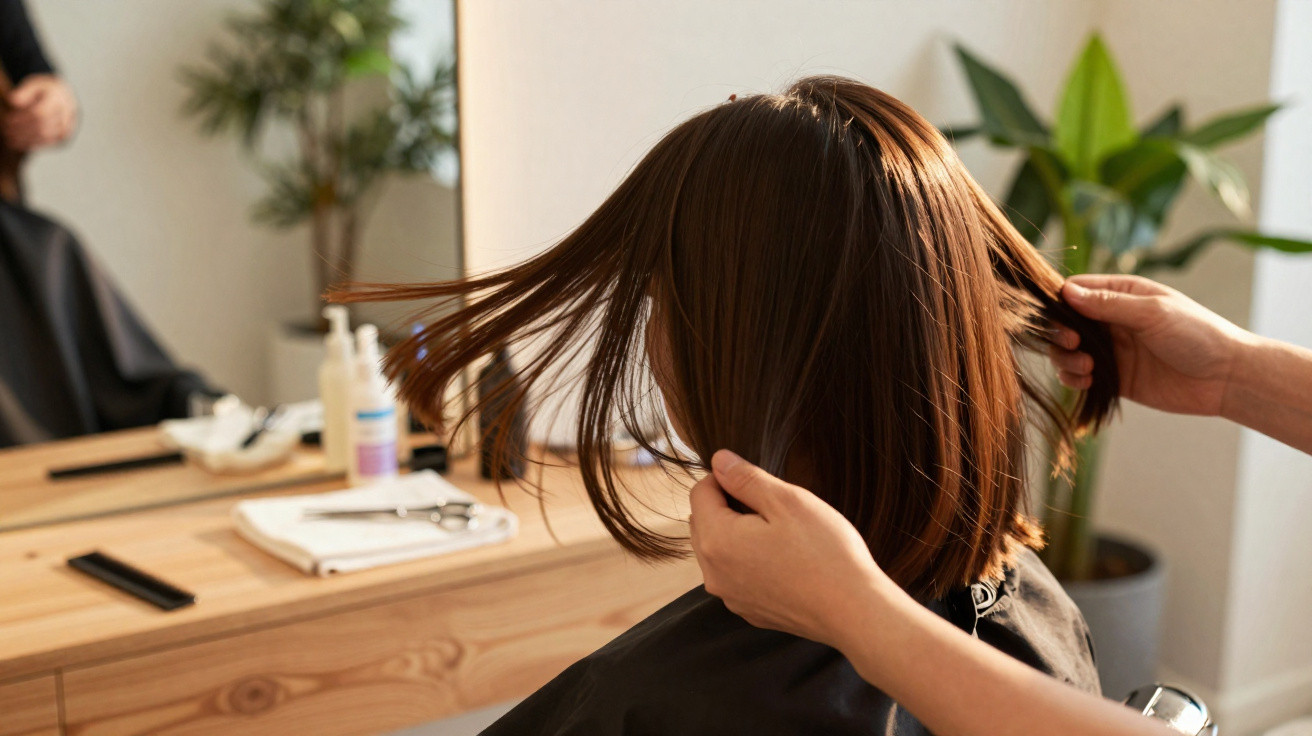
At 8:47 a.m., under the harsh neon glow of a city salon, a young woman fixes her eyes on her reflection and murmurs the line every hairdresser has heard a thousand times: “Cut everything that’s dead.”
Her hair is long, yes - but it droops in weary, ragged strands, the ends pale and snapping like overcooked spaghetti. A summer of sun, sea salt and too-tight hair ties has taken its toll. The colour has dulled, the curls have lost their direction, and her blow-dry has all the life of yesterday’s air.
The hairdresser watches her in the mirror. Then he grins, as if he’s sharing a secret: “This autumn, we’re going for a swinging bob.”
She blinks, thrown.
A bob… when your hair’s damaged?
An hour later she walks out with her neck feeling lighter, her hair moving again, and the odd sense that the season is about to look completely different.
That tiny flick at the ends has changed everything.
Swinging bob: why this cut saves damaged hair in autumn
Step into any salon in September and you’ll spot the pattern straight away.
Sun-kissed faces, holiday freckles - and hair that looks as if it’s been sandblasted. Ends that crackle, mid-lengths that snarl, and roots weighed down with oil as the scalp tries to compensate.
The painful part is how many people hang on to length at any price.
They beg for “just one centimetre” while the stylist is clearly fighting five months of chlorine, straighteners and frantic messy buns. The outcome is predictable: hair that still looks worn even after a wash, and styles that collapse within hours.
That’s precisely where the swinging bob arrives as a quiet sort of hero.
Short enough to take off the most damaged sections.
Long enough to stay feminine, easy to wear and current.
Take Léa, 29, a marketing manager, who came into a Paris salon last September with hair down to the middle of her back - and no scissors near it since before her summer in Greece.
Her lengths were bleached, the texture dry as straw, and broken pieces stood up along her crown. She admitted she’d spent most of the summer in a low ponytail, “because loose, it looked like old tinsel.”
Her hairdresser proposed a swinging bob that sat at the base of the neck, with a slightly longer front.
Léa paused for three long minutes, then agreed with the nerve of someone handing in their notice. When the final damaged strand dropped to the floor, her whole face looked brighter. Her hair had bounce again.
Three weeks later, she messaged the salon a selfie. No filters - just glossy hair that shifted as she moved.
“People think I changed my colour,” she laughed. “I just removed the damage.”
The reasoning is straightforward.
Hair that’s been compromised tends to snap in the same places: through the mid-lengths and at the ends. By cutting back to a bob, the stylist removes the exhausted portion and keeps the thickest, healthiest hair closer to the root.
The “swinging” part comes down to the shape.
A touch of internal layering, or a gentle angle from back to front, helps the hair lift and catch the light instead of sitting as a heavy, blunt block. That movement creates an instant impression of health - even before any treatments begin.
Your eye reads bounce as vitality.
Where long, stringy hair broadcasts every split end, a bob ends the story early. Literally.
Sharper edges, more lift at the base and fewer tangles reduce everyday stress… and mean fewer hot tools clamped in desperation onto already-tired strands.
How to ask for - and live with - a swinging bob when your hair is already damaged
The first trick is the consultation.
Don’t simply say “bob” and cross your fingers. Sit down, breathe, and tell your stylist how damaged your hair feels, how you normally style it, and what you absolutely will not do each morning.
A swinging bob on wavy, coloured hair won’t be cut the same as one on straight, fine hair.
Ask for a length that clears the most compromised area, but doesn’t land exactly at the widest part of your face. For many people, the jawline or just below the collarbone is a sweet spot.
Then use the magic sentence: “I want movement, not a stiff helmet.”
It gives your hairdresser licence to add the subtle internal layers that make the bob genuinely swing - rather than sit there like a rectangle.
The biggest pitfall, especially when your hair is already damaged, is assuming the cut will solve everything on its own.
Yes, a swinging bob removes the worst dryness. But if you go home and hit those fresh ends with a 230°C straightener every day, you’re simply repeating the same plot - just in a shorter book.
Let’s be realistic: almost nobody does the perfect routine day in, day out.
Hardly anyone applies a mask under a hot towel twice a week, rinses with lukewarm water, gently pats dry with a microfibre towel, and always uses heat protection. That’s fine. You only need two or three non-negotiables.
Drop your styling tools by at least one heat setting.
Use a leave-in conditioner on the mid-lengths.
Sleep with your hair loose, or with a soft scrunchie instead of a tight elastic.
Small shifts, big payoff - especially for a bob that still feels springy after week three.
Then there’s the emotional part: daring to go shorter, and trusting the swing.
A Paris-based hairdresser captured it perfectly for me between two appointments.
“Women arrive terrified of losing their length,” he told me, scissors in hand. “But damaged length isn’t power, it’s weight. With a swinging bob, they walk out taller, not shorter.”
For looking after the cut, he suggests a straightforward, doable routine - nothing that feels like a second job:
- Use a gentle, moisturising shampoo, concentrating on the scalp rather than the ends.
- Apply a nourishing conditioner or mask from mid-lengths to tips only, so the roots don’t get heavy.
- Detangle with a wide-tooth comb on damp hair, starting at the ends and working upwards.
- Dry to about 70% with a towel or in the air, then finish with a round brush or your fingers for a natural swing.
- Book a micro-trim every 8–10 weeks to maintain the shape and stop damage before it’s visible.
With that, the swinging bob stops feeling like a scary “big chop” and starts to look like a low-pressure reset.
More than a cut: what a swinging bob changes in your daily life
What stands out with this cut is that the difference isn’t confined to the mirror.
People who choose a swinging bob after a damaging season often say their routine feels lighter too: quicker mornings, fewer products, and less time battling ends that won’t curl properly - or stay straight.
The bob works like a filter.
You keep the habits that help, ditch the rest, and your hair gradually stops shouting for help. The reduced length also reveals your true texture, without the weight dragging everything down. Curls return, volume lifts, shine comes back.
Some describe feeling “more adult”, others “more French”, and some simply “more myself”.
What’s clear is that this autumn - with energy bills, packed diaries and the quiet tiredness of recent months - there’s something deeply calming about a cut that does some of the work for you.
A swinging bob doesn’t promise a brand-new life.
But for damaged hair, it opens a very real chapter of second chances.
| Key point | Detail | Value for the reader |
|---|---|---|
| Swinging bob removes damage | Cut targets dry, broken mid-lengths and ends while preserving healthy roots | Cleaner edges, less breakage, instantly healthier-looking hair |
| Movement built into the shape | Subtle layers or slight angle front-to-back create natural swing | Hair looks fuller and shinier with minimal styling effort |
| Simple routine to maintain | Gentle wash, basic protection, and trims every 8–10 weeks | Low-stress, realistic care that keeps the cut beautiful all season |
FAQ:
- Is a swinging bob good for very fine, damaged hair? Yes - provided your stylist doesn’t over-layer. A lightly graduated bob, slightly shorter at the back, can add volume to fine hair while removing frayed ends.
- Can I keep my curls with a swinging bob? Absolutely. Ask for a bob designed for curly or wavy textures, with longer front pieces and soft shaping rather than aggressive thinning. Then use a diffuser or air-dry with curl cream.
- How often should I trim a swinging bob? Every 8–10 weeks is ideal to keep the line sharp and prevent new damage travelling upwards. If your hair is very fragile or bleached, aim nearer 8 weeks.
- Do I need to blow-dry my bob every day? No. Let it partly air-dry, then smooth just the front sections or the crown for a polished finish. The cut is meant to move even with minimal styling.
- What should I tell my hairdresser so I don’t end up with a stiff, old-fashioned bob? Bring one or two photos of bobs with visible movement and say you want “soft, swinging ends, not a rigid line”. Tell them how long you realistically spend styling so the cut fits your day-to-day life.




Comments
No comments yet. Be the first to comment!
Leave a Comment