

The first white hair tends to appear without warning, like an uninvited guest who slips in unnoticed. Then, one day-somewhere between 48 and 55-you spot yourself in a shop window and think: “Wait… when did I start looking this tired?”
Not necessarily older. Just… a little more weighed down through the face, as though everything has dropped by one small notch.
Sit in a hairdresser’s chair for long enough and the chat nearly always lands on the same dilemma: “Do I go shorter? Will it make me look younger?” Your stylist pauses with the scissors mid-air, because that single choice can either define your features-or add five years in a flash.
In the best salons, one rule comes up again and again.
And it all comes down to length.
The surprising “sweet spot” length that lifts a mature face
Ask a skilled colourist-stylist what tends to flatter white or salt-and-pepper hair after 50, and you’ll hear a very similar answer: aim for the space between the jawline and the collarbones.
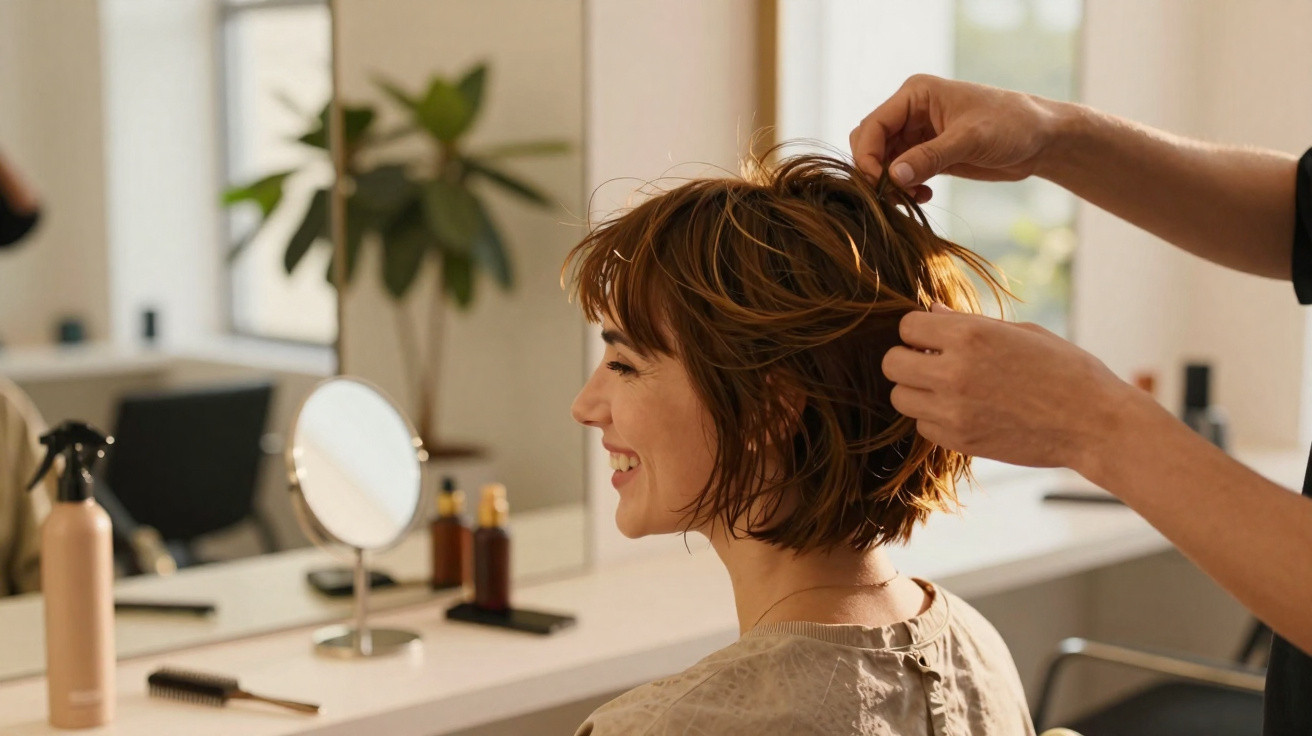
Not a boyish crop, and not hair that trails down your back. Instead, a soft mid-length cut with natural swing when you move.
After 50, the game becomes light and movement. Hair that’s overly long and weighty can pull the face down visually. Go too short and every dip, line, and loss of fullness is put on display. That’s why this mid-length “sweet spot” can look quietly transformative in everyday life.
Consider Fran, 56, who arrived at a Paris salon with silver hair that reached her waist. Friends praised her for looking “so elegant”, yet strangers addressed her as “madam” in the careful voice people use for someone’s grandmother. Her hair sat like a curtain around her face, adding weight to cheeks that already looked tired.
Her stylist recommended a cut just under the collarbones, shaped with long layers and finished with a light curtain fringe. They didn’t change the white-only made it brighter. The outcome? A cleaner-looking jaw, a longer-looking neck, and white hair that felt chosen rather than overlooked.
A month later she returned, laughing: “Everyone keeps asking what I’ve done to my skin. I only cut my hair.”
The reasoning is straightforward. Mid-length hair draws gentle vertical lines along the neck and jaw, pulling the overall silhouette upwards. Your eye follows that lift rather than settling on jowls or a softer chin. With white hair, the effect can be even stronger, because each strand catches light like a tiny reflector.
Super-short cuts can be strikingly chic, but they usually demand stronger bone structure and frequent styling. Very long hair can feel romantic, yet with white hair it often becomes finer and more frayed at the ends-giving off a subtle impression of tiredness. The in-between length, hovering around the shoulders, keeps softness without letting the hair overwhelm the face.
The expert formula: length, layers and fringe that cheat the years
If you want something clear to take to your hairdresser, keep it simple: length, layers, lift.
- Length: anywhere from just below the jaw to just above the bust, depending on your neck and height.
- Layers: delicate and minimal, with softness around the face-never chunky or choppy.
- Lift: volume at the roots and crown, not bulk on the sides.
Request a slightly longer back, then soften the front with pieces that skim the cheekbones or jaw. This helps open up the centre of the face and softens the look of nasolabial folds without “hiding” you. When white hair is cut into airy sections, it bounces light back around the eyes like an in-built ring light.
There’s a trap many women over 50 stumble into at least once: the “safe” haircut. Either the ultra-practical short pixie “because it’s easier”, or the long ponytail “because I don’t know what else to do”. Both can make features look harsher when the proportions are off.
Most people know that sinking feeling: you ask for “just a trim” and walk out with a style that makes you resemble your old school headmistress. Usually, the issue isn’t the white hair. It’s volume sitting at ear level, blunt ends that create a solid block, or a parting that splits the face in two. And realistically, hardly anyone blow-dries and styles every day like they do in the salon-so the cut needs to behave on low-effort mornings too.
That’s where a good fringe-or simply face-framing pieces-can make an outsized difference. A soft curtain fringe that begins a little lower, somewhere between brows and cheekbones, can reduce the look of a heavy forehead, camouflage a thinning hairline, and bring attention back to the eyes.
If you want a gentler commitment, a side-swept fringe can do the job.
“On white or silver hair after 50, the best anti-aging tool isn’t a miracle serum, it’s the right line of cut,” explains London-based hairstylist Emma Clarke, who specializes in grey transitions. “I look at where the face is falling and I place the length like scaffolding. Just an extra centimeter below or above the jaw can add or remove years.”
- Opt for a length between the jawline and the collarbones to create a visual lift.
- Choose subtle layers and face-framing pieces rather than thick, choppy steps.
- Go for a light fringe or a soft side part to break up a rigid hairline.
- Keep volume at the roots (not the sides) to avoid a “helmet” look.
- Ask your stylist to cut on dry hair once, so they can see how your white texture truly falls.
Learning to see your white hair as an ally, not an enemy
A quiet shift is taking place in bathrooms and salons: women who used to conceal regrowth every three weeks are now letting white and silver take centre stage. As the colour becomes natural, the cut turns into the main beauty tool. Often, it’s the length-more than the shade-that changes the reaction from “You’ve gone grey” to “You look so fresh.”
The most flattering haircut for white hair past 50 isn’t about chasing youth at all costs; it’s about matching your outer shape to the person you are now. That could be a crisp shoulder-length bob, a deliberately undone long bob that lands at the collarbone, or a slightly longer, fluid cut that still holds its structure. The goal is simple: a reflection that looks alert rather than drained.
| Key point | Detail | Value for the reader |
|---|---|---|
| Ideal length zone | Between jawline and collarbones, with a slight preference for collarbone length on softer faces | Creates a visible “lift” without feeling dramatic or inadvertently ageing |
| Shape and movement | Subtle layers, face-framing pieces, light fringe or side part, volume at the roots | Softens lines, brightens the eyes, and avoids the helmet or “stringy ends” effect |
| White hair as highlight | Neat ends, airy texture, and a cut matched to bone structure rather than old habits | Makes grey/white hair feel like an intentional style choice that updates the whole face |
FAQ:
- Question 1 What is the most flattering haircut length for white hair after 50?
- Answer 1 Most experts favour a length between the jawline and the collarbones, finished with soft layers and movement. This range typically lengthens the look of the neck, refines the jawline, and stops the hair visually pulling the face down.
- Question 2 Does short hair always make you look younger with white hair?
- Answer 2 No. Very short styles can look current and elegant, but they emphasise bone structure and every small hollow. They suit those with strong features who are happy to style regularly. A mid-length cut is often more forgiving.
- Question 3 Can I keep long white hair after 50 without looking older?
- Answer 3 Yes-provided the hair stays in good condition, the ends look tidy, and the shape keeps some volume through the top rather than only at the tips. Adding long layers and removing just a few centimetres can make long white hair feel lighter and fresher.
- Question 4 Is a fringe a good idea with white or grey hair?
- Answer 4 Yes. A soft curtain fringe or side-swept fringe can reduce the look of a high forehead, soften frown lines, and draw the eye towards your eyes. Ask for a light, airy fringe that blends into the cut instead of a thick, straight bar across the forehead.
- Question 5 How often should I trim my white hair to keep a youthful shape?
- Answer 5 Every 6 to 10 weeks tends to work well for mid-length cuts. It keeps the ends clean, stops the shape collapsing, and maintains that fine balance where the length lifts rather than weighs down your features.





Comments
No comments yet. Be the first to comment!
Leave a Comment