
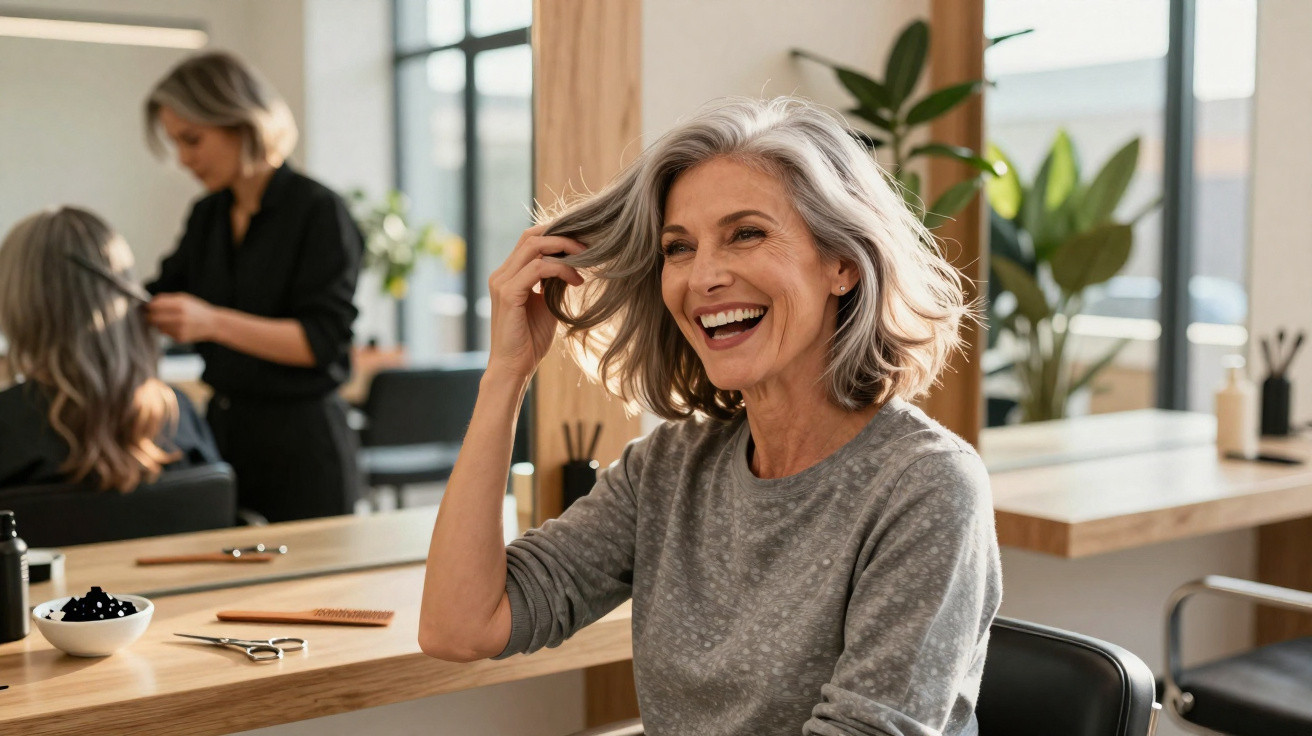
The woman ahead of me in the café queue had the sort of hair most people book appointments for: a polished shimmer of silver at the temples, soft smoky grey through the mid-lengths, and a bright white streak at the front that looked as if it had been traced on with a highlighter.
I clocked three people doing a double take before someone finally leaned over and asked, “Who does your color?” She chuckled and said, “No one. I stopped.”
All around us, phones were already up: glowing screens flicking through before-and-after galleries, saved posts from grey-haired influencers, TikToks of women clearing dye boxes out of bathroom cupboards. Something has clearly moved.
The new “anti-colour” is quietly beginning to look like the most modern colour going.
Grey hair isn’t giving up, it’s showing off
Open any feed and it’s there: silver bobs with razor-sharp cuts, gentle salt-and-pepper curls, steel-grey buzzcuts set against dewy skin and a bold red lip. The tired storyline that grey means you’re “letting yourself go” is splitting apart in plain sight.
In its place is something far lighter. Instead of merely tolerating grey, people are designing around it - cutting it, sculpting it, and wearing it like a statement in the way balayage once signalled “done”. It reads less like resignation and more like a calm flex.
There’s an attitude of: “If this is what my hair is doing, I’m going to allow it - and I’m going to make it look deliberate.”
On TikTok, the hashtag #greyhair has collected hundreds of millions of views, with women, men, and non-binary people documenting their grow-out journeys week by week. A 52-year-old Londoner shared a straightforward time-lapse of her roots expanding from a one-centimetre band to a full head of silver over 18 months. It passed a million views in a single weekend.
The beauty industry has clocked it, too. There are now serums designed to brighten greys that turn yellow, shampoos promising “silver radiance”, and stylists selling “transition packages” that blend old colour into new growth rather than concealing it. Even stars who once relied on discreet root touch-ups are turning up to red carpets with visible streaks.
The takeaway - repeated everywhere, quietly - is clear: grey is no longer the ‘before’ picture.
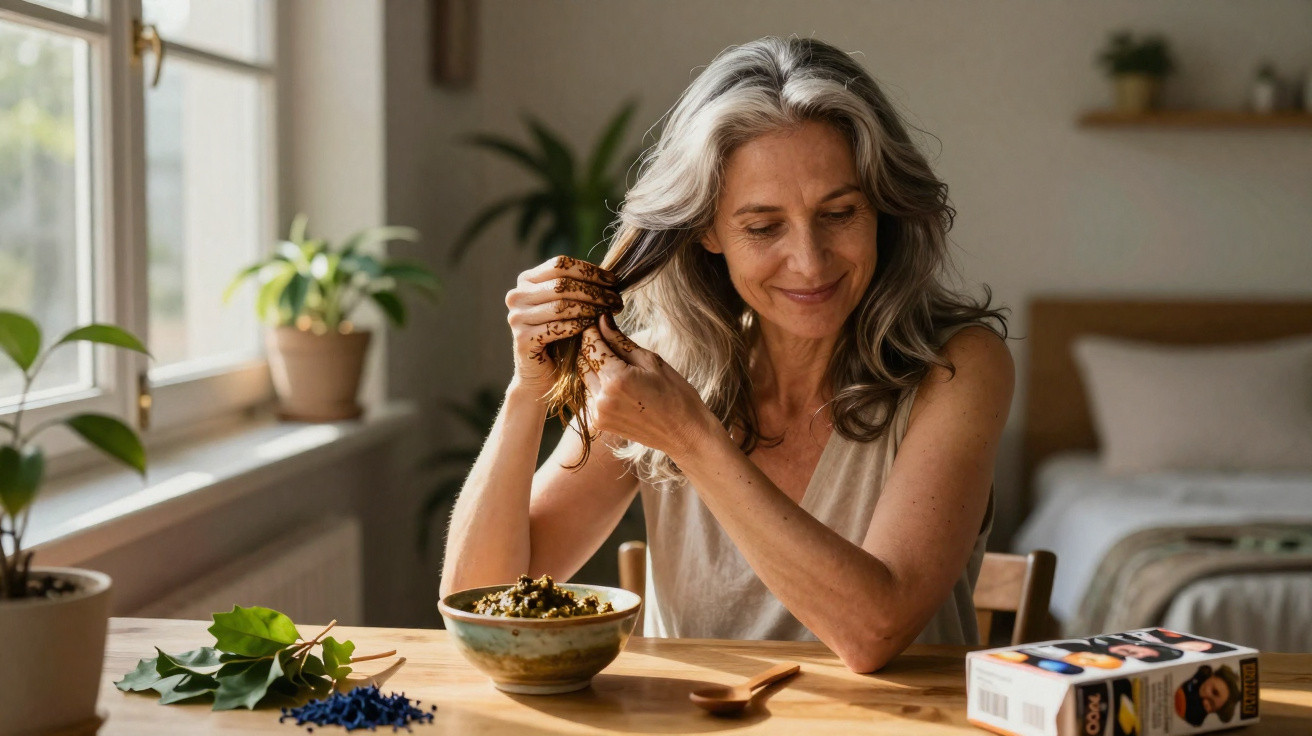
And the shift isn’t only about looks. Keeping up with dye can cost a lot, swallow time, and become, for many scalps, a small recurring assault. Dermatologists are quietly noting more sensitivity and allergy cases linked to hair colour, particularly at-home kits. At the same time, the cultural fixation on “looking young at all costs” is beginning to feel… exhausted.
Choosing to go grey lands right in the middle of that change. It keeps the idea of appearing well looked-after, but it drops the strain of trying to look 10 years younger. With a sharp cut, cared-for skin, and an intentional wardrobe, natural grey often reads less as “old” and more as “curated”.
That’s the unexpected turn: when natural coverage is treated like an aesthetic decision, it can look younger than dye that’s trying too hard to hide.
How to go grey without feeling like you’ve “let yourself go”
People whose grey hair looks genuinely striking tend to share one habit: they approach the transition as a plan, not something that simply happens to them. Usually, it starts with a proper chat with a skilled hairdresser - not to add more colour, but to map out a cut.
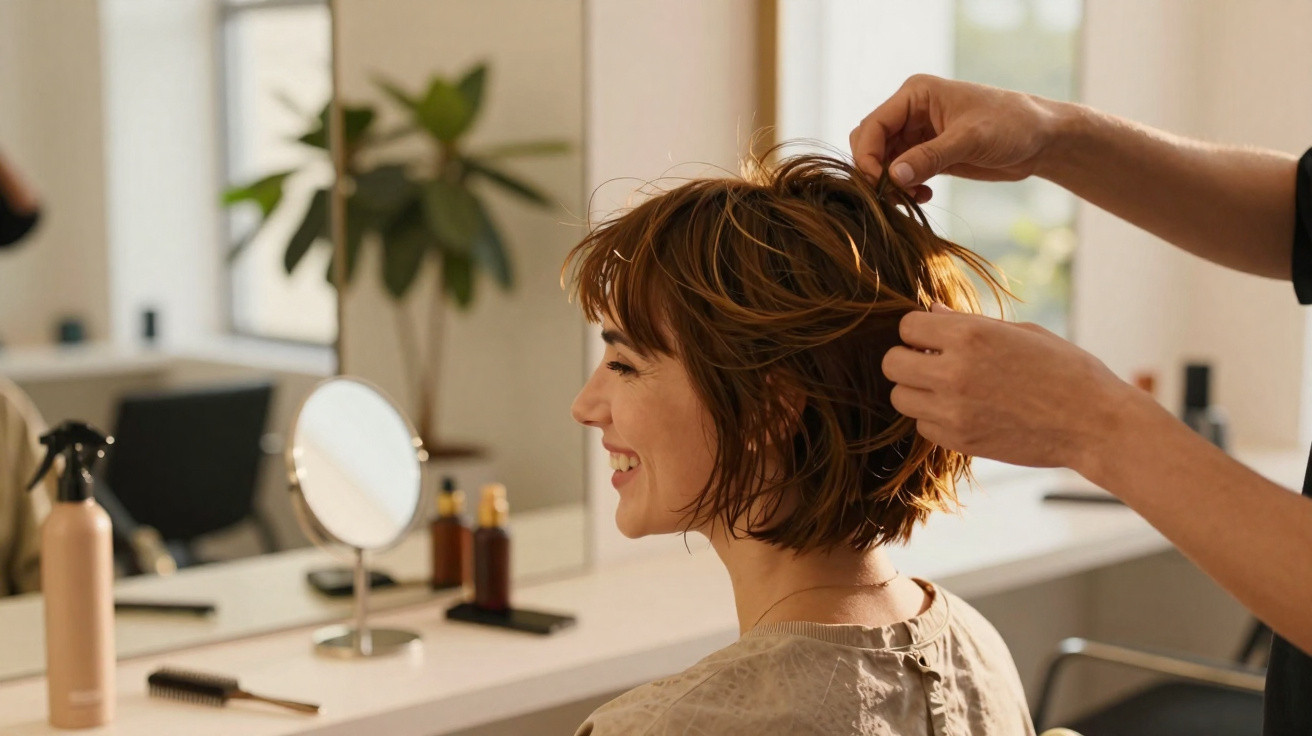
Going shorter and more structured makes the grey register as a design choice rather than a root crisis. Picture crisp bobs, layered lobs, pixies, or tight curls shaped to flatter the face. In the in-between months, a stylist may also weave in a few ultra-fine highlights or lowlights to blur the boundary between old dye and new growth.
Grey hair also rewards gloss. A simple set-up - a gentle shampoo, a hydrating mask once a week, and a lightweight finishing oil - can make silver strands look almost chrome on a bright day.
The most difficult part isn’t the products; it’s your reflection. The first six months can feel merciless: a stark band at the roots, the previous shade hanging on at the ends, and no tidy label for whatever stage you’re in. Feeling “unfinished” can weigh more heavily than any promise printed on a box.
This is where small styling shifts can carry you. A slightly stronger brow, a touch more colour on the lips, glasses with more presence - these details counterbalance the softness of grey and communicate that, yes, this is intentional. You haven’t “missed” your colour appointment; you’ve cancelled it with purpose.
To be fair, no one does all of this every day. But a handful of easy defaults makes the whole thing feel like a choice rather than a slump.
“The turning point,” confided Claire, 49, “was when a colleague told me my hair made me look ‘tired’. I went to the bathroom, stared at myself, and realized it wasn’t the grey that aged me. It was the old dye clinging to the ends, the cut that hadn’t changed in ten years, and the way I kept apologizing for my roots. Once I cut it into a blunt bob and owned the silver, people started saying I looked refreshed, not older.”
- Pick a “transition cut” date and treat it like an occasion
- Swap in a purple or silver shampoo once a week to brighten grey
- Refresh one detail: brows, glasses, or your lipstick shade
- Use heat protection; grey hair can be more fragile
- Take a photo every month - progress beats staring at roots
Grey as a new kind of youthfulness
What’s most noticeable about this viral grey trend is that it doesn’t dismiss youth; it reframes it. Here, youthfulness isn’t about scrubbing away years - it’s about keeping curiosity, playfulness, and presence visible. Once harsh dye lines vanish, your features step forward again. Eyes often look brighter beside soft silver. Skin can read warmer. Suddenly, the whole person - not only the hair - comes back into view.
Most of us know that supermarket moment: comparing “ash brown 6.1” with “natural brown 5.0”, wondering, privately, who we’re really doing it for. The new grey wave asks a quieter question: what if your real colour was already the boldest option on the shelf?
This isn’t a manifesto telling everyone to quit dye tomorrow. It simply creates an opening. Perhaps you try your natural shade for a season. Perhaps you ease into it. Perhaps you keep your favourite brunette but stop panicking over every millimetre of regrowth. The point is that there’s now room - socially - to decide.
Some people will step through and never return. Others will take a look, experiment, and go back to colour with clearer reasons. The viral images, the silver influencers, the proud salt-and-pepper side parts on your commute - they all deliver the same understated message. Age will show up regardless. Choosing how it shows up might be the most current beauty move we have.
| Key point | Detail | Value for the reader |
|---|---|---|
| Grey can look youthful | Sharp cuts, shine, and intentional styling turn natural grey into a statement | Helps readers see grey as a style option, not a defeat |
| Transition is a process | 6–18 months of mixed colours, managed with cuts, toning shampoos, and small makeup tweaks | Prepares readers mentally and practically for the awkward phase |
| You’re allowed to choose | The trend removes stigma from natural hair while keeping colour as a valid preference | Gives readers permission to experiment without guilt or pressure |
FAQ:
- Question 1 How long does it usually take to fully grow out grey hair? On average, between 12 and 24 months, depending on how fast your hair grows and how long your current cut is. Shortening your hair during the process speeds everything up.
- Question 2 Will going grey automatically make me look older? Not necessarily. A modern cut, healthy texture, and well-chosen makeup or glasses often make natural grey look fresher than flat, over-dyed color.
- Question 3 What if my grey comes in patchy or yellowish? That’s common. A purple/silver shampoo once a week and a professional toner every few months can even out tone and reduce yellow. A good cut also helps blend patches.
- Question 4 Can I still color my hair after going fully grey? Yes. Grey hair can be colored, though it may resist pigment more. A colorist can use specific formulas or glosses so you can play with tones without heavy commitment.
- Question 5 Am I “giving up” on myself if I stop dyeing? No. Stopping dye is a style decision, not a moral one. You’re not less groomed if your hair is natural; you’re simply choosing a different kind of care.

Comments
No comments yet. Be the first to comment!
Leave a Comment