
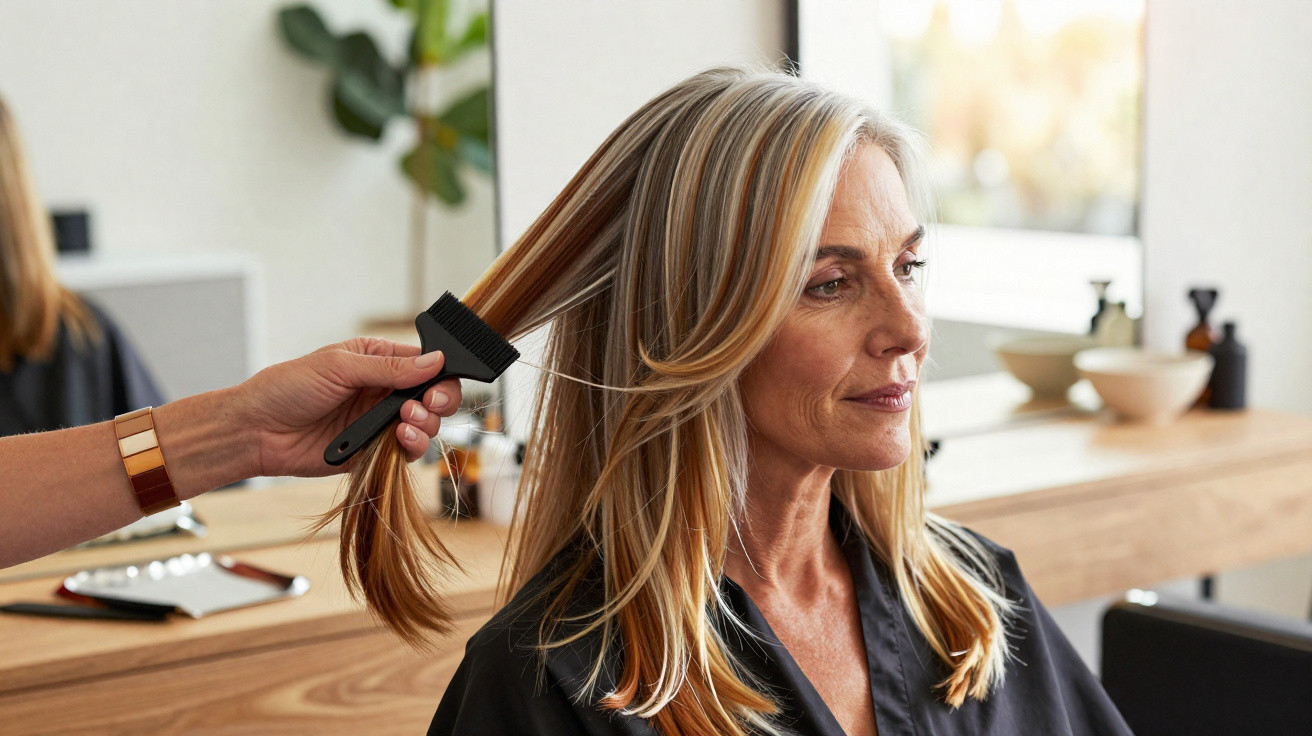
Saturday morning in the salon: the coffee has gone tepid, the magazines are a few issues behind, and - in the glow of the big mirror - the same worry circles back again and again.
“My roots again,” a woman in a navy blazer sighs, tilting her head to catch the light. She’s in her early 50s, with a dusting of silver along the hairline. “I don’t want to look like I’m trying to be 30,” she adds, “but I don’t want this harsh line either.” Around her, people nod - that small jolt is familiar, the moment the grey suddenly feels louder than the haircut.
Her colourist leans closer, as if sharing a secret: “Have you thought about stained glass hair? It’s what we’re doing for all my over-50 clients right now.”
The chatter drops. A new phrase. A new promise: a way to keep grey hair without feeling like you’re wearing it.
Why grey hair feels so brutal after 50
Professionals will often tell you the same thing: the grey hair itself usually isn’t what throws you. The issue is the contrast.
By 50, faces tend to soften and skin tone can subtly change - yet the hairline may turn white in crisp little streaks that pick up every bit of harsh bathroom lighting. That’s why it can feel like you’ve “aged overnight”, when what’s really happened is your hair has stopped blending.
Your eyes lock onto the helmet effect: years of tint create a dark, uniform colour through the lengths, and then a bright band of grey appears at the roots. It doesn’t read as natural ageing; it reads as a hard border between “before” and “after”.
Ask any colourist used to working with women over 50 and you’ll hear a familiar pattern. There’s the client who comes in every four weeks, worn down by constant root touch-ups, bringing screenshots of celebrities with soft silver highlights. She’s not asking for a radical transformation - she just wants to stop feeling tethered to the appointment diary.
One Paris-based colourist describes Anne, 56, who paused her usual dye during the pandemic. When she finally came back to the salon, she was half-grey and half-dark chestnut. “I looked like a skunk,” she joked. But when the colourist began weaving transparent shades through her hair - not covering, simply veiling - Anne cried at the end. “That’s me,” she whispered. “Just quieter.”
Grey hair can also behave differently: it’s often drier, coarser and more resistant. Traditional permanent dyes may cling unevenly to that texture, leaving patches that look flat - or even slightly greenish under fluorescent lights. So the harder you push for full coverage, the more artificial the result can appear.
Stained glass hair flips that logic on its head. Instead of battling every white strand, colourists work with the grey as a base - like a canvas that lets light pass through. The aim shifts from “no grey visible” to “soft, luminous hair that doesn’t shout dye job”.
What “stained glass hair” really does to your grey
Stained glass hair isn’t one specific shade; it’s a method. Professionals liken it to placing a tinted lens over natural light.
Rather than laying down opaque blocks of colour, they use ultra-sheer demi-permanent colour or gloss formulas, applied in translucent veils. You still see the hair’s natural texture. The grey is still present - simply filtered, softened and brought into harmony.
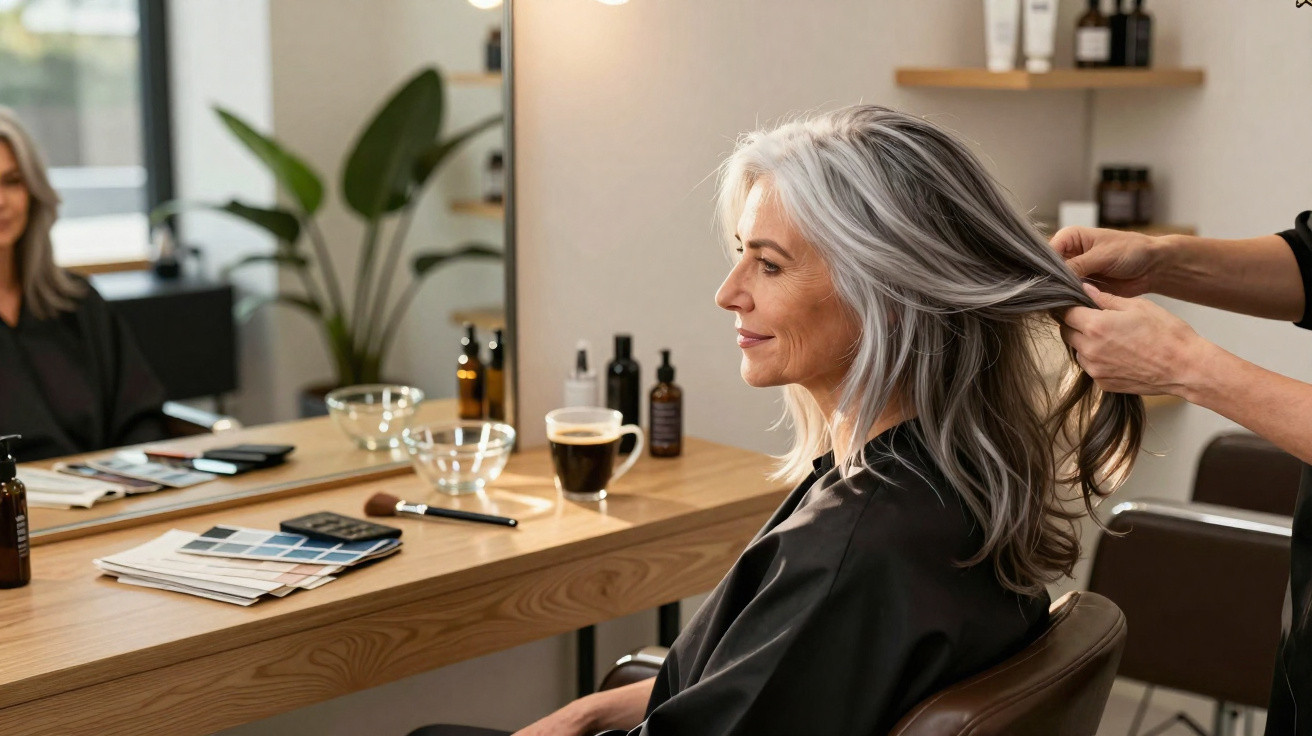
On a brown base with around 40–70% grey, that might look like smoky mocha glazes, iced beige, or soft mushroom tones threaded through. On lighter hair, it can be champagne tones and pearl flashes that catch the sun. The principle stays the same: reduce contrast, maintain dimension, and make it look as though the hair grew that way.
Most stained glass hair appointments begin with conversation rather than a colour chart. Your colourist will ask where the grey bothers you most - at the temples, along the parting, around the face, or scattered through the lengths. Then they choose where to place the sheen, much like a make-up artist deciding where to add highlighter.
Imagine your temples are almost completely white, your crown is mixed, and your nape remains mostly dark. With old-school coverage, the whole head often becomes a single, flat brown. With stained glass hair, the colourist might lay a transparent smoky glaze over the darkest areas, add a cooler pearl tone to the whitest strands, and leave the in-between largely untouched. The finish reads as natural, expensive hair - not “freshly dyed”.
There’s a mental shift built into this approach too. Instead of chasing roots every three weeks, you’re managing light every two to three months. Because there’s no stark line, the grow-out is gentler: the tonal veils fade gradually rather than creating a sharp demarcation. That creates breathing space - fewer panic bookings, and fewer mornings staring into the mirror, measuring regrowth in millimetres.
Realistically, nobody keeps up salon-perfect hair every single day. You want hair that still looks good on the weeks you aren’t thinking about it - not only the afternoon you walk out of the salon. That’s where stained glass hair quietly wins over traditional coverage. It fits the rhythm of everyday life, and after 50 that feels less like a trend and more like relief.
How to ask for stained glass hair (and not regret it)
Start with the wording. Many salons won’t literally list “stained glass hair” on their price list, but they’ll recognise the idea: translucent blending instead of full coverage.
When you sit down, say it plainly: “I like my grey, I just don’t like the harsh line. I want it softened, not erased.” That tells a professional you’re open to glosses, toners and lower-commitment shades rather than permanent, all-over dye.
Bring images that show transparency and texture, not just a single colour. Look for hair where you can still pick out individual strands, subtle shifts in tone, and small flashes of silver. Share your ideal maintenance schedule too - every six weeks, every ten - so the plan is something you can actually keep up.
The mistake people make most often is asking for stained glass hair while still trying to recreate the solid shade they wore in their 30s. That’s when formulas become too dark and too opaque, and the entire effect disappears. Another pitfall is attempting a DIY version with box dye: those products are rarely sheer enough, and they tend to grab unevenly on grey - especially on more fragile, post-menopausal hair.
There’s an emotional angle as well. Some feel guilty for not “fully embracing” their grey, or embarrassed to still want a bit of camouflage. You don’t owe anyone a statement. You’re allowed to prefer a softer hairline - and you’re equally allowed to love every silver strand.
“Stained glass is like mood lighting for hair,” explains London colorist Marta Ruiz. “You’re not repainting the walls, you’re changing the atmosphere. The grey is still yours. We just make it kinder to you.”
- Ask for sheer or demi-permanent formulas, not heavy permanent dyes.
- Start lighter and more translucent; you can always deepen next time.
- Prioritise the front and parting where the eye lands first.
- Schedule a gloss refresh every 8–10 weeks, not constant root retouches.
- Use sulphate-free, colour-safe shampoo to keep the shine and transparency.
Grey, but gentler: choosing hair that matches your life now
Stained glass hair speaks to more than a passing colour trend. It sidesteps the old, either-or choice between “pretend nothing’s changing” and “let it all go and live with the shock”. For many people over 50, the goal is a middle way: hair that acknowledges age without hardening the face - and without demanding relentless upkeep.
Once you start thinking in terms of transparency rather than coverage, your routine often changes with it. You may stretch the time between appointments, spend less time styling, and put more energy into shine and movement than into hiding every strand. Some people find that, as the stained glass tones fade, they actually prefer the softer, paler grey beneath. Others stay in that in-between space long-term, because it simply feels like them.
| Key point | Detail | Value for the reader |
|---|---|---|
| Translucent color | Uses sheer, gloss-like formulas over grey instead of opaque dye | Softer, more natural result that doesn’t scream “fresh color” |
| Reduced contrast | Blends grey, base color, and highlights to avoid harsh root lines | Less visible regrowth, fewer urgent salon visits |
| Customized placement | Focuses on face frame and parting, based on where grey bothers you | Personalized look that flatters your features and lifestyle |
FAQ:
- Does stained glass hair fully cover grey? Not in the traditional, full-coverage way. It tones and softens grey so it blends into your base colour, while leaving some natural silver visible for a realistic, dimensional finish.
- How long does stained glass color last? Typically 6–10 weeks, depending on the products used and how often you wash your hair. It fades down slowly rather than leaving a hard line.
- Will it damage my already fragile hair? Demi-permanent glazes are generally gentler than permanent dyes and often include conditioning ingredients, making them a good match for mature, drier hair.
- Can I transition from full coverage color to stained glass? Yes. Many people use stained glass hair as a stepping-stone. Your colourist may slightly lighten the overall shade first, then add translucent veils to blend the new grey as it grows in.
- Is this technique only for women? No. Men with salt-and-pepper hair can also use soft, transparent toning to reduce yellowing, sharpen the grey, and keep the finish polished but natural.


Comments
No comments yet. Be the first to comment!
Leave a Comment