
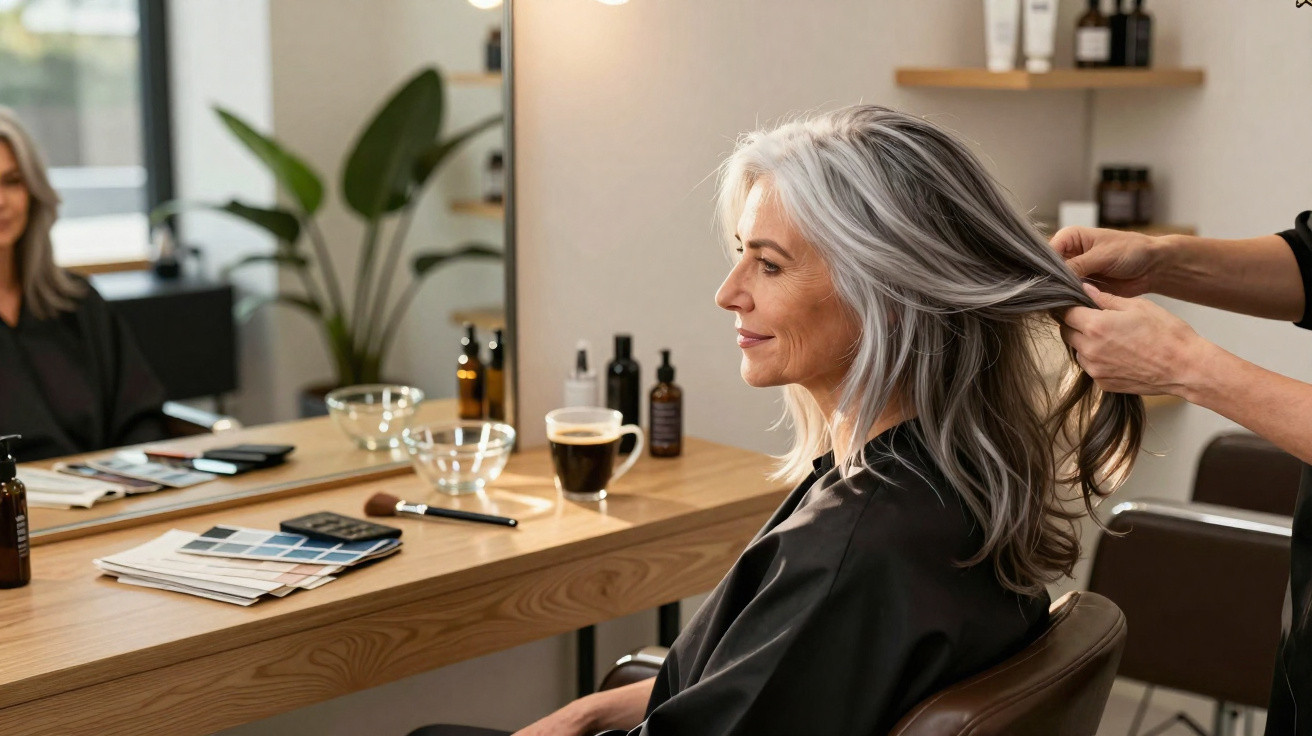
The first white hair tends to appear at the most ordinary moment - paused at traffic lights, catching your own reflection in a car window. You angle your head, tease the strand forward, and there it is: a fine silver filament that definitely wasn’t there a few weeks ago. For a while, it becomes a private game of hide-and-seek: root spray, box dye in the bathroom, salon slots crammed between meetings, and photos taken only from “the good side”. Then you spot someone on the Tube with a glossy, intentional salt-and-pepper mane, and something clicks. Perhaps the issue isn’t the grey itself - perhaps it’s the awkward growing-out phase. That’s where a smart colour technique known as “High-Low” balayage earns its reputation: a colourist’s in-between solution, sitting neatly between relentless root top-ups and switching to full silver overnight. A small, quiet revolution in the mirror.
Why salt-and-pepper hair suddenly looks…cool
Step into a salon right now and you’ll see a group that still feels quietly bold: women in their 30s, 40s, 50s and beyond wearing their natural salt-and-pepper hair with real confidence. No scarf wrapped around the hairline, no urgent pleas to “cover my gray!”. Instead, the requests are for gloss, depth, movement and softness. Many colourists will tell you - almost under their breath - that grey isn’t being treated as an emergency any more. It’s being treated as a base to work with. What once got rushed into hiding is now being sculpted, brightened and framed. The change isn’t only about trends; it’s a different way of reading those persistent roots when you catch them in the mirror.
In Paris, a hairdresser named Claire*, who has focused on grey transitions for ten years, watches this shift play out week after week. A 47-year-old client arrived with 2 centimetres of silver regrowth and dark brown lengths that read as heavy and flat - the classic “helmet” look. She was exhausted by monthly appointments and fed up of worrying about humidity ruining holiday photos. Together, they opted for High-Low balayage: cooler, brighter ribbons to mirror the natural white, paired with deeper, shadowy pieces to blur the harsh boundary line. Three months later, she returned not for panic coverage but for a simple gloss. “My colleagues keep asking me if I changed my haircut,” she laughed. “They don’t get that I just stopped fighting my hair.”
Salt-and-pepper hair works because of contrast: darker strands sitting beside white ones create immediate depth, like built-in highlights. Yet that same contrast can look severe when the grey is only at the roots and everything else remains a single dyed shade. That’s why traditional all-over colour can feel like a treadmill - the more you cover, the sharper the regrowth line becomes. High-Low balayage does the opposite: it uses contrast rather than trying to delete it. By weaving deliberate light and shade into your natural pattern, it turns the grow-out into something that looks designed. The goal isn’t to look younger at all costs, but to look like yourself, upgraded.
What “High-Low” balayage really does to your gray
High-Low balayage is, in practice, exactly what the name suggests: freehand-painted lighter tones alongside slightly deeper tones, placed to work with your existing salt-and-pepper. The “high” sections lift and echo the white and silver strands so they appear purposeful - almost glowing. The “low” sections bring back gentle depth where your base feels washed out, or where the grey gathers in a block and needs softening. Instead of one dense sheet of colour, you end up with a gradient - like sunlight moving through hair.
To do it well, the colourist looks closely at how your regrowth behaves: where the grey is concentrated, where it’s sparse, and how it naturally frames the face. The placement isn’t random; the brush follows your particular map.
Claire often comes back to one client in particular: a 55-year-old lawyer who walked in with a familiar conflict. “If I stop dyeing, I’ll look old. If I continue, I look artificial.” Her hair was 70% grey at the temples and 30% across the rest of her head, and she’d been colouring it dark brown for twenty years. They began cautiously with a very soft High-Low balayage: ultra-fine light pieces around the face, plus a handful of cool beige strands through the mid-lengths. Then they added thin lowlights, a touch ashier than her base, to settle the hard line of regrowth. After the first appointment, friends were convinced she’d “gone blonder”. Six months later, she was largely natural, with only a few painted sections maintaining the blend. The grey didn’t vanish - it finally had company.
Technically, the biggest benefit is time. As your roots come through, they don’t crash against a single uniform shade because the surrounding hair is already multi-tonal. The eye registers variation rather than a stark border. That can push appointments from every four weeks to every three or four months, and it also reduces the stress and damage associated with frequent full-head colouring.
There’s a quieter advantage too: High-Low balayage lets you experiment with seeing more grey without the shock of stopping dye overnight. Gradually, you can allow your natural salt-and-pepper to take centre stage, while the balayage supports the transition in the background.
How to ask your hairdresser for the perfect salt-and-pepper “High-Low”
The most important part happens before any colour is mixed: the consultation. Turn up with clean, dry hair so your true texture is visible. Skip slick buns and avoid heavy oils. When you sit down, explain what you’re trying to get away from - the monthly root panic, lengths that have gone too dark, the “shoe polish” look along your parting.
Then keep the language straightforward: “I want to blend my gray, not hide it. I heard about High-Low balayage. Can we create light and shade to work with my salt-and-pepper?” Bring reference photos that show real, visible grey - not just standard blonde balayage. The right colourist will immediately start assessing your temples and crown and talking you through where to brighten, where to deepen, and where to leave your natural colour alone.
A lot of people arrive almost apologising - “I’m going gray, fix it,” - and walk out with hair even darker than before. That’s the trap. If your stylist pushes full, opaque coverage “to look younger,” trust your instincts. You’re not something to be erased.
Another common misstep is trying to go dramatically blonde in one appointment as a way to disguise the grey. Often, that ends with hair that feels dry and overprocessed, like straw. Salt-and-pepper hair responds better to a gentler approach: space, softness and restraint.
The emotional side matters as much as the technical one. Many of us know that moment when the mirror feels as if it’s judging rather than simply reflecting. A good colourist will address that honestly and guide you through it - not steamroller your uncertainty with one harsh dye job.
“High-Low balayage is like good makeup,” says Claire. “You don’t notice the technique, you just notice that the person looks rested, bright, and strangely at ease with themselves.” She adds: “Believe me, the sexiest thing is not zero gray. It’s hair that tells the truth softly.”
- Create a “mood board” with 3–5 photos of salt-and-pepper hair you love, not celebrity blondes.
- Ask the stylist exactly where they plan to place the light and dark pieces before they start.
- Start with a conservative first session; you can always add more light next time.
- Plan for a toner or gloss every 6–8 weeks to keep the grey bright, not yellow.
- Remember this plain-truth sentence: nobody really sticks to a 4-week root schedule forever.
Living with salt-and-pepper: beyond the salon chair
After a well-done High-Low balayage, day-to-day life shifts in small ways. Under stark bathroom lighting, the hairline looks softer. In daylight, the silver catches the sun rather than clashing against a flat dye. You may notice you stop pinning it back so often, let it fall naturally over your shoulders on video calls, and skip the last-minute scramble to disguise your parting.
Some mornings will still feel unfamiliar. Other days, you’ll catch a new white streak and think - to your own surprise - “That looks kind of cool.” That’s the real work of a thoughtful grey transition: it isn’t only about changing colour, but about changing the story you tell yourself each time you pass a reflective surface.
| Key point | Detail | Value for the reader |
|---|---|---|
| High-Low balayage blends grey | A mix of lighter and darker sections painted to sit with natural salt-and-pepper | Roots show less, the transition looks smoother, and contrast is softened |
| Fewer root touch-ups | Appointments can be spaced every 3–4 months rather than monthly | Saves time and money, and reduces regrowth stress |
| Personalised placement | Colour is placed according to your grey pattern and face shape | A more flattering, natural-looking result that still feels “like you” |
FAQ:
- Does High-Low balayage work on very dark, almost black hair with grey? Yes - but most colourists will take a slower approach, using cool-toned, subtle highlights and gentle lowlights to avoid brassiness and overly stark contrast. It may take several sessions to reach a soft, blended finish.
- Will my hair get damaged by this technique? When it’s done properly, it’s typically less harsh than frequent full-head colouring because only selected sections are lightened. Ask about bond-repair treatments and avoid combining this with a dramatic overall blonde change in the same visit.
- How do I keep my grey from turning yellow after balayage? Use a violet or blue shampoo once a week alongside a hydrating mask. Rinse with lukewarm water, use heat protection, and limit smoking or time in heavily polluted environments, which can dull grey.
- Can I go back to full colour if I don’t like the result? Yes - but be candid with your colourist first. Often a toner tweak or a few additional lowlights will solve it. Jumping straight back to opaque colour can look harsher than you remember.
- How often will I need to redo my High-Low balayage? Many people refresh it every 3–6 months, with quick gloss appointments in between. The main advantage is that it grows out softly, so there’s no strict deadline.


Comments
No comments yet. Be the first to comment!
Leave a Comment