
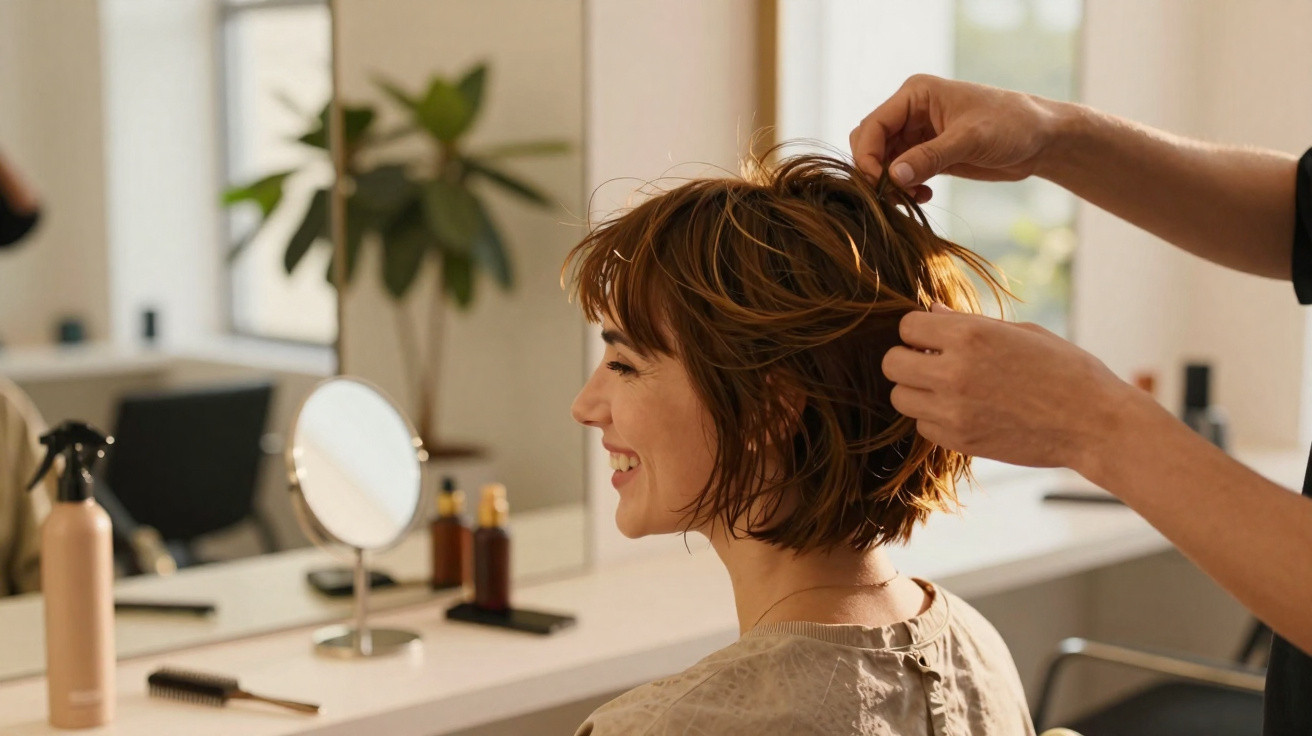
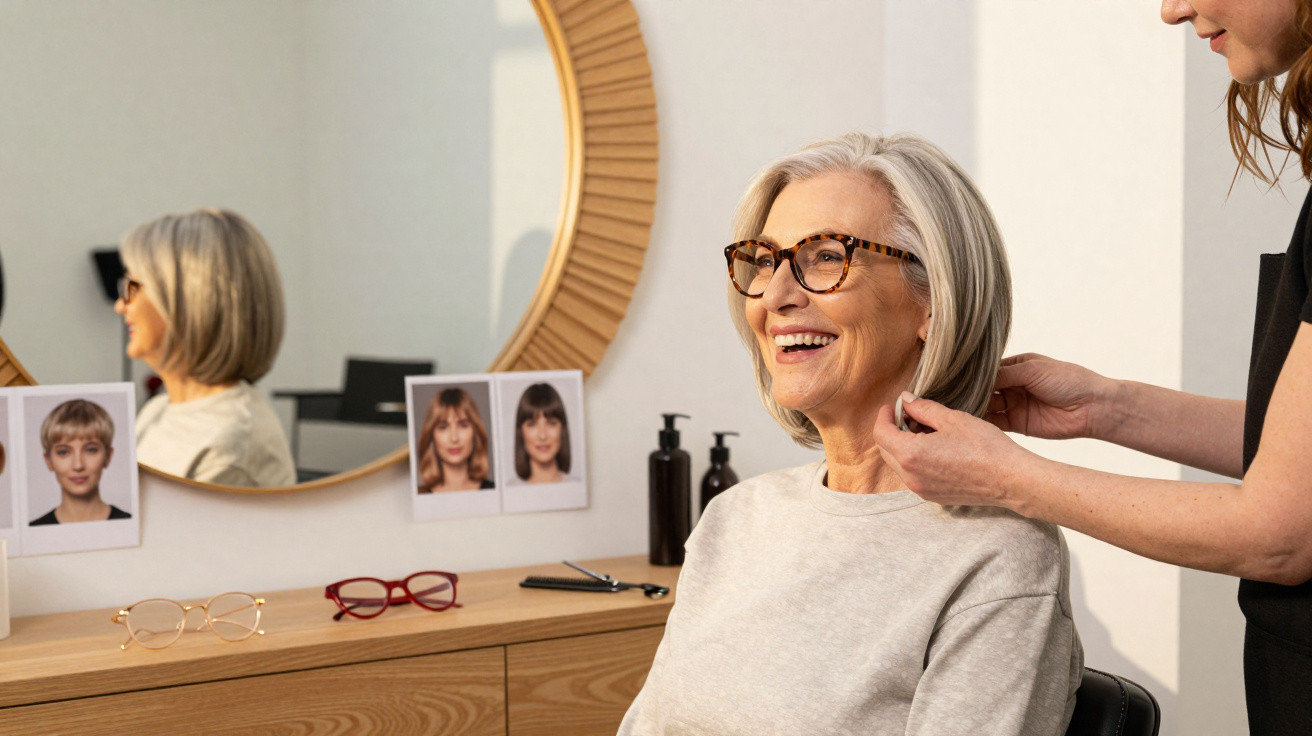
The woman in the salon chair is wringing her fingers in her lap, watching her reflection in the mirror. Her hair is pulling the same trick it always does on rainy Wednesdays: swelling up on one side, falling limp on the other, with a stray cowlick standing to attention. She laughs - the weary sort of laugh you hear from someone who’s tested every smoothing cream on the shelf and still lost by 3 p.m.
Her stylist grins, lifts a section with the comb and says softly, “You know… you could stop fighting it.”
Twenty minutes later, most of the length is on the floor. Her neck is on show, her jawline suddenly defined. The silhouette feels crisp and light - even a little cheeky.
Those chaotic mornings? They just became much simpler.
The short textured crop that refuses to have a bad hair day
Let’s call it what it is: the cut climbing to the top of everyone’s request list is the short, textured crop. It isn’t the rigid, spiky pixie you remember from the 2000s, and it isn’t a tidy bob that demands a blow-dry every time you wash it. This one is meant to look a touch tousled, with softened edges and deliberate movement.
It’s also the rare haircut that can look better when your hair is a bit unruly - the kind that meets humidity with, “Go on then.”
The blueprint is straightforward: close and neat at the nape and sides, then longer on top with texture worked through. The real magic, though, is that it leans into your natural pattern instead of trying to press, flatten or stretch it into something it simply isn’t.
Stylists in major cities and small towns are repeating the same line: “Everyone’s asking for a version of this cut.” A Paris stylist says she’s gone from doing three crops a week to three a day. A New York colourist jokes that people arrive for highlights and leave with half their hair gone - and a massive grin.
One salon owner even kept track for fun: short textured cuts rose 40% in six months. That’s not a fleeting micro-trend; it’s a quiet shift happening right under the cape.
When clients explain why, the answer rarely changes: “I just needed something that works when I don’t.”
The logic is blunt. Long hair can look romantic, but it comes with a daily bill: drying, brushing, detangling, and disguising oily roots with creative buns. Shoulder-length looks effortless on Instagram - then in real life, one side kicks out and the other doesn’t.
A textured crop, by contrast, gets on with the day alongside you. It makes space for your hair type, your odd growth patterns, and the reality of your routine. You buy back time each morning - and a bit of headspace too.
If the whole point is to look slightly undone, it’s hard to truly get it “wrong”.
Why this cut works on “difficult” hair
Treat this shape as a clever middle ground between control and ease. Keeping the nape close and tidy makes everything look purposeful rather than messy. Leaving extra length through the top and crown gives your hair room to move - to wave, curl, or flick in the way it naturally wants to.
A strong stylist won’t cut it blind. They’ll observe how your hair behaves as it dries, note where your cowlicks kick up, and build the outline around those quirks. They may keep more weight where your hair pops up, and remove bulk where it tends to collapse.
The payoff is simple: the haircut does a large part of the work, and you only do the remainder.
Take Laura, 36, whose fine hair frizzes the moment rain is mentioned. For years she followed the familiar script: long layers, round brush, heat protectant, then twenty minutes attached to a hairdryer before work. By lunchtime, her hair would mutiny again - flat at the roots, puffy at the ends.
Then one day, caught in a downpour, she arrived drenched, laughed and said, “Cut it. I’m done negotiating.” Her stylist took her to a short textured crop, keeping a bit of airy length on top and adding barely-there bangs.
The next morning she sent a selfie: she’d slept on it, used a pea-sized blob of cream, and stopped there. “I woke up late and still looked human,” she wrote. “This feels like cheating.”
That “cheating” has a practical explanation. With less length, hair weighs less - so it’s less likely to pull itself into limpness. A crop also gives frizz less surface area to take over, while curls and waves can bounce up rather than being stretched out.
On top of that, the textured cutting approach - point cutting, micro-layers, controlled thinning - interrupts heavy sections. As a result, hair is less prone to clumping strangely when it’s damp or you’ve been sweating.
And because the overall design is built for motion, the occasional stubborn strand reads as style, not failure. Any “mistakes” you make simply look like part of the look.
How to wear it so it really fits your life
The most important move is this: use your hands instead of relying on tools. After washing, towel-dry by squeezing rather than rubbing, and skip chasing a salon-perfect blowout. Warm a little cream, wax or foam between your fingers, then scrunch or twist small pieces while the hair is still slightly damp.
Try shifting the top forwards, backwards or a little to one side and notice where your face looks brightest. A textured crop thrives on movement. Tip your head, rough it up, then step away from the mirror for ten seconds before you correct anything.
Give the hair time to settle into its new pattern.
The first week is often when people panic. They attempt to replicate the salon styling every day - the same products, the same steps, the same hand movements. Realistically, no one keeps that up daily.
This cut is meant for actual life: rushed starts, post-gym showers, children tugging your sleeves, and commutes that leave you with helmet hair. If it only looks good after 25 minutes of work, you haven’t found the right version for you.
Be patient as you learn it. A slightly off day doesn’t automatically mean the cut is wrong - more often it means you’re still trying to use “long hair” habits on a shorter shape.
“People think short hair needs more styling,” says Ana, a London hairdresser who’s been doing crops for twenty years. “What it really needs is more trust. Once we cut away the old length, the real texture shows up. That’s when the haircut finally starts working with you, not against you.”
- Ask for softness, not sharpness: Tell your stylist you want a textured crop with movement, rather than a rigid, graphic pixie. Words such as “airy”, “undone”, and “lived-in” are genuinely useful.
- Bring real-life photos, not only polished campaigns: Choose images in everyday lighting - outdoors, in a café, slightly windblown. That helps your stylist judge behaviour, not just an editorial finish.
- Plan your maintenance rhythm: Crops change quickly in feel as they grow. If you prefer a clean neckline, expect a tidy-up every 5–7 weeks. If you’re happy with a softer outline, you can leave it longer.
- Match the cut to your actual routine: If you never blow-dry, say so. If you own one styling product, say that too. The best version of this cut should work in the life you truly live, not an imagined one.
More than a haircut: what you’re really choosing
This kind of cut often comes with a quiet emotional reset. Without a curtain of hair to hide behind, your face is more present, your neck is visible, and your profile can look sharper. Some people describe feeling “seen” again; others simply feel oddly lighter walking out of the salon, as though they’ve set down an invisible obligation.
That’s also why the short textured crop is taking off so quickly in salons: it’s not merely fashion, it’s a truce - with your natural texture, your timetable, and your mornings. It doesn’t claim every day will be perfect. Instead, it suggests that even on the chaotic days, you’ll still look like you chose your hair, rather than gave in to it.
Maybe that’s the real draw. Not perfection - just a dependable version of you, even when your hair refuses to play along.
| Key point | Detail | Value for the reader |
|---|---|---|
| Works with natural texture | Short, textured crop built around your waves, curls, or straight pattern | Less daily styling, fewer fights with frizz or flatness |
| Low-effort routine | Finger-styling, light product, no complex blow-dry required | Time saved in the morning, style that survives real life |
| Customisable shape | Adjustable length on top, fringe options, softer or sharper nape | Cut can fit different face shapes, ages, and lifestyles |
FAQ:
- Question 1 Will a short textured crop work if my hair is very thick and puffy?
- Answer 1 Yes - provided your stylist removes bulk thoughtfully with internal layering and debulking. The aim isn’t to thin everything evenly, but to take weight out in specific areas so the hair sits closer to the head without ballooning.
- Question 2 What if my hair is fine and limp - won’t short hair make it look even thinner?
- Answer 2 Not necessarily. A well-executed crop can make fine hair appear fuller because shorter lengths reduce the drag that pulls hair down, and textured cutting creates an illusion of density - particularly at the crown and through the fringe.
- Question 3 How do I know if my face shape suits this kind of cut?
- Answer 3 Most face shapes can wear a crop when the details are adjusted well. Round faces often suit extra height on top, longer fringes can soften strong jaws, and a slightly asymmetric front can balance features. What matters is the shape, not only the length.
- Question 4 Do I really need trims every 5–7 weeks?
- Answer 4 That timing is best if you prefer a crisp outline. If you like it a bit shaggier, you can usually extend to 8–10 weeks. Ask your stylist how the cut will evolve between appointments and what kind of grow-out you’re aiming for.
- Question 5 Can I grow it out easily if I change my mind?
- Answer 5 Yes - growing out a crop is very manageable, especially when it’s been cut with soft texture. You’ll typically move through a flattering short-bob stage; small, regular micro-trims can keep the in-between phase looking intentional.


Comments
No comments yet. Be the first to comment!
Leave a Comment