
The first white hair almost never turns up solo. It appears on some frantic Monday, tucked by your temple, precisely when you’re already running late and your tea’s gone cold. You move closer to the mirror, pinch the strand, and there it is: a streak of silver that pays no attention to your diary, your skincare habits, or your last birthday.
For a while, you pluck it out, you dye over it, you act as if it isn’t happening. Then, one day-under unforgiving lift lighting or reflected in a shop window-you catch yourself properly and realise the “odd few” greys have become a genuine salt and pepper situation.
And that’s when the question changes. Perhaps hiding it isn’t the goal any more. Perhaps the real problem is something else entirely.
How do you let grey sit on your head… without it ageing your whole face?
Step 1: Get the cut right before you touch the colour
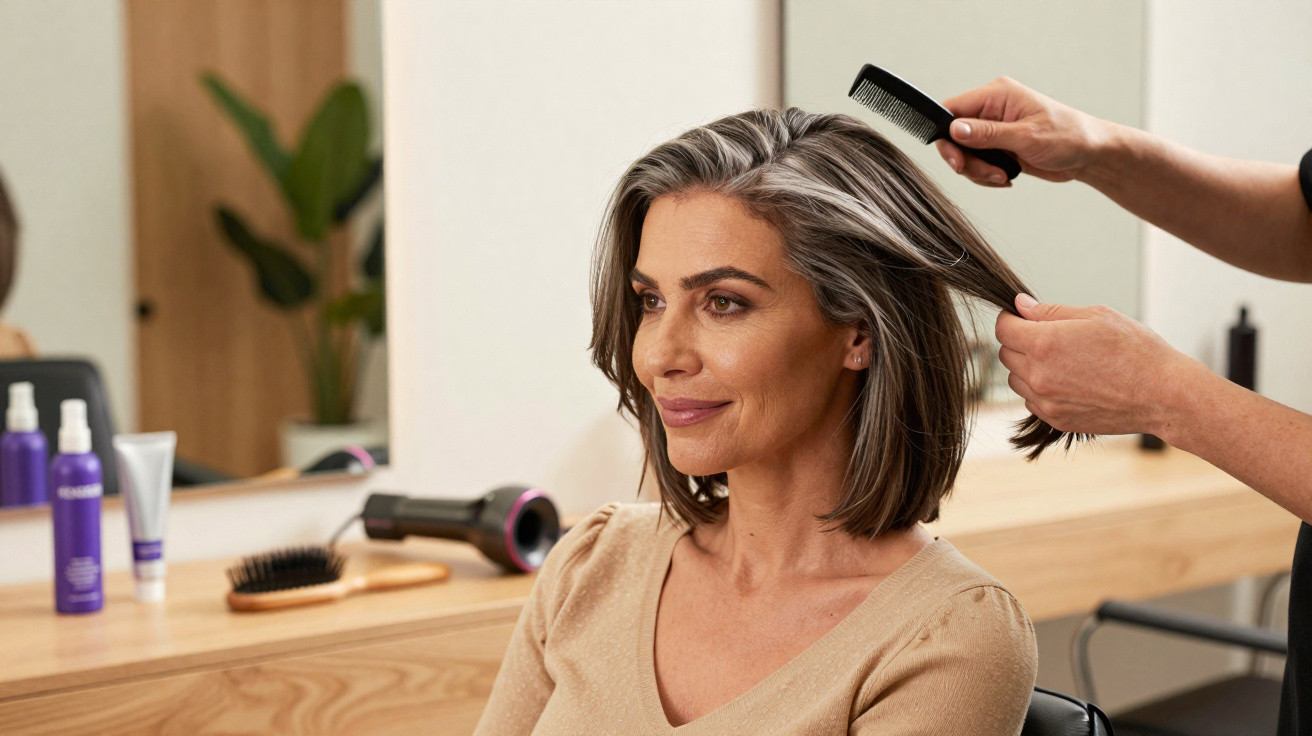
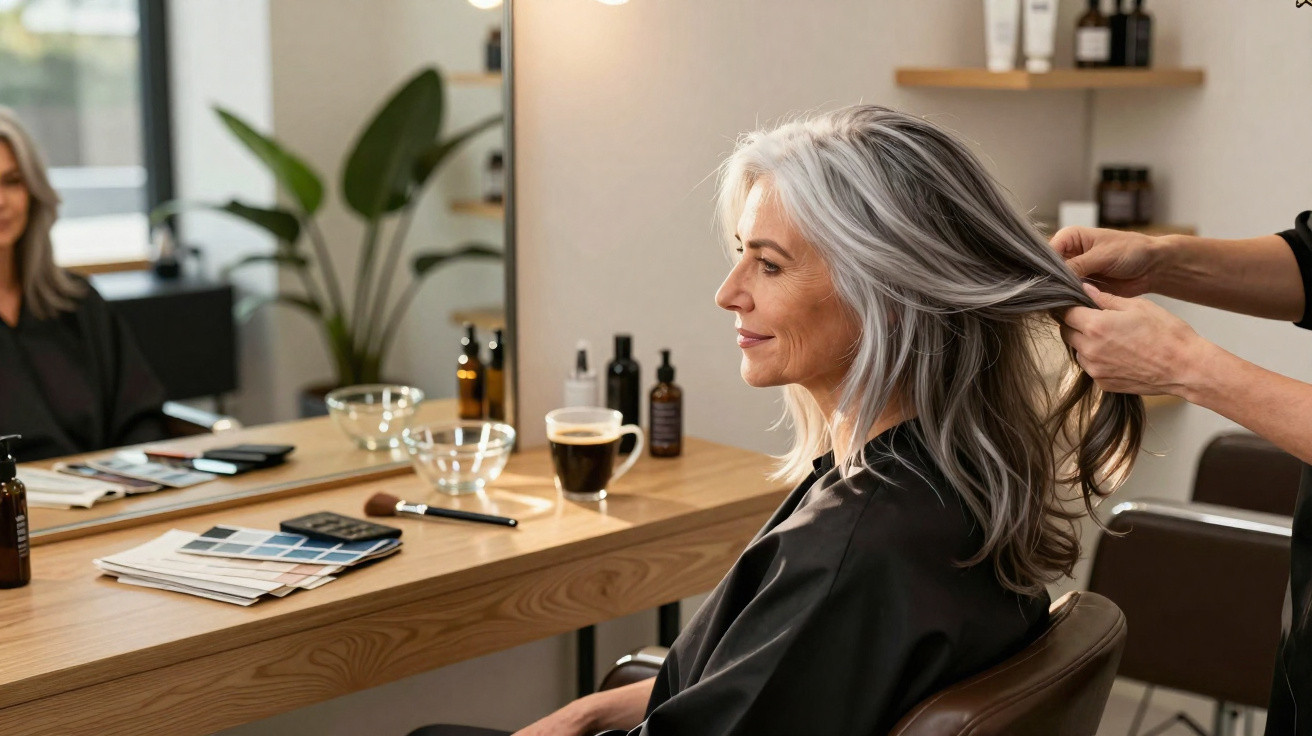
A decent hairdresser will usually start with the same point: grey isn’t what makes you look older-an unflattering haircut is. Salt and pepper hair behaves differently; it has its own texture and the way it reflects light isn’t the same as fully pigmented hair. On a limp, dated shape, it can pull your features down. On a crisp, current cut, it can do the reverse-lifting, framing, and making the colour look deliberate.
It’s a bit like a blazer: identical fabric can read as vintage-chic or “left in the loft” depending on the tailoring. Hair works the same way.
A Paris-based stylist I spoke to described a client, 49, who arrived almost apologising for her grey strands. She’d kept the same long, flat layers for a decade and coloured every four weeks. By then, the grey was breaking through along the parting and at the temples, and she felt it made her “look exhausted”.
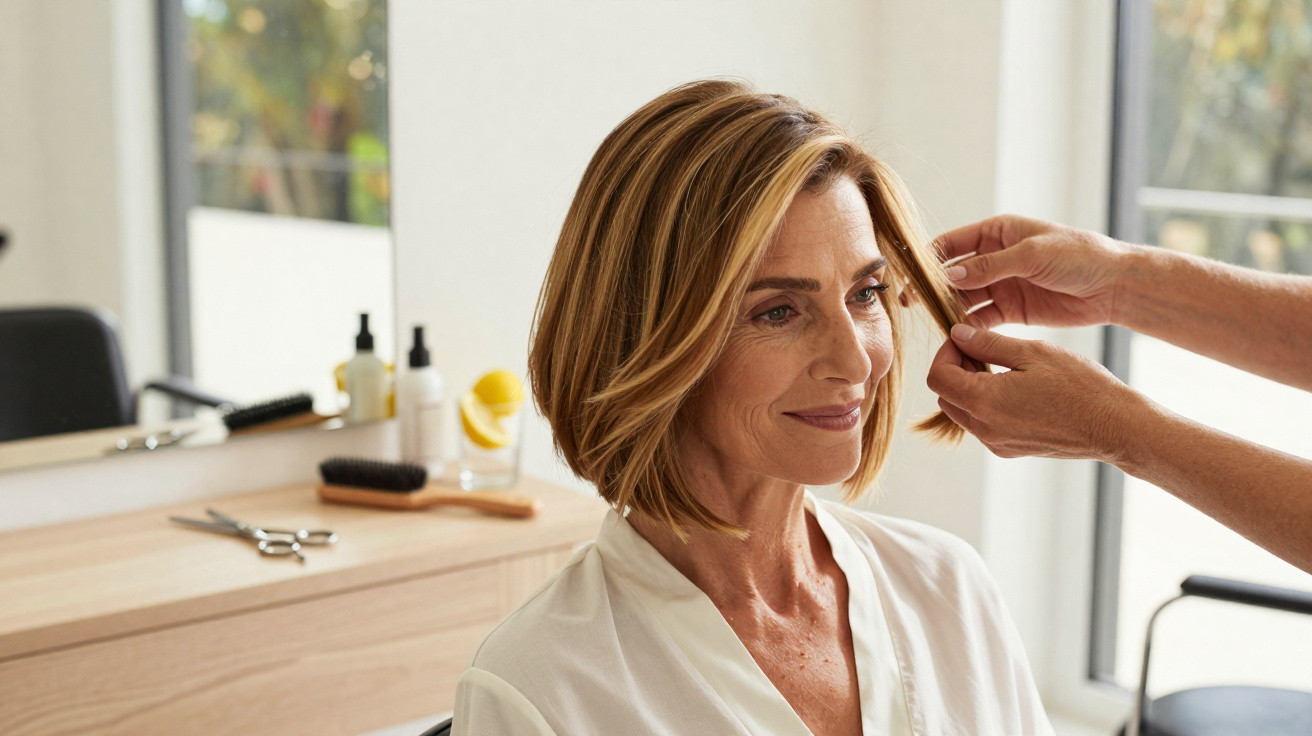
Rather than racing to cover it, the stylist took the length to just below the collarbone, added light, face-framing pieces, and opened up the neckline. The grey hadn’t vanished. Yet people started asking where she’d been on holiday.
There’s a straightforward reason. As the face shifts with age-softer jawline, cheekbones that look less sharply defined-a heavy, shapeless cut highlights every line. A more structured shape does the opposite: it creates angles, shows more skin, and adds movement. Grey hair is like highlighter; it needs a good architecture to work on.
So the first step isn’t “go grey” or “cover grey”. The first step is to modernise the cut so your salt and pepper reads as a style choice, not a mistake.
Step 2: Neutralise yellow, boost shine, stop the “dull” effect
Once your shape is sorted, the next battleground is tone. Grey hair contains less pigment and often has different porosity, so pollution, heat styling and old dye build-up can shift it towards yellow or leave it looking flat. That’s the point where salt and pepper starts giving “tired” rather than “chic”.
The upside is that a few targeted products can make a dramatic difference. Think violet or blue shampoos, gloss treatments, and masks that increase shine-used consistently, not compulsively.
Most of us know the routine: you buy a purple shampoo, use it twice, then it lives in the corner of the shower for six months. Let’s be realistic-almost nobody does it daily. The colourists I spoke to kept repeating the same idea: what matters is rhythm, not perfection.
One stylist suggested a simple plan: violet shampoo once a week, a clear or softly silvery gloss at the salon every 6–8 weeks, and finishing each rinse with a few seconds of cool water. Nothing intense-just small habits that stop grey drifting into that tea-stained cast that can make the complexion look older.
A grey specialist hairdresser put it very plainly:
“Gray doesn’t make you look old. A yellow veil and zero shine do. When the hair is luminous, people read it as intentional color, not as ‘I gave up’.”
To avoid that veil and keep salt and pepper looking bright, most professionals return to the same practical kit:
- A gentle violet or blue shampoo, used once a week
- A nourishing mask, because grey often feels drier
- A clear or pearl gloss at the salon for reflection
- A heat protectant before blow-drying or straightening
These aren’t fancy add-ons. They’re what separates grey that catches the light from grey that disappears into the background of your face.
Step 3: Soften the contrast at the roots, not the whole head
The third step is about approach. When you’re moving into salt and pepper, the most obvious “I colour my hair” tell isn’t the ends-it’s the roots. That stark line between dark dye and white regrowth is what can make you feel older overnight.
Many colourists now steer people towards a more considered compromise: leave most of the hair alone, and focus work only near the roots and around the face.
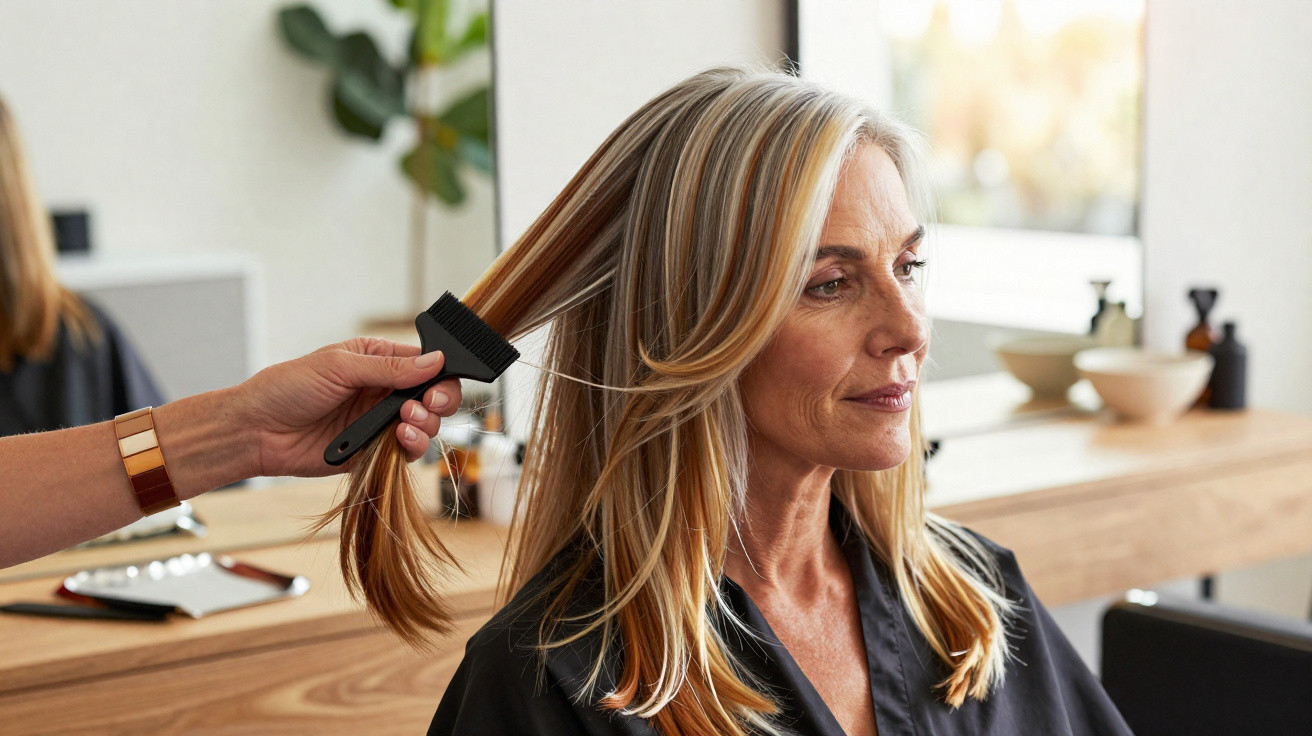
Instead of a full head of colour every 4 weeks, your hairdresser might gently lighten the parting and temple area-sometimes only one or two tones closer to your natural. They may weave ultra-fine highlights through the front pieces and the top layer.
What do you get? Softer regrowth. The eye no longer lands on a sharp border. And those white hairs start to look like a planned salt and pepper pattern, not evidence of a missed appointment.
This is particularly helpful if you’ve spent years dyeing your hair dark. Stopping all at once can feel brutal. A root-softening plan lets you grow out your grey while still looking finished. It communicates something different: not “I let myself go”, but “I’m changing direction-slowly, deliberately”.
The rule most hairdressers follow here is: less saturation, more dimension. Keep depth at the nape and in the inner layers, lighten only the key areas, and the grey blends more naturally, the skin looks softer, and you avoid endless full-head colouring.
Step 4: Adjust your eyebrows and makeup to your new contrast
Anyone who works with grey hair tends to say the same thing: when your hair becomes lighter, your brows and makeup need to shift with it. A black pencil against icy grey hair can make features look severe. Very thin brows with visible silver at the temples can leave the face looking “emptier”.
The fix isn’t “pile on more makeup”. It’s making slightly different choices.
Most professionals start with eyebrows. If your natural hair is dark, you can absolutely keep a defined brow-just go one shade softer and a touch cooler. A taupe or ashy-brown pencil is usually more believable than stark black.
For the rest of the face, a little cream blusher, a bit of light reflection (on cheekbones and the inner corner of the eye), and a lipstick that isn’t drying can quickly rebalance grey hair. One colourist framed it the same way for every client: if your hair carries less colour, your face needs a little life.
One hairstylist also mentioned a pattern she sees often: when clients first go grey, they sometimes switch everything off at the same time-less lipstick, fewer accessories, more neutral clothes. That “fade-out” is what creates the suddenly “older” feeling in the mirror.
Salt and pepper hair suits contrast. Not loud contrast, but a gentle echo: brows with definition, a mouth colour that looks alive, perhaps glasses with some character. It doesn’t require a full makeover-just aligning the frame (hair) with the picture (face) so they read as one.
Step 5: Style and attitude – the everyday details that change everything
Here’s the blunt line hairdressers repeat often: grey that’s brushed, shaped and slightly glossy reads as a “choice”; the same grey, left flat and frizzy, reads as “I gave up”. It’s a tough way to put it, but it’s what they watch play out on clients’ faces every day.
The daily effort doesn’t need to be complicated. A quick blow-dry with a round brush at the roots, a few minutes with a large-barrel curling iron for movement, or even a small amount of styling cream to calm frizz can completely change how your salt and pepper shows up.
One stylist told me about a client who returned every two months insisting she “hated” her grey. Each time, the stylist offered the same routine: air-dry to 80%, then spend 5 minutes with a blow-dry brush on the front, followed by a drop of serum through the lengths. The client refused, claiming she had “no time”.
When she finally tried it and came back, she didn’t ask for colour. She asked how to make that result last longer. Her hair was still the same blend of white and dark. The difference was the care invested-and the way she sat a little straighter in the chair.
One hairdresser summed it up like this:
“Gray hair isn’t a problem to fix. It’s a material to style. If you treat it like a tired compromise, that’s what it will look like. If you treat it like a designer fabric, people will ask where you got it done.”
On a practical level, most stylists recommend:
- One simple, repeatable styling routine that takes under 10 minutes
- A light serum or cream to control frizz and add reflection
- A clear parting decision (side or middle), not “somewhere in between”
- Accessories that feel current: modern clips, scarves, or minimalist hair ties
Grey hair doesn’t age you. Feeling like you’re hiding inside your own hairstyle does.
Owning the grey: a style, not a surrender
Living with salt and pepper hair isn’t one big decision made in a single moment at the mirror. It’s a chain of small choices: the cut, the tone, how you handle the roots, the brow pencil you reach for, the five minutes you give yourself before you leave the house.
For some, the route is straightforward: stop colouring, change the cut, and feel instantly in sync. For others, it takes longer, with doubts and a bit of back-and-forth. Both are completely valid. There’s no “right age” and no “right amount of grey” before your white strands can become an asset.
From the hairdresser’s side of the mirror, the pattern looks simple: the clients who feel best aren’t always the ones with the least grey-they’re the ones who made a choice and then styled that choice. Whether you settle on soft salt and pepper, bold silver, or grey with a hint of subtle colour, the strength is in deciding rather than enduring.
Maybe that’s the quiet shift behind the whole grey story. It’s less about battling time and more about refining how you present yourself. The question isn’t “How do I hide my age?” but “Which version of me do I want my hair to underline today?”
| Key point | Detail | Value for the reader |
|---|---|---|
| Modern cut first | Reshape length and layers before tackling colour | Makes grey look intentional and flattering, not accidental |
| Tone and shine care | Use violet shampoo, gloss, and nourishment regularly | Prevents yellowing and dullness that can age the face |
| Root strategy + styling | Soften regrowth and keep a simple daily styling routine | Reduces “grown-out dye” effect and boosts confidence with grey |
FAQ:
- Does going gray always make you look older?Not necessarily. A fresh cut, bright tone, and adapted makeup can make gray look modern and chic. What tends to age is dull color, a harsh grow-out line, and an outdated haircut.
- How long does it take to fully transition to salt and pepper?On average 12 to 24 months, depending on your length and how fast your hair grows. Using highlights and root-blending can make the process feel smoother and less obvious.
- Should I cut my hair short to go gray?Not a rule. Short cuts speed up the transition, but many people keep medium or long hair. The key is a structured, updated shape that works with your texture and gray pattern.
- What if my gray is patchy or uneven?A colorist can add very soft highlights or lowlights to balance the contrast. You don’t have to cover everything; you just harmonize the mix so it looks intentional.
- Can I still heat-style gray hair?Yes, but always with heat protectant and moderate temperature. Heat can yellow and dry gray hair faster, so gentle tools and quick styling sessions are your best allies.


Comments
No comments yet. Be the first to comment!
Leave a Comment