
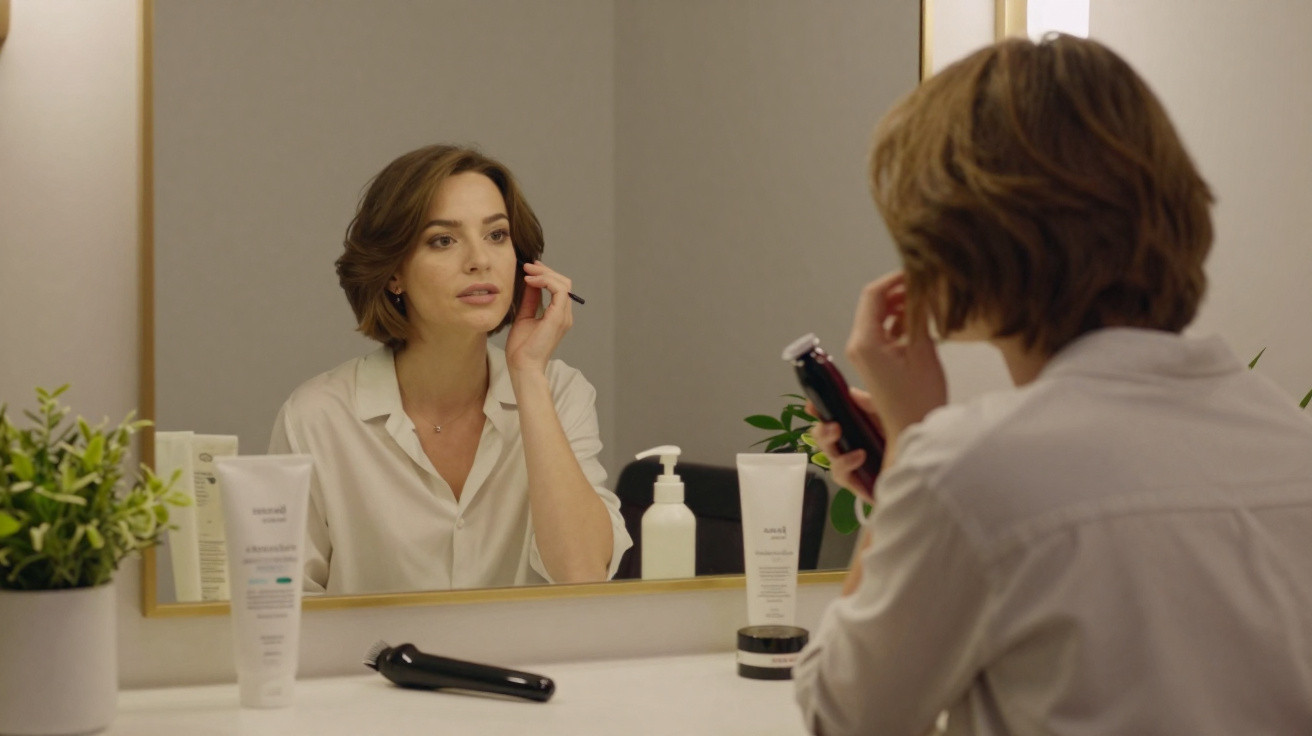
You’re sat in the salon chair with the cape clipped at your neck, flicking through photos of celebrities wearing perfectly fluffy short hair. Your stylist grins and delivers the magic line: “This cut will give you so much volume.”
You agree, full of optimism. You’ve read the features and saved the Pinterest boards. Short hair, you’ve been told, is the miracle solution for fine, flat strands.
Then you get home, shampoo it once, let it air dry… and your supposedly “volumising” short cut suddenly sits limp. It splits into miserable little tails and, somehow, looks even finer than it did before.
You catch your reflection and think: what on earth happened?
Here’s the uncomfortable reality: not every short cut is on your side. Some of the “best” hairstyles for fine hair can be quiet saboteurs.
The fake promise of the blunt bob for fine hair
The blunt bob is absolutely everywhere - on Instagram, on red carpets, and in every “chic French girl” mood board going. It’s marketed as the unbeatable fast track to thicker-looking, swishy hair: that one cut that instantly makes the ends appear fuller.
With fine hair, however, it can play out the opposite way.
If the line is too uncompromising and the length lands in the wrong place, a blunt bob can become a sharp outline… around your scalp. Rather than a dense, graphic shape, the hair can hang like a curtain, sticking to the head and revealing every little gap.
Think of Léa, 32, who went into a fashionable salon with long, wispy layers and left with a razor-straight bob at chin level. The stylist reassured her, “All that weight gone, you’ll have crazy volume.” On day one - with a salon blow-dry and a round brush - she looked like a magazine spread.
By day three, after a quick air-dry before work, the whole thing caved in.
The ends started clustering together, the crown lay flat against her head, and her scalp suddenly seemed more visible on top. The haircut meant to mimic thickness ended up spotlighting exactly where her hair was genuinely sparse.
The issue is structural. A blunt bob creates a heavy, solid edge at the perimeter, but it offers no internal scaffolding within the cut. Without the density needed to fill that shape, the hair simply… drops.
Instead of forming a rounded silhouette, the weight pulls everything downwards, making the face look longer and the sides appear narrower. On thick hair, that crisp line showcases fullness. On fine hair, it often highlights the reverse: where the fullness just isn’t there.
The tricky “pixie with lots of texture” that exposes your scalp
The textured pixie is another style routinely pitched as the holy grail for fine hair. It’s short, it’s light, it’s easy to lift at the roots - and there are endless Instagram tutorials selling the idea. The sales pitch is seductive: “We’ll chop it all off, add loads of texture, and you’ll have instant body.”
The catch sits inside the phrase “loads of texture.”
On fine hair, that frequently means heavy-handed thinning with razors or thinning shears. The result can be airy and feathered… or just transparent in normal bathroom lighting.
Take Emily, who decided to “take the plunge” after years of shoulder-length hair. Her stylist gave her an extremely choppy pixie with piece-y ends, finished with texturising spray and a touch of clay. Under salon lighting, it looked current and effortless.
The next morning at home, after a quick towel-dry and a small amount of product, it didn’t feel quite right.
Leaning towards the window, she noticed the crown looked strangely patchy. The more she “scrunched” for texture, the more she could glimpse her scalp between the separated pieces. The cut looked cool, yes - but it had traded density for movement.
The reasoning behind a textured pixie is straightforward: take away bulk so the hair can lift and separate. On thick or medium hair, that can be brilliant. On very fine hair, too much “taking away” leaves you with almost nothing.
Yes, the hair lifts - but it breaks into skinny strands rather than holding a compact shape. And every space between those strands becomes a tiny spotlight on your scalp.
Fine hair needs smart lightness, not random emptiness.
The layered shag and “wolf cut”: volume in photos, chaos in real life
Then there’s the modern shag and its rebellious cousin, the wolf cut. Both are all over TikTok, sold as effortless volume and a “lived-in” finish that supposedly transforms flat hair.
They depend on lots of layers - often short, scattered pieces around the crown and face.
On fine hair, those layers can pull a nasty trick. Instead of giving soft fullness, they can leave the ends looking stringy while the top turns oddly spiky, as if the volume has evaporated into thin air.
You see this scenario constantly: someone with fine, shoulder-length hair goes into a salon asking for a shag “like the girl in this video.” The influencer has naturally dense hair that expands beautifully with layering.
Our real-life client doesn’t.
After the cut, the short layers at the top may lift a little when styled, but the lengths underneath can resemble a sparse fringe. Tied back, the ponytail looks shockingly thin. Worn down, the hair forms uneven clumps with empty pockets between them. What reads as full and rock’n’roll on camera becomes an ongoing fight against flatness in real life.
The reason is basic: layers redistribute weight. With thick hair, that’s good news - it breaks up heaviness and releases hidden volume. With fine hair, every layer is a slice of density you’re giving away.
When those layers stack up, especially at the crown, you remove the one thing fine hair relies on: continuous mass. The shag’s “messy” vibe can quickly become a scattered one, where no area has enough hair to look genuinely lush.
And let’s be real: hardly anyone maintains this every single day with a full styling routine and perfect angles.
The “volumizing” short bob with rounded brush: why styling lies to you
There’s also the classic short bob that’s blow-dried with a round brush. In the salon, it’s pure magic: roots lifted, ends tucked under, a mist of shine spray - and suddenly your hair looks twice as thick.
You walk out believing you’ve finally worked it out.
That illusion lasts until the next wash. Without the round-brush skill, the exact dryer angles and the professional products, the bob shows its true behaviour: fine strands that fall straight, flip outwards, or cling in flat sheets around your face.
Plenty of women get caught here. The haircut itself isn’t always the villain; it’s that it can be too dependent on daily styling gymnastics. With fine hair, this kind of routine requires time, patience and arm strength that everyday life rarely provides.
On a rushed morning you skip the full blow-dry, let it mostly air dry, maybe hit the roots quickly… and the hair immediately returns to its flat baseline.
Because the cut’s shape is built around that rounded, polished structure, if you don’t recreate it there’s no “built-in” volume doing the work for you. The haircut doesn’t hold you up when you’re tired, late, or simply not bothered.
This is the quiet truth behind many “volumising” short cuts for fine hair: they don’t generate volume - they rent it to you for the lifespan of a blow-dry.
Once the styling fades, the structure falls apart.
A genuinely clever cut for fine hair should look convincing with your natural texture showing, minimal product, and a quick dry. If it doesn’t, those volume promises are just marketing.
“The best cut for fine hair isn’t the one that looks great when you leave the salon,” says one Paris-based stylist. “It’s the one that still looks decent three weeks later on a random Tuesday, after a five-minute dry with a half-broken hairdryer.”
- Avoid cuts that need daily round-brush perfection
- Be wary of heavy thinning or extreme layering on already fine hair
- Choose gentle, invisible layers over dramatic, choppy ones
- Ask for a shape that looks good with air-drying, not just blowouts
- Judge a cut after your first at-home shampoo, not just at the salon
So what actually works when your hair is fine and you love it short?
The most useful shift happens when you stop chasing the four “star” short cuts and start paying attention to what your own hair is quietly telling you. Fine hair rarely thrives on drama.
It wants support, lightness in the right areas, and a shape that respects what it can and can’t do.
Often, the strongest options sound almost boring on paper: a lightly graduated bob that’s shorter at the nape, a soft pixie with fuller sides and minimal thinning, or a chin-length cut with discreet internal layers placed only where the hair naturally bunches. These aren’t TikTok trends - they’re architecture.
The emotional trap is real. You arrive at the salon hoping for a transformation that screams change. Stylists feel that pressure too, and sometimes reach for the trendiest template rather than building a cut that’s genuinely bespoke.
Yet what tends to wear best on fine hair is the opposite of spectacle.
It’s a shape that keeps a little extra weight behind the ears, that doesn’t hollow out the crown, and that avoids harsh, graphic lines your density can’t actually fill. It’s the haircut that still looks acceptable on day-three hair, when you’ve half finger-combed it in the bathroom with the tap running and your phone buzzing. That’s the kind of cut that quietly improves your life.
Then you notice a small change: you feel calmer in front of the mirror. You focus less on chasing “volume” and more on balance - proportions, and how your jawline and neck are framed. You stop zooming in on your scalp in photos and start noticing your overall expression.
The surprising truth is that many of the “best” hairstyles for fine hair have been misleading you, selling drama instead of durability.
Once you clock that, you can ask better questions. Not “What cut will give me more volume?” but “What shape makes my hair look like itself… only calmer, fuller, and kinder?”
That’s the conversation worth having - with your stylist, and with yourself.
| Key point | Detail | Value for the reader |
|---|---|---|
| Blunt bobs can backfire | On fine hair they create a heavy line with no internal support | Helps avoid cuts that highlight thinness instead of disguising it |
| Too much texture removes density | Thinning and choppy layers can expose the scalp | Encourages asking stylists to go easy on razors and thinning shears |
| Low-maintenance structure beats styling tricks | A good cut must look decent without a full blowout | Guides readers toward realistic, everyday-friendly hair choices |
FAQ:
- Question 1Which short haircut is safest for very fine hair?
- Question 2Are layers always bad for fine hair?
- Question 3How short is “too short” for fine hair?
- Question 4What should I tell my stylist to avoid thinning my hair too much?
- Question 5Can products really create volume, or is it mostly the cut?



Comments
No comments yet. Be the first to comment!
Leave a Comment