

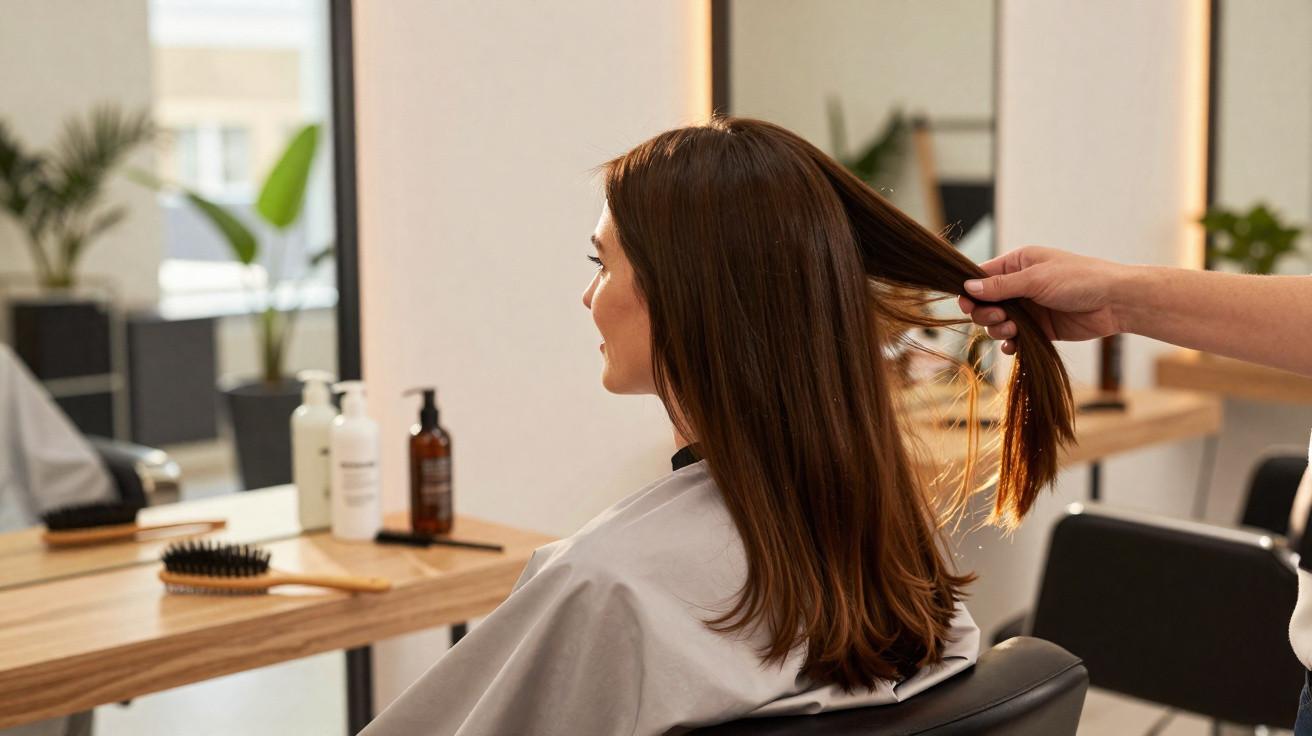
A dull grey Tuesday in a city-centre salon: a ring light glares harder than the fluorescent strips above the mirrors. A young woman in an oversized hoodie studies herself, with roots showing by barely half a centimetre, while her stylist flicks through TikTok screenshots of copper bobs and vanilla blonde. “We’ll do a full bleach again, right?” she asks, already tilting her phone to capture a before shot. The stylist pauses, then pulls over the mixing bowl. Nearby, a dermatologist’s leaflet on “scalp health” sits curled and ignored. Nobody records that.
The colour bowl gives off that sharp, biting smell. Someone laughs about “burning the old me away”, and the rest of the room joins in. Then the timer begins.
When the glow-up becomes a monthly chemical assault
Open any beauty feed and the cycle is obvious within seconds: fresh colour, a new persona, a dramatic before-and-after, then the same thing again 30 days later-predictable as a calendar reminder. Roots that are barely there get called “disgusting”. A tonal shift of half a shade is framed as a personal failing. At first the idea feels harmless; then it hits hard: change your hair constantly, or you’re falling behind.
Dermatologists are increasingly naming this pattern. Some refer to it as “chemical self harm”-not as a sensational headline, but as a matter-of-fact clinical description: repeated, deliberate damage to hair and scalp until the body can no longer keep pace. The trouble is, that kind of warning doesn’t sit neatly inside a 15-second Reel.
We’re now in a place where the algorithm rewards transformation more than it rewards health.
Spend a Saturday in a fully booked colourist’s chair and you’ll see the consequences immediately. A London dermatologist describes a surge of clients in their early 20s arriving with hair that behaves like overcooked spaghetti-flat, stretchy and gummy when wet, snapping with the gentlest pull. Some have coin-sized bald patches along the hairline, concealed beneath curtain bangs and claw clips. Many are committed beauty fans, proudly scrolling through a camera roll of “hair eras”-black, ginger, platinum, lavender, silver-packed into a single year.
On Instagram, those 12 shades read like a playful mood board. In a consultation room, they present as chemical burns, persistent inflammation and thinning that starts far earlier than it should. Dermatologists are seeing more allergic contact dermatitis linked to dye ingredients such as PPD (p-phenylenediamine), with rashes creeping down the neck and across the face days after a “quick root touch-up”. One specialist recalls a patient who collapsed from a severe dye allergy after a fourth bleach session in six months. That footage never reached anyone’s feed.
This is the contradiction people avoid saying plainly: the routines that help build “hair influencer” status can quietly wreck the very hair being showcased. Behind soft-focus filters sit tender scalps, steroid creams and months of enforced “hair rest” that online suddenly reappear as an unexplained “mental health break”.
Biology makes the mechanism grimly straightforward. Hair colour-especially permanent dye and bleach-works by prising open the cuticle, the hair’s protective outer layer, so pigment can be removed and replaced. It depends on powerful alkalising agents and oxidisers such as ammonia and hydrogen peroxide. Do it occasionally and hair often has a chance to recover, particularly if it’s naturally robust. Do it every three to five weeks, chasing tiny tonal tweaks, and you’re effectively sandblasting the same fibres over and over.
Your scalp takes the hit as well. Every application places skin in contact with a mix of irritants and potential allergens. Small burns, low-grade inflammation and barrier damage can accumulate out of sight. Dermatologists often describe “cumulative trauma”-nothing dramatic at the start, just a steady wearing down of the scalp’s defences until, one day, the itching, flaking or burning doesn’t resolve. That’s when many people finally arrive at a clinic and say, “My hair just stopped behaving like hair.”
And, honestly, almost nobody sits down to read the full warning leaflet in a box-dye kit-let alone track every exposure across an entire year. Your body keeps the record quietly, cell by cell, until the cost shows up.
Choosing colour without quietly destroying your scalp
You can enjoy colour without turning your head into a chemistry project. The first (unfashionable) move is simply to extend the gap between chemical appointments. Colourists who collaborate with dermatologists commonly advise targeting 8–12 weeks between full dye jobs, then relying on root touch-ups or low-commitment glosses in the meantime. That change alone can nearly halve your annual chemical load.
It also helps to pick methods that don’t repeatedly punish the same strands. Balayage, low-lights and “rooted” looks concentrate lightening through mid-lengths and ends, leaving the scalp and natural root mostly untouched. You still get an obvious shift, but you avoid re-bleaching the same vulnerable regrowth line every four weeks. The healthiest hair transformations are often the ones designed to look a little grown-in.
Patch tests may feel dull next to GRWM videos, but they remain the single step most likely to prevent you waking up with a swollen face and a blistered scalp. It’s 48 hours, a cotton bud and a coin-sized dab of product behind the ear. Not exactly a trending sound-quietly life-saving, though.
Most people aren’t trying to damage their hair on purpose. They’re reaching for something softer: a sense of reset, a bit of control when life feels chaotic, the small rush of validation when comments arrive saying “New hair, new you!” That’s why shame rarely helps. If anything, it drives the pattern underground, with damage hidden out of guilt. A better framework is to treat hair more like skin-something you inhabit, not a costume you can strip off and repaint endlessly.
A practical shift is to think in “eras” measured in seasons, not weeks. Rather than jumping from platinum to espresso to cherry red in three months, choose one colour family and vary within it: deeper, warmer, cooler, using glosses or semi-permanent changes that fade without drama. You still get the emotional lift of change without the scorched-earth chemistry. And if your scalp is already protesting-burning during processing, soreness after washing, shedding that’s more than usual-that isn’t you “being dramatic”. It’s your body sending a very clear email marked urgent.
There’s another option too-quiet, unsexy, and the one many stylists privately wish clients would choose: stop chasing the shade that’s trending and start working within what your hair can realistically tolerate. Some textures take bleach in their stride. Others disintegrate after one session. Respecting the second group isn’t a defeat; it’s how you keep your hair.
“People will tell me, ‘I know it’s bad, but my audience expects a new color every month,’” says Dr. Léa Martin, a dermatologist who sees a steady stream of influencers in her Paris clinic. “I tell them: your audience doesn’t have to live with your scalp. You do. When the camera is off, it’s you dealing with the hair that won’t grow back.”
- Red flags during dyeing
Intense burning, stinging or swelling during processing isn’t “normal”. It may indicate irritation or an emerging allergy, rather than simple sensitivity. - Smart spacing of appointments
Waiting at least 8 weeks between full-head dyes and prioritising partial techniques reduces repeated trauma to the same hair shafts and follicles. - Safer product choices
Semi-permanent or ammonia-free dyes, professional patch testing and transparent ingredient lists reduce exposure to harsh sensitisers such as PPD. - Recovery phases
Planning “hair rest” months into your year-gentle shampoos, scalp serums, and zero bleach-gives follicles a genuine chance to recover. - Professional oversight
If you experiment frequently, regular check-ins with a dermatologist or trichologist can spot early warning signs before the damage feels permanent.
Beauty, algorithms and the quiet right to keep your hair
There’s something quietly radical about deciding your hair doesn’t need a cliff-hanger every month. Not because change is wrong, but because the pace has stopped feeling human. When dermatologists compare constant dyeing to “chemical self harm”, they’re not accusing anyone of bad intent. They’re highlighting a cultural script that nudges people to keep injuring the same part of their body for engagement-and to laugh off the discomfort while the camera rolls.
The awkward question is who gains from that. Platforms that boost transformation content. Brands that sell bleach kits and “repair” masks side by side. Sometimes, the influencer whose views surge when hair shifts from honey to ash. The person who steadily loses is the one whose follicles are quietly surrendering. This isn’t a case against colour; it’s a nudge to put colour back where it belongs: in the realm of choice, not compulsion.
Perhaps the next “relatable” trend won’t be yet another emergency bleach bath, but a creator saying, “I wanted to dye my hair again this month. My scalp said no. So you’re getting the same brown, with healthier curls.” Imagine that going viral-not flawless, not dramatic, just stubbornly kind to the part of you that doesn’t regenerate on demand.
| Key point | Detail | Value for the reader |
|---|---|---|
| Spacing out colour sessions | Aiming for 8–12 weeks between full dyes and using root touch-ups or glosses instead of constant full bleach | Cuts yearly chemical exposure and lowers the risk of breakage, burns and chronic scalp irritation |
| Listening to warning signs | Burning, itching, unusual shedding or rash after dyeing are early red flags, not “normal” discomfort | Helps you act early, seek professional advice and prevent long-term damage that’s harder to reverse |
| Choosing gentler techniques | Balayage, low-lights and rooted looks avoid repeatedly attacking the same new growth near the scalp | Lets you enjoy visible change while preserving scalp health and overall hair density over time |
FAQ:
- How often is “too often” to dye your hair?
Many dermatologists recommend limiting full-head permanent dye to no more than 4–6 times per year. Root touch-ups spaced 6–8 weeks apart, plus occasional glosses, are typically less intense than monthly all-over makeovers.- Can constant hair dyeing really cause permanent hair loss?
Yes, in some cases. Repeated chemical trauma and ongoing scalp inflammation can harm follicles over time, leading to thinning, receding hairlines or patchy loss that doesn’t fully recover-particularly when allergic reactions are ignored.- Are “ammonia-free” or “organic” dyes completely safe?
They’re often milder, but they aren’t risk-free. Many still use strong oxidisers and may contain allergens. Reactions can still happen, especially with frequent use, so patch testing and spacing treatments remain important.- Is bleaching worse than regular dye?
Bleach is usually more aggressive because it removes natural pigment entirely, lifting colour several levels in one session. That can be particularly tough on fine, curly or previously processed hair, and harsher on the scalp when repeated.- What can I do if my hair already feels fried from over-dyeing?
Stop chemical treatments for several months, prioritise gentle cleansing, deep hydration and protein-balancing masks, reduce heat where you can, and speak to a dermatologist or trichologist if you have scalp pain, rashes or continued shedding.


Comments
No comments yet. Be the first to comment!
Leave a Comment