
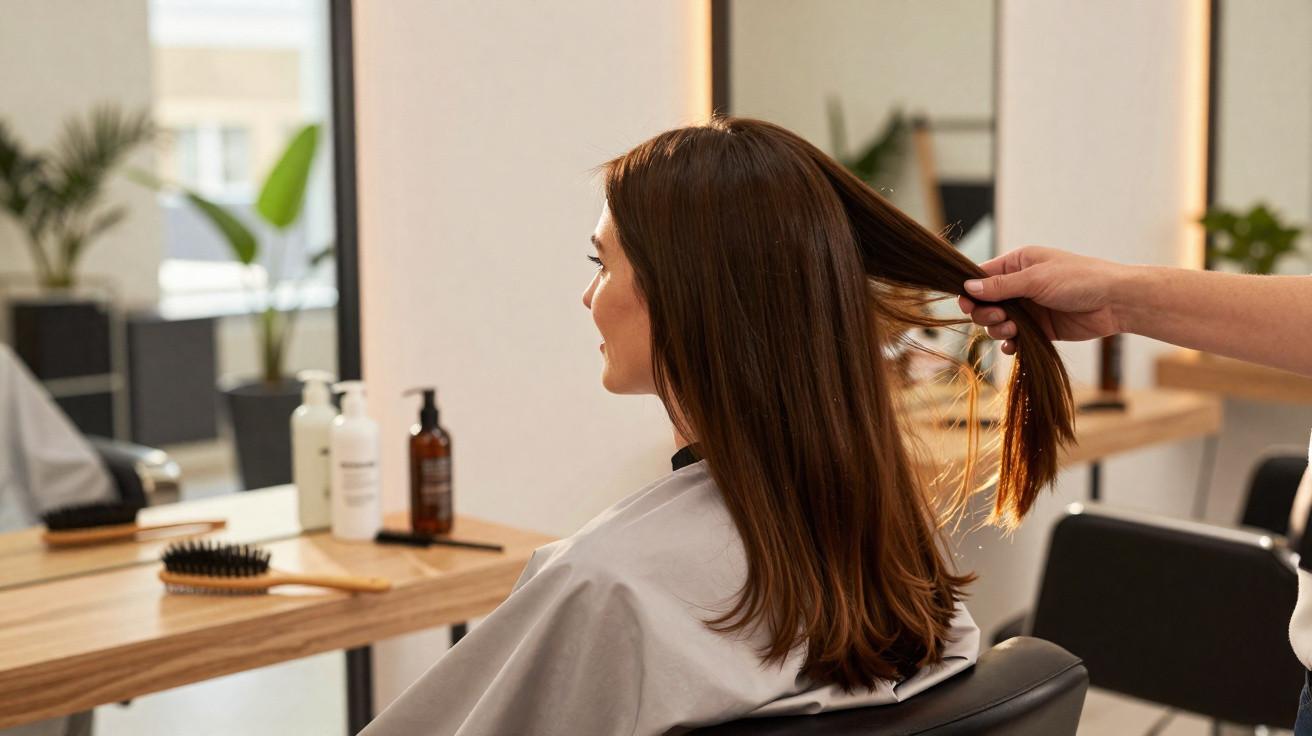
The woman in the salon chair wore a familiar expression. With one hand, she pinched the very ends of her hair and pulled them forward; with the other, she held up her phone, a photo of her “dream hair” glowing on the screen. She was in her late 40s. The length was still there, but the bottom third looked weary - thin, stringy, almost transparent under the harsh neon. She wasn’t willing to lose it. After years of growing it out, that length carried a quiet kind of pride.
The stylist didn’t push back. Instead, she angled the mirror and let her see the back properly. The shape was telling: bulky and flat through the upper section, then feathery and sparse at the ends.
“You don’t need short,” she said. “You need shape.”
And there’s a cut made for exactly that moment.
The cut that saves your length (and your ends)
Ask any capable hairdresser what women in their late 40s tend to murmur as they settle into the chair, and you’ll hear a version of the same thing: “I want to keep the length, but my ends look dead.” Hormones change, texture shifts, and hair that used to feel thick and swishy can start to hang like an exhausted curtain. The solution many of us fear is the predictable one: the big chop.
But there is a middle option.
The shape turning up more and more in salons right now is the long, softly layered U-shape cut. It keeps the length through the back, introduces gentle layers that lift the sides, and replaces a blunt, dragging edge with a rounded, lighter-looking hemline. The effect reads as fullness - not loss.
Imagine hair that falls to mid-back when straightened. In theory, that sounds abundant. In practice, for plenty of women around 48 or 49, that length can start working against you. The top half may still behave, yet the last 10 centimetres can look limp and frayed - particularly if colouring, straighteners or frequent blow-drying have played a role.
A colourist I spoke to described a client who’d held on to a one-length cut for two decades. Her ends had thinned so much she could twist them between her fingers into something like a thread. Rather than cutting her “short”, they went for a U-shape cut with face-framing layers. The change was brutal: same woman, the same impression of length, but now with movement and a thicker-looking outline - and a profile that made her neck and jawline appear sharper on camera. She texted a selfie from the car park because she couldn’t quite believe it was still her hair.
There’s a reason this specific silhouette tends to flatter after 45. Density often drops at the nape and around the temples, which can make a blunt, straight-across line look like a heavy slab on top with a sparse veil beneath. By gently scooping the back into a slight U and adding soft, long layers starting below the shoulders, you shift the weight in a way that brings the shape back to life.
Instead of all the volume collapsing at the bottom, the layers interrupt that dead line and create lift through the mid-lengths. You keep the emotional comfort of “long hair”, while fixing the part that gives away age and damage first: those flat ends that snag in your brush and refuse to hold a curl. The eye reads movement first, length second.
How to ask for this cut (and not regret it)
It helps to begin with a single, unambiguous sentence: “I want to keep my length, but I need to lose the flat ends and add movement.” Then bring photos - not 25-year-olds with extensions, but women closer to your age wearing long, layered, rounded shapes. Ask specifically for a long layered U-shape or a “soft V” that only lifts the centre back slightly, rather than creating a dramatic tail.
A strong stylist will usually set the perimeter first, shaping the hemline so it curves up gently towards the sides. After that, they’ll add long, subtle layers that begin at least 5–7 centimetres below your shoulders. Face-framing pieces around the cheekbones or jaw can also open up the front, especially if your hair tends to fall forward like a curtain.
One worry stops many women: “If they start layering, I’ll walk out with half my hair gone.” It’s a fair fear - particularly if you’ve lived through a few “trust me, it’ll grow” disasters in your 30s. This is where precision helps. Ask for layers you can still gather into a low ponytail without short pieces popping out. Say clearly that you’d prefer interior under-layers rather than taking too much from the bottom.
Another classic misstep is trying to preserve every last millimetre of length. When the ends are translucent and split, they’re not really giving you length anymore. They don’t hold a bend, they don’t reflect light, and they don’t photograph well. Let’s be honest: nobody really trims six-week-perfect like magazines suggest. So when you do make it into the chair, allow your stylist to remove the genuinely dead section - not just a symbolic half-centimetre.
“Once women accept that the last two or three centimeters aren’t helping them, everything shifts,” says Julie, a Paris-trained stylist now working in London. “We do a long U, soft layers, and suddenly their hair looks longer because it’s fuller. It’s like tailoring a dress that finally fits your body now, not ten years ago.”
- Phrase to use at the salon
“I want a long, softly layered U-shape that keeps my length but thickens my hemline and removes flat, see-through ends.” - What to avoid saying
“I don’t want you to cut anything, just dust the ends” if your hair is clearly shredded at the bottom. That sentence almost guarantees you’ll keep the problem. - Quick self-check at home
Bring your hair forward and examine the bottom 5–7 centimetres in natural light. If that section looks noticeably thinner than the rest, that’s the part your new cut needs to take back.
Living with long hair that finally works again
The most unexpected part of this cut is how it performs once you’re back in normal life - not under perfect salon lighting. Blow-drying often becomes quicker because you’re no longer battling a dense, blunt chunk at the bottom. Waves and curls tend to last longer because they aren’t being pulled straight by a heavy plate of length. Even on non-wash days, a simple half-up twist can look intentionally “done” rather than vaguely worn out.
You may notice something subtler, too: your face feels more present in the mirror. Long, flat ends can tug the eye downwards, stretching the overall outline in a way that can exaggerate tiredness. When the perimeter curves and lifts, your jawline, shoulders and collarbones come forward again. It’s a small adjustment - but on a Zoom call or a quick selfie, it can read as a dramatic one.
We all recognise that moment of scrolling through older photos and thinking, “Why did I cling to that haircut for so long?” This isn’t about acting as though you’re still 28. It’s about working with the hair you have now - its texture, its history - and giving it a shape that supports it rather than fighting it. Some women will go shorter later. Others will keep this long-layered outline well into their 60s.
And some will quietly pass the name of this cut to a friend who’s still stroking fragile ends in the bathroom mirror - not ready to surrender the length, but more than ready for it to look alive again.
| Key point | Detail | Value for the reader |
|---|---|---|
| Shape over sheer length | Long, softly layered U-shape thickens the outline while preserving overall length. | Keeps the emotional comfort of long hair without the ageing effect of flat, thin ends. |
| Strategic layering | Layers start below the shoulders, with gentle face-framing pieces. | Adds movement and lift without sacrificing ponytail options or density. |
| Realistic maintenance | Regular but not obsessive trims, plus honest removal of see-through ends. | Hair looks healthier, styles faster, and photographs better in everyday life. |
FAQ:
- Question 1
Can this long U-shaped layered cut work if my hair is fine and thinning?- Question 2
How often should I trim this haircut to keep the shape without losing length?- Question 3
Is this cut suitable if my hair is naturally curly or wavy?- Question 4
What should I tell my stylist so they don’t cut too many layers?- Question 5
Can I grow out my existing blunt cut into this shape, or do I need a big change right away?




Comments
No comments yet. Be the first to comment!
Leave a Comment