
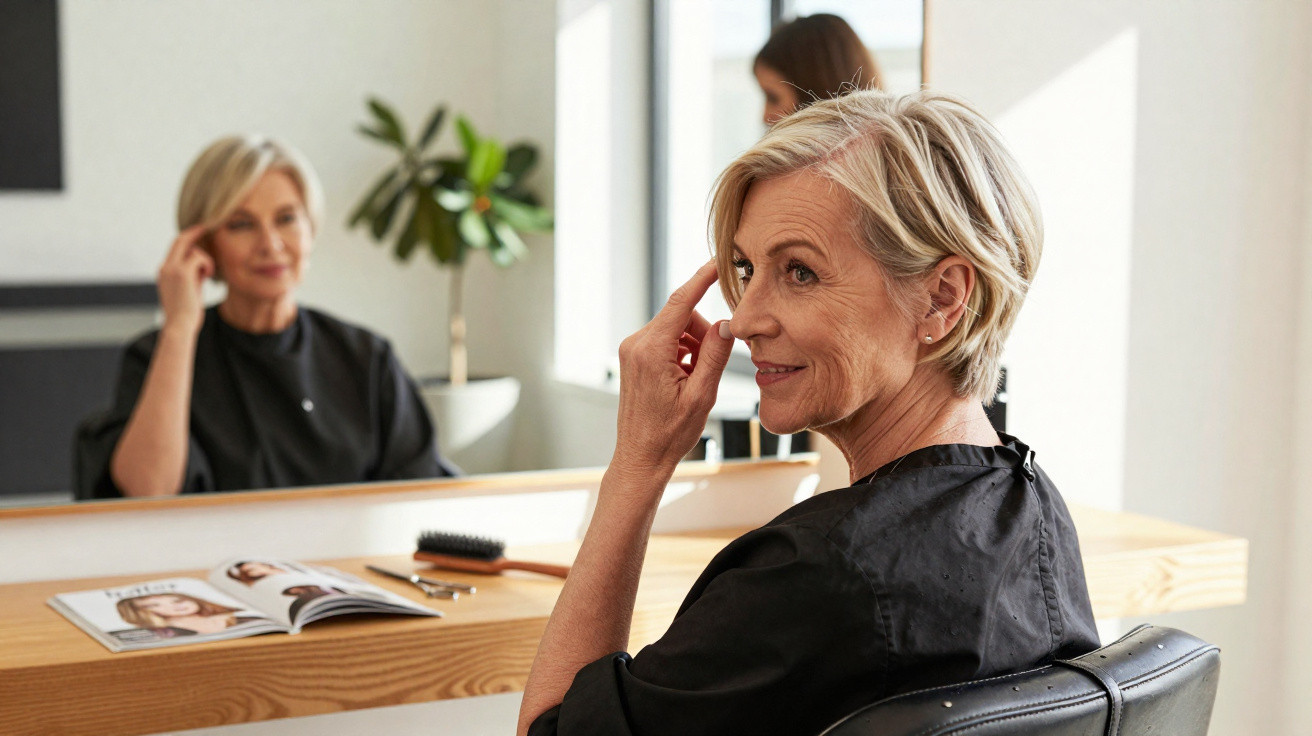
The salon was close to empty when she stepped inside, her shoulders set like she was bracing for a fight. Under the strip lights, her silver roots caught the glare; her lipstick was perfectly done. She inhaled and delivered the line hairdressers hear daily - but after 60, it can feel like a declaration: “Cut it short. Really short.”
The stylist practically beamed. They huddled over Pinterest pictures, giggling and weighing up fringes and layers like they were back at school. Forty minutes later, she walked out with a cropped, feathered pixie that picked out her cheekbones and finally made her fine hair look intentional. She even seemed ten centimetres taller.
And by the time she got home, the reactions were already rolling in.
When a bold short cut becomes a public referendum on your age
That first mirror selfie felt like a win. She dropped it into the family WhatsApp group, expecting a shower of hearts and a chorus of “You look amazing, Mum!” Instead, the replies were… complicated. A sister typed, “Wow, very drastic.” A daughter followed with a careful, “Do you like it?” A cousin chipped in: “Careful, you’ll be mistaken for Grandma’s twin.”
It wasn’t hard to read what they meant. For plenty of people, short hair on a 60-year-old woman with fine strands still looks like “giving up” - or, just as harshly, like trying far too hard to look edgy. Hair professionals call these cuts freeing. Detractors label them desperate.
Somewhere between the salon chair and the group chat, a haircut turned into a judgement call.
Spend ten minutes trawling beauty forums for “short hair over 60 fine hair” and you land in a bizarre split-screen world. On one side are stylists championing feathered pixies, soft crops and sculpted bobs as the fix for sparse hair that needs volume and a cleaner, more modern outline. On the other are commenters insisting anything above the jaw is “ageing”, “severe” or “too masculine” for a “lady of a certain age.”
The responses can sound scripted: “You’ll regret it,” “You’ll look older,” “Men prefer longer hair,” “Short hair is for grandmas or 20-somethings.” None of that appears out of thin air. It’s the leftover hum of decades where “feminine” meant long, gentle and unobtrusive.
Now, women past 60 are refusing to follow that old rulebook out loud - and it clearly rattles some people.
Beneath the debates about fringes and hemlines (or, in this case, necklines), there’s something more loaded happening. Hair is one of the last socially acceptable ways to police how women age in public. Long, coloured, carefully arranged hair signals, “I still make an effort.” A bold crop on fine, thinning hair can be read as defiance - or as a visible decision not to disguise time passing.
From a stylist’s perspective, short, structured cuts add lift and texture where fine hair naturally collapses into flat, separated strands. From a critic’s perspective, that same cut reveals the neck, the jawline and the skin’s texture - exactly the areas women are often taught to hide.
So it was never only about hair. It’s about who gets to decide what a 60-year-old woman “should” look like.
The cuts stylists love… and how to make them work on real, fine hair
Ask three talented hairdressers what tends to flatter fine hair over 60 and you’ll hear variations on the same theme: airy pixies with a longer top, soft crops that follow the head shape, and loose, layered bobs that skim the jaw. These silhouettes support the face and create height at the crown rather than pulling delicate strands downwards.
The detail that makes the biggest difference is easy to miss: micro-layers instead of chunky, blunt edges. A truly good short cut for fine hair has almost invisible engineering - tiny graduations at the nape, slightly longer pieces around the temples, and just enough fringe to blur forehead lines without turning into a heavy curtain.
When it’s done properly, you don’t notice the technique. You notice the eyes, the cheekbones, and a neck that reads as elegant rather than exposed.
The real danger isn’t choosing short hair. It’s choosing short hair without a strategy. Lots of women sit down, say “Do whatever you want,” and leave with a one-size-fits-all crop that ignores their hair’s behaviour and the reality of their routine. That’s when regret arrives - followed by the awkward grow-out and the sense of being “talked into” a look that never felt like theirs.
A decent stylist will ask how your hair dries on its own, how often you actually style it, and how you feel about your forehead, ears and neck. And let’s be truthful: almost nobody is doing mousse, a round brush and hairspray every single day the way tutorials suggest.
Your cut needs to look presentable on an ordinary Tuesday - not only on Day 1 as you float out of the salon.
“Women over 60 arrive whispering, ‘I’m scared of looking ridiculous,’” says Claire, a French stylist who specialises in fine, thinning hair. “My job isn’t to make them younger. It’s to give them a cut they can own without apologising. Confidence is worth more than five extra centimetres of hair.”
- Soft pixie with movement
Close at the nape, with longer, wispy layers through the top. A strong option if your fine hair has a touch of natural wave and you’re happy with a slightly tousled finish. - Ear-grazing crop
Neat sides, a bit more length above the ears, plus a fringe. Works particularly well if you wear glasses and if your face shape looks best when attention is drawn to the eyes. - Light layered bob
Sitting at - or just below - the jaw, with internal layers for lift. A useful in-between cut if you’re not ready for ultra-short hair but you’re fed up with limp, shoulder-length lengths.
Any of these can be “loud” or understated depending on your colour, your styling and how crisp you keep the edges. The uproar is rarely about the shape alone - it’s about that shape clashing with what people expect a woman your age to choose.
Between bravery and backlash: who are you cutting your hair for?
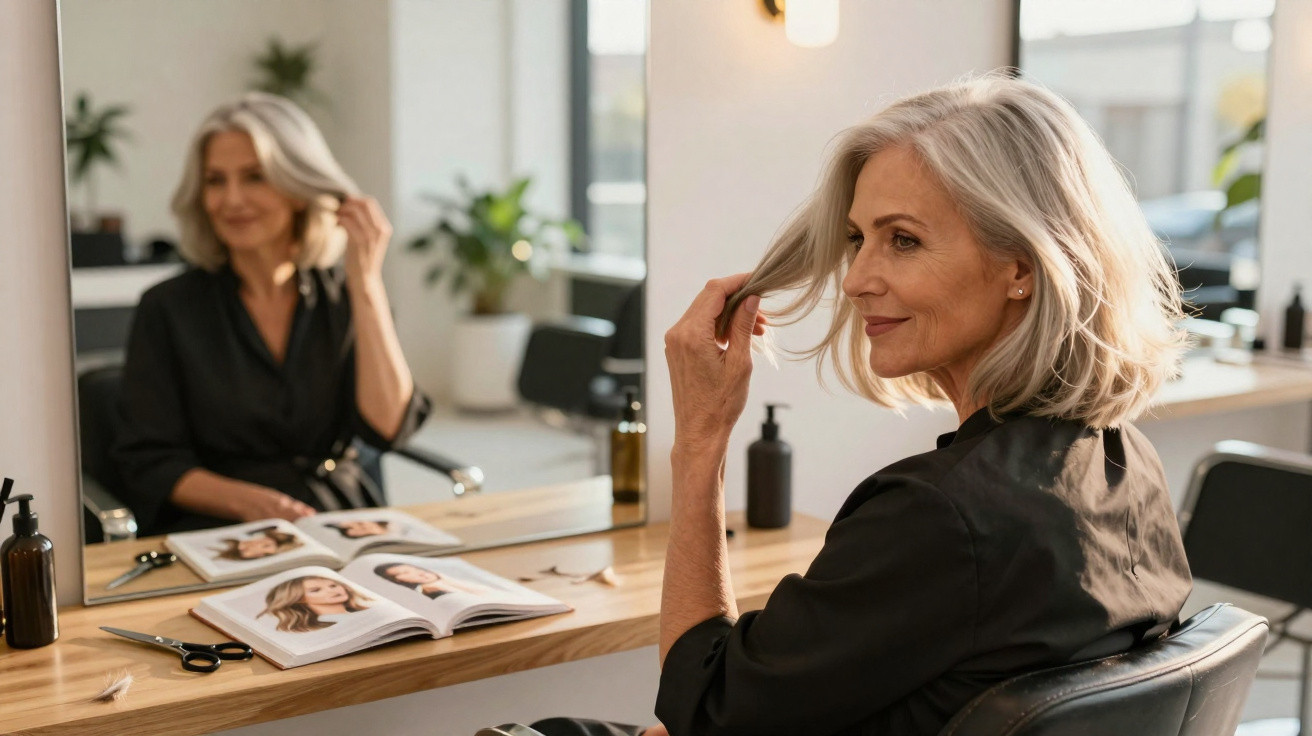
Speak to women who’ve gone for a dramatic chop after 60 and a familiar rhythm comes up. The first few days feel electric. Showers are quicker. Pillows stop wrecking your hair overnight. Strangers in supermarkets lean in to say, “Love your hair - so chic.” Friends of a similar age often respond with genuine admiration, sometimes with a flicker of envy.
And then come the other comments. A neighbour murmurs, “I preferred you with longer hair - it softened your face.” A colleague jokes that you’ve joined the “granny cut” club. An ex-partner says nothing at all. Suddenly, every reflection becomes a tug-of-war between the lightness you feel and the discomfort of being evaluated.
Most people know that moment: one offhand remark threatening to poison something you were proud of.
Here’s the blunt reality: hair has never been just about looking nice. It’s about fitting in. Long, coloured, shoulder-length hair says, “I’m still following the rules.” A short, textured, silver crop on fine hair says, “I’m making my own.” That shift can feel exhilarating - and it can also feel isolating.
Some women decide short cuts simply aren’t “worth the drama” and quietly grow them out. Others lean in, try sharper silhouettes and bolder colours, and end up feeling more themselves at 65 than they ever did at 35. Neither choice is a defeat.
The only thing that matters is that the decision comes from your life - not from someone else’s idea of what’s age-appropriate on Instagram.
The so-called scandal of “embarrassing” short cuts for women over 60 says far more about our culture than it does about your hair. Who gets laughed at for trying something new on fine, thinning hair? Seldom men. Their silver buzz cuts are framed as distinguished, practical - “finally embracing it.”
When a woman opts for the same simplicity, she’s accused of behaving like a teenager or an old lady, depending on who’s talking. Yet the second she thinks, “I am not my hair, but I can enjoy it while I have it,” something shifts. Expectations loosen.
Maybe the truly age-inappropriate thing isn’t the haircut at all, but the belief that at 60 your role is to fade quietly into the background.
| Key point | Detail | Value for the reader |
|---|---|---|
| Choose structure over length | Short, layered shapes give fine hair lift, while heavy, long cuts drag it down | Helps you understand why your current length may be aging you more than a bold crop |
| Plan the cut around real life | Discuss styling time, natural texture and “bad hair day” options before the chop | Reduces regret and grow-out frustration after going short |
| Define your own “age appropriate” | Expect conflicting reactions and decide whose opinion truly counts | Supports you in choosing a haircut that boosts confidence, not compliance |
FAQ:
- Is short hair always better for fine hair over 60? Not always, but cuts above the shoulders with light layering tend to create more lift and fullness. What matters is avoiding heavy, blunt lengths that pull fine strands flat and emphasise thinning.
- Will a very short cut make me look older? It can, if the shape is too harsh for your features or colour is flat. Soft edges, movement on top and a flattering shade around the face usually make the overall impression fresher, not older.
- How often should I trim a short, fine cut? Every 4–7 weeks, depending on how fast your hair grows and how precise the shape is. Fine hair loses its structure faster, so small, regular trims keep it from collapsing.
- Can I wear a pixie if my hair is thinning at the crown? Yes, if the top is cut with gentle layers and not too short. A bit more length and smart texturising can disguise sparse areas better than longer, separated strands.
- What if my family hates my new short hair? Give everyone, including yourself, a few weeks to adjust. If you like how you feel in the mirror and daily styling is easier, that comfort often matters more than initial reactions.


Comments
No comments yet. Be the first to comment!
Leave a Comment