
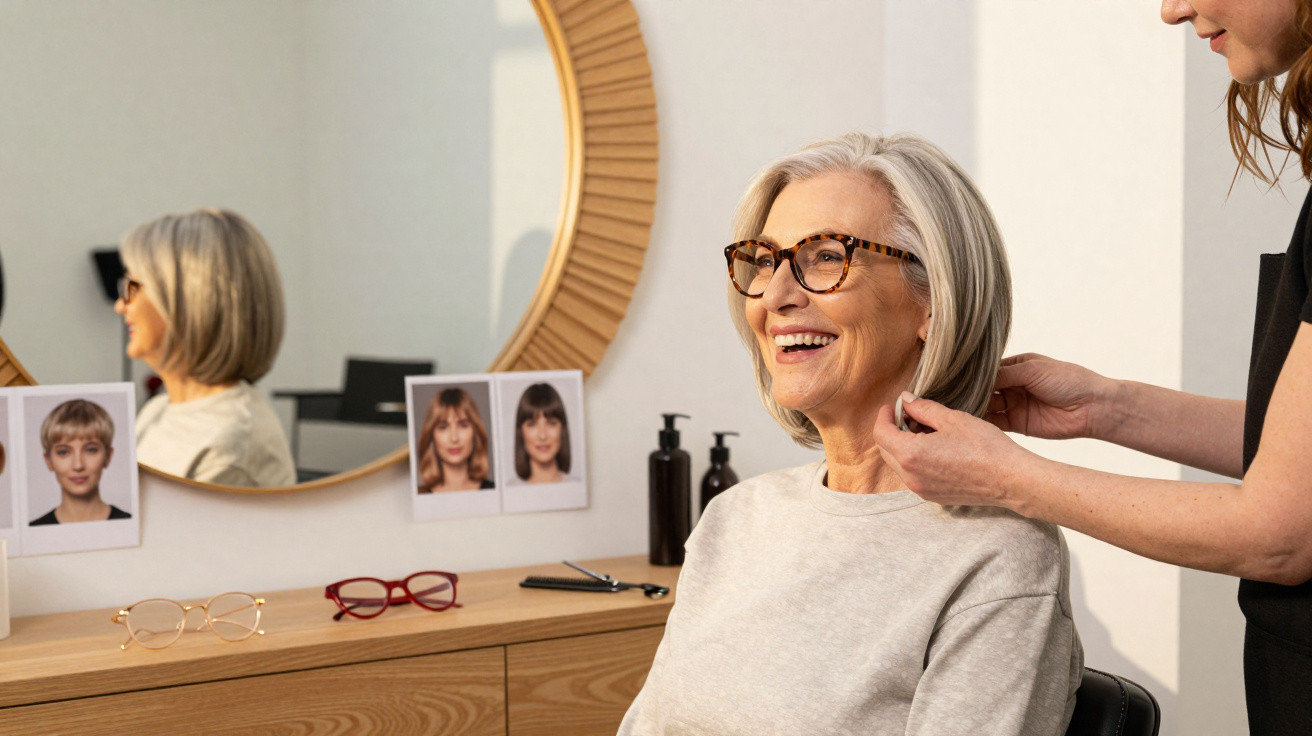
The salon was already busy when Jeanne nudged the door open, her spectacles slightly misted from the winter air outside. At 72, she wore a grown-out silver bob and carried that familiar pause you notice in women who haven’t altered their hair for decades. Her gaze went straight to the mirror, then to the frames perched on her nose. “I’d like something that doesn’t make my face fall,” she murmured to the hairdresser - half teasing, half in earnest. Around her, other women in their seventies were making the same quiet inventory: hair, lines, lenses, jaw.
A single, unspoken thought seemed to hang between the chairs.
Can a simple haircut, chosen with your glasses in mind, really make you look younger?
The rule nobody tells you: your frames are part of your haircut
After 70, the biggest shift isn’t only the cut itself. It’s the partnership between your hair and your glasses. Many women come in talking about a “new style”, yet overlook the fact that their frames are the strongest line on their face. When a hairstyle competes with that line instead of working alongside it, features can look sharper and more severe.
Our eyes are drawn to contrast. Pair blunt, straight fringe with square frames, for instance, and the upper face can start to feel heavy, making drooping lids more noticeable. By contrast, softer layers that mirror the curve of your glasses can genuinely change the mood of the face.
That’s why the most rejuvenating haircuts after 70 begin with a single question: what shape sits on your nose every day?
Consider Maria, 74, a retired teacher, who arrived with a picture of a celebrity pixie cut. In the photo, the model wasn’t wearing glasses. In everyday life, Maria relies on thick rectangular frames for varifocals. The first attempt at her pixie - too short and tight at the temples - fought with the frames and made her look more stern than she felt.
Her hairdresser paused, lifted Maria’s glasses into place and reassessed. Attempt two: a pixie kept slightly longer, with a feathery fringe that skimmed the top of the frames and a touch more height at the crown. All at once, the forehead looked gentler, the cheeks seemed raised, and the glasses read as a style choice rather than something purely practical.
She left the salon saying, with a laugh, “I’ve had these glasses for ten years and it’s the first time they look intentional.”
From a visual point of view, the face is made up of horizontal and vertical lines. Glasses add two strong horizontals: one across the eyes and another across the top of the cheeks. A well-chosen cut after 70 won’t stack more weighty horizontals in the same zone - it will interrupt or soften them. That’s why very blunt bobs that sit exactly at chin height can, with thick frames, sometimes pull the face down.
What tends to flatter more? Styles that introduce diagonals and lightness: a side-swept fringe that glides towards the corner of the frames, layered sides that uncover cheekbones, or a neckline that reveals a little nape. Age doesn’t rule out modern cuts - it simply penalises anything that feels rigid around the lenses.
Treat your frames as the first sketch, and your hair as the watercolour that finishes the picture.
The 4 best rejuvenating haircuts after 70 when you wear glasses
Top of the list is the soft, layered bob that falls somewhere between the jawline and the base of the neck. Not the old helmet-like bob, but an airy version with lightly tapered ends. With glasses, it keeps the lower face open and avoids the “square-on-square” look that can age so many women.
Ask your hairdresser for delicate layers around the face, particularly near the temples. If you wear round or oval frames, a gentle inward bend through the lengths can make the cheeks appear lifted. If your frames are more rectangular, a hint of outward movement prevents the overall effect from becoming too angular.
This bob looks especially good with a longer, weightless fringe that just grazes the top of the glasses without hiding the eyebrows.
Second place goes to the soft pixie with volume through the top. Not a very short, military crop that can harden the face, but a more feminine pixie with extra length at the crown and lightly textured sides. On a woman over 70 who wears glasses, it shows off the neck, opens the eye area and brings an immediate sense of energy.
Picture Françoise, 79, in small round frames and a shy smile. For years she tucked herself behind a flat, mid-length style held back with a clip. When her hairdresser reshaped it into a gentle pixie, adding a light quiff above the frame line and softening the sideburns, the change was startling: the glasses looked less heavy, the mouth seemed less tight, and the eyes were suddenly much clearer.
She didn’t look younger “at all costs”. She looked awake. And that changes everything in the mirror.
Third, a shoulder-length cut with curtain fringe can work brilliantly - especially if your frames are thin or understated. The length sits between collarbones and shoulders, with movement that guides the eye downwards and away from the lower face, where skin may feel less firm. A curtain fringe, split down the middle or slightly off-centre, frames the lenses rather than crashing into them.
Fourth, a structured short cut paired with a long side-swept fringe is a strong choice if your frames are bold or colourful. The sides are kept tidy along the temples, while a generous side fringe runs diagonally across the forehead, just brushing the frames. That diagonal acts like a subtle lift: it breaks up rigid horizontals and softens expression lines.
Be realistic: hardly anyone styles their hair perfectly every single day, but even finger-styled, these four cuts tend to hold a modern, flattering shape.
How to talk to your hairdresser so your cut and glasses really work together
Arrive wearing the glasses you use every day - on your face, not tucked into your handbag. Sit down and look straight at yourself in the mirror before anyone touches a strand. Then lift and lower your chin and turn your head left and right. That small habit shows you exactly where the frames divide the face, where the hair feels bulky, and which areas you’d like to brighten.
When your hairdresser comes over, skip vague lines like “make me look younger” or “I’ll leave it to you”. Instead, be specific: “Here, by the corner of my glasses, I feel weighed down. Here, above the frame, I want it softer.” Clear direction leads to a more precise cut - and after 70, every millimetre around the eyes matters.
Also ask them to cut and keep checking the length with your glasses on, not off. For fringes and side pieces, that one detail can change the whole result.
Many women over 70 feel the need to apologise for wanting something different: “At my age, does it really matter?” It does, for a simple reason - you still meet your reflection every morning. A poorly chosen cut can amplify tiredness; a good one can gently blur it. That isn’t vanity; it’s comfort.
A common misstep is requesting the exact haircut from a photo of someone not wearing glasses, and then feeling disappointed when the frames seem to “age” the look. The problem isn’t you - it’s a mismatch between three things: the cut, the glasses and the face. Another classic error is holding on to very long hair “because my husband likes it”, while pinning it up daily to keep it off the frames. That often drags the features down and exposes the forehead too harshly.
You’re allowed to say: “I want something practical that I can style in three minutes, but that doesn’t close my face behind my glasses.”
“Past 70, the best haircut isn’t the one that erases your age. It’s the one that aligns your hair, your frames, and the woman you’ve become,” says Claire, a Paris-based stylist who works mostly with clients over 65.
- Soft layered bob (jaw to neck) - Best with round or oval frames. Light layers around the face, ends slightly curved. Brings movement without hardening the jawline.
- Feminine pixie with crown volume - Ideal with medium or thicker frames. Short at the nape, airy on top. Opens the eyes and showcases the glasses as an accessory.
- Shoulder-length with curtain fringe - Perfect with discreet or rimless glasses. Diffuses attention from lower face, draws focus to eyes and cheekbones.
- Structured short cut with long side fringe - Great for bold or coloured frames. Neat sides, diagonal fringe that elegantly crosses the upper line of the glasses.
A new age of style: wearing your glasses like jewellery, not a burden
Something changes when women over 70 stop treating their glasses as something to conceal and start wearing them the way you’d wear earrings or a necklace. The haircut stops being camouflage and becomes a frame around a frame - and that’s when softness returns. Silver hair, fine wrinkles, the choice of frames and the shape of the cut begin to tell the same story.
Most of us know that moment - catching your reflection unexpectedly in a shop window and thinking, “Is that really me?” The right cut, designed around your glasses, can turn that jolt into a calm “Yes, that’s me, actually.” Not younger at any price - simply more aligned.
Perhaps real rejuvenation isn’t about subtracting years, but about adding intention. What if your next appointment was less about age and more about claiming your place - glasses included?
| Key point | Detail | Value for the reader |
|---|---|---|
| Think in duos: hair + glasses | Choose cuts that echo or soften the lines of your frames | Face looks more open and harmonious, without aggressive “makeovers” |
| Favor soft movement and diagonals | Layered bobs, curtain fringe, side-swept pixies, structured short cuts | Visual lifting effect, less emphasis on sagging areas |
| Communicate differently at the salon | Show your glasses, point precisely to “heavy” zones, ask for checks with glasses on | Higher chance of leaving with a truly rejuvenating, easy-to-live-with cut |
FAQ:
- Which haircut is best if I have fine, thinning hair and wear glasses?
A soft pixie with a bit of volume on top is often ideal. It gives the illusion of density, avoids flat lengths that clash with the frames, and is light enough not to flatten the roots.- Can I wear a fringe after 70 if I have varifocals?
Yes, but go for light, airy fringe or a curtain fringe. The length should sit just above or gently touching the top of the frames so it doesn’t interfere with your vision or weigh on the eyes.- Do very long cuts still work with glasses after 70?
They can, but they tend to drag the face down, especially when constantly tied back. Slightly shortening to shoulder length with movement usually gives a fresher, more dynamic look.- What colour works best with silver hair and glasses?
Soft highlights in beige, pearl, or light sand tones around the face can brighten the eyes and frames. Avoid very stark contrasts that harden facial features.- How often should I trim my hair to keep a rejuvenating effect?
Every 6 to 8 weeks for short and mid-length cuts is ideal. Past that, shapes lose structure, and the hair can start to crowd the glasses and weigh down the expression.
Comments
No comments yet. Be the first to comment!
Leave a Comment