
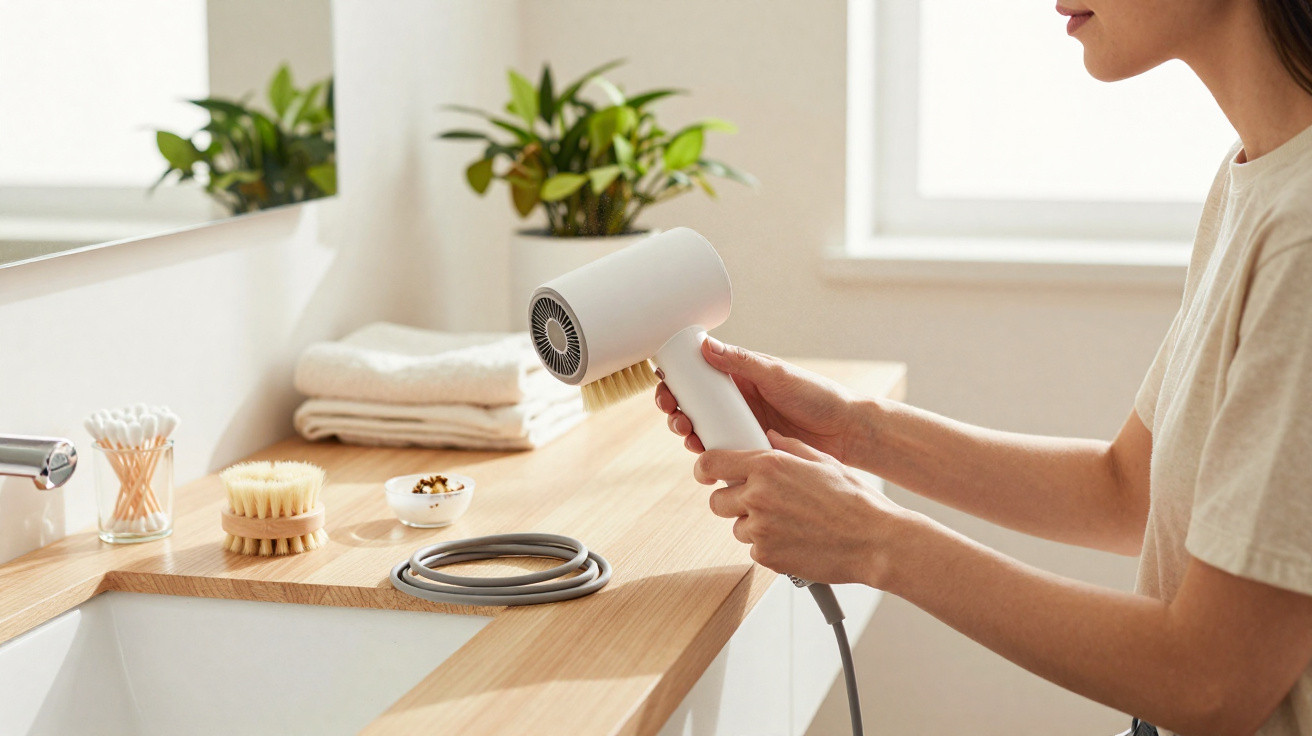
The hairdryer is resting on the edge of the basin, still warm from the last time you used it. Behind the rear grille, between the little slots, there’s a grey film of dust, hair, and something that looks suspiciously like make-up powder. You know that look: slightly gross, slightly embarrassing-because you also know the question you’ve been avoiding. When did you actually clean this thing last?
When you switch it on, it gives a brief wheeze. The air smells faintly scorched, with that thin hint of “this can’t be good for me”. And yet you use it again the next morning, like millions of other people. Then, one day, it finally gives up-usually at the exact moment you’re already running late.
Why your hairdryer is quietly struggling - and you only notice late
When you’re half-asleep in front of the mirror, a hairdryer rarely feels like a risk. It’s more like a trusty bit of kit that’s supposed to work, no questions asked. But at the back, around the air-intake grille, everyday life builds its own little ecosystem of dust, fabric fluff, and hair. Each time you use it, that layer gets thicker, airflow gets tighter, and the unit runs hotter. A harmless styling tool slowly turns into a small heat-stress machine.
Often, it only gives itself away once the warning signs become hard to ignore: a faint whistling sound, a sharp smell, or a plastic section that’s suddenly hotter than your patience on a Monday morning.
A hairdresser once said she can spot “neglected” hairdryers instantly. The rear grille will be coated in a grey mat, and the nozzles at the front will feel tacky from hairspray. During one of her courses, she put a completely clogged hairdryer on the table and asked people to guess its age. Most of them went for five or six years. In reality, it wasn’t even two years old-it had simply never been cleaned.
We all recognise that moment when a device suddenly loses power and we’re shocked, even though it’s been “asking” for help for months. Insurers’ statistics repeatedly show that small electrical appliances in the bathroom are among the more commonly underestimated sources of household fires.
From a technical point of view, it’s straightforward. A hairdryer uses a heating element and a small, fast motor that forces air over it. If the rear grille becomes blocked, the motor has to work harder to push the same amount of air through. At the same time, heat stays trapped inside for longer. Components wear out, cables age more quickly, and safety cut-outs can trip sooner. The results can include sudden failure, flickering behaviour, a burning smell-or, in the worst case, a small short circuit.
Let’s be honest: nobody takes their hairdryer apart after every use and lovingly wipes it out. But this exact neglect is why a device that could easily last five to seven years sometimes gives up after only two.
The gentle clean: how to get your hairdryer clean without killing it
The first step sounds obvious, yet it’s the one people skip most: unplug it. Not halfway, not “I’ll be careful”-properly out of the socket.
After that comes the part that can feel almost calming. Many hairdryers have a removable rear filter or grille. Carefully unclip it, pull it off, and take a close look. You’ll likely be surprised by how much has collected there. Use a soft, dry toothbrush or a small, fine brush and lightly sweep the dust out of the slats. No water, no harsh cleaners-just gentle, mechanical cleaning, as if you were brushing down something delicate. Suddenly, the appliance can breathe again.
It’s very tempting to take a damp cloth and wipe straight over the ventilation slots-or even try to clean inside the hairdryer. That’s where the classic mistakes happen. Moisture inside can trigger corrosion or speed up damage to small components. A better approach is to work dry first, then (at most) wipe the exterior with a barely damp microfibre cloth.
Many people, for convenience, spray glass cleaner straight onto the casing. That’s a bad idea because liquid can run into openings where you can’t control it. Another common misstep is poking around the vents with sharp objects (toothpicks, hairpins, tweezers). That can bend the grille or even touch the fan. “Gentle” here isn’t about being nice-it’s about extending the life of your hairdryer.
An experienced electrician once put it like this:
“Most hairdryers don’t die because they’re old-they die because nobody treats them like an electrical appliance, and instead treats them like an unbreakable brush with a cable.”
Once you think of it that way, basic care starts to feel like common sense. It helps to turn it into a small routine-say, a quick check every few weeks on a Sunday. The key points are:
- Unplug the plug before you touch anything
- Remove the rear grille and clean it dry with a brush/toothbrush
- Don’t use liquids anywhere near the ventilation slots
- Check the cable regularly for kinks or bare patches
- If you notice a burning smell, stop immediately and don’t “just finish drying quickly”
How often you actually want to clean your hairdryer - and what it says about you
If you blow-dry your hair every day, you’re effectively living in a fine cloud of micro-particles you barely notice. Face powder, hairspray, dry shampoo, towel fibres-all of it gets pulled in and ends up reliably inside the hairdryer.
A realistic schedule for frequent users is a quick clean about once a month. If you only use it now and then, every two to three months is typically enough, depending on how dusty your bathroom is and how many styling products you use. It’s not a strict programme-more like cleaning the oven: at some point, you just realise it’s time.
It gets especially interesting the next time you’re in a hotel and you find yourself looking at the hairdryer’s grille, wondering how many guests before you never gave it a second thought.
| Key point | Detail | Benefit for the reader |
|---|---|---|
| Regular dry cleaning | Once a month, remove the grille and clean with a brush/toothbrush | Longer lifespan and less burnt smell |
| Avoid water inside | Only wipe the outside with a lightly damp cloth; no cleaners near vents | Lower risk of short circuits and faults |
| Watch for warning signs | Take unusual noises, heat, and smells seriously | Earlier protection from damage to the device and to you |
FAQ:
- How often should I clean my hairdryer? If you blow-dry almost every day, quickly clean the rear grille about once a month. With rare use, every two to three months is usually enough, depending on dust levels and product use in the bathroom.
- Can I clean the hairdryer with water or cleaning products? Only wipe the outside carefully with a slightly damp cloth. Don’t get liquids into slots, onto the grille, or towards the fan-don’t use glass cleaner either.
- What should I do if my hairdryer smells burnt? Switch it off immediately, unplug it, and let it cool down. Clean the grille and check whether the smell returns next time. If it does, it’s better to dispose of it or have it checked than to keep using it.
- Can a dirty hairdryer really become dangerous? A heavily clogged hairdryer can overheat, suffer internal damage, and in extreme cases contribute to a smouldering fire-especially if it’s running on a flammable surface or left unattended.
- Does compressed air help with cleaning? Used carefully, compressed air can blow dust out of the slots-ideally outdoors or over the basin. Don’t hold it too close and don’t blast one spot for too long, so nothing inside comes loose or gets damaged.






Comments
No comments yet. Be the first to comment!
Leave a Comment