
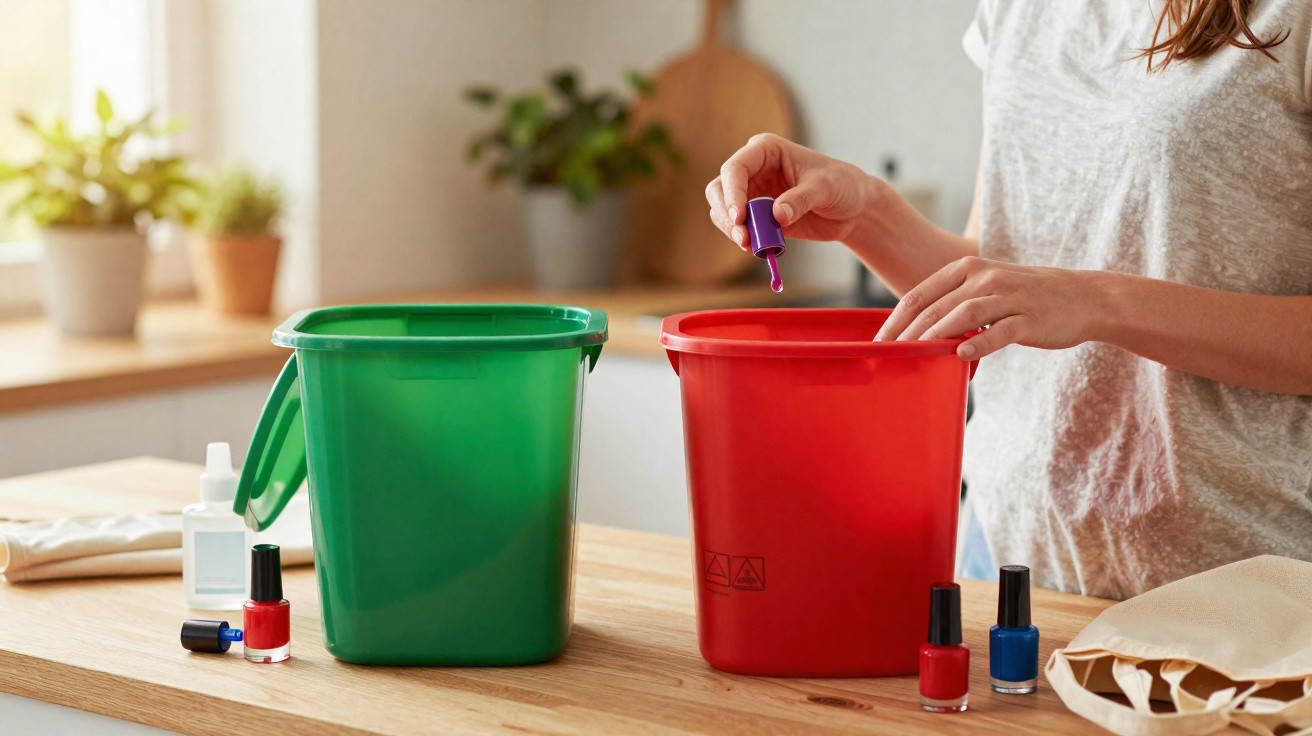
Many people regularly have a clear-out in the bathroom and, without thinking twice, drop old nail varnish into the household rubbish or the glass recycling. The classic red has gone solid, the nude shade is long past its moment-so into the bin it goes, job done. That’s exactly where the trouble starts: in legal terms, nail varnish is not treated as ordinary cosmetic waste, but as a hazardous residue that has to be disposed of under strict rules.
Why the little glass bottle does not belong in the glass recycling
The misunderstanding about glass: “Surely it’s all recyclable”
At first glance, a nail varnish bottle looks like a miniature wine bottle: glass plus a lid, so it feels reasonable to put it in the bottle bank. It sounds environmentally responsible and seems like the right thing to do. Recycling plants, however, treat it very differently.
Glass processors separate materials with great precision. Cosmetic packaging glass can differ chemically from drinks bottles and jars: it may be thicker, melted differently, coated, or coloured in a way that doesn’t match food-grade glass. Even small amounts of the wrong material can spoil an entire batch. Because food and drink packaging requires especially pure recycled glass, nail varnish bottles can cause real disruption.
Too small, too contaminated, too risky for sorting machinery
The glass type is only part of the issue. These bottles are tiny, so they can slip through screens and shaker sieves in sorting systems. Sensors that separate items by colour and material also struggle when there are residues and mixed components.
“The combination of glass, a plastic brush and chemical remnants makes nail varnish bottles a contaminant in the recycling stream-not usable recycled glass.”
On top of that, varnish residue clings to the inside, along with solvents and often glitter particles. This contaminates the recycled cullet. That recycled material is meant to become hygienic bottles again later on-and with chemical traces present, that simply isn’t permitted.
Nail varnish as an environmental issue: what is actually inside the bottle
A solvent cocktail, not ‘harmless colour’
Behind fashionable shade names sits a fairly aggressive chemical mix. Many varnishes contain-or for years contained-substances regarded as critical, such as toluene, formaldehyde or certain plasticisers. Even newer “free from” formulations often still rely on ingredients that are not unproblematic, including specific solvents and synthetic resins.
If these substances end up in general waste and are incinerated, poor handling can lead to toxic fumes. Modern plants can manage this, but only when they are designed for such waste and the quantities remain predictable. When nail varnish is disposed of incorrectly on a large scale, the workload and costs for local authorities rise noticeably.
In landfill, the potential harm can be even greater. Substances may seep into soil over time, pollute groundwater and accumulate in the environment. What feels like “just one small bottle” in a bathroom becomes, across the country, a difficult-to-control source of chemicals.
High fire risk in refuse lorries and at waste facilities
Nail varnish is highly flammable, and matching remover is too. It is usually stated on the bottle, but it’s easy to overlook in day-to-day life. In reality, bottles often end up in residual waste, then get compressed in refuse lorries and sometimes smashed.
“Leaking solvents, pressure, friction and other chemicals in the same bin-this mixture can, in extreme cases, trigger fires.”
Waste workers repeatedly report smoking sacks, small explosions or smouldering fires in the load area. At incineration sites, the risk increases wherever waste is stored temporarily and moved around. Disposing of nail varnish incorrectly doesn’t just harm the environment-it can also put people working in waste and recycling at risk.
Empty or half-full: the difference that decides how it must be disposed of
The theoretical exception: completely empty and properly cleaned
In theory, a bottle that is totally empty and thoroughly cleaned could be treated like ordinary residual waste. In some areas, councils may even accept it in glass recycling in individual cases. In practice, that situation is rare.
The neck of the bottle is narrow and the varnish is thick and sticky. To clean it properly you would need substantial amounts of nail varnish remover or specialist thinner. That merely shifts the problem into another container-the chemical waste still exists.
The reality: dried residue, thick sludge, half-used bottles
Most bathrooms are more typical: there’s a leftover pool at the bottom that the brush can hardly reach, and the varnish has become thick or crumbly. In that condition, the bottle is legally classed as hazardous waste because it still contains chemicals-whether they are liquid or dried.
“As soon as there is still varnish in the bottle, it is no longer treated as packaging but as a chemical container.”
That triggers stricter rules. The contents must not be poured down the drain, and the container does not belong in the standard bin. Local authorities generally categorise nail varnish as a “problematic small quantity” from private households-comparable to leftover paints, thinners or aerosol cans.
An expensive misunderstanding: which fines can apply
The wrong bin can cost around €35
Many towns and cities have stepped up checks. Collection crews and recycling teams are expected to flag incorrect items quickly because contamination can make entire loads unusable and push costs up. If chemicals are found in residual waste or recycling, it may be treated as an administrative offence.
If you are caught, many regions impose a fine of around €35 per incident. That is a surprisingly high amount for one old bottle-particularly when it was tossed into the bathroom bin almost automatically.
Higher amounts for repeat offences, non-payment and illegal dumping
If payment is missed or breaches occur repeatedly, the figure can rise significantly. €75 can become due quickly, and in some areas it can be more. It becomes far more expensive if chemicals are left in a park, at the edge of woodland or on a car park.
“Anyone who leaves problem substances in nature or next to recycling containers risks fines of several hundred euros-and, in extreme cases, criminal proceedings.”
At that point, a simple comparison is sobering: the cost of a single fine could buy several new bottles of high-quality nail varnish-and you could still dispose of them correctly at the end.
The right place to take old nail varnish
The special category: ‘problematic small quantities’
Within household waste systems, nail varnish sits in a group often labelled “household hazardous waste”, “problem waste” or “small hard-to-dispose quantities”. This category typically includes:
- old wall and furniture paints/varnishes
- solvents and thinners
- adhesives, including superglue
- cleaning products with hazard symbols
- plant protection products and pesticides
- nail varnish, nail varnish remover and similar products
These materials are accepted at household waste recycling centres (HWRCs), council hazardous-waste collection points or mobile collection vehicles. Specialists then sort the waste, group compatible materials, and send them to dedicated facilities where they are incinerated at very high temperatures with appropriate filtration.
How to find the correct collection point
The most straightforward option is usually your local recycling centre (HWRC). Almost every council operates at least one. There is often a separate area or container specifically for chemicals, and staff can point out exactly where nail varnish bottles should go.
Many councils also run mobile hazardous-waste collections. Collection vehicles park for a few hours at set locations-for example near the town hall or on market squares. Dates and times are typically listed in the council waste calendar or on its online portal.
Before you throw it away: giving old varnish a second life
Rescue thickened varnish instead of disposing immediately
If a favourite shade has only thickened slightly, it doesn’t necessarily need to go straight into hazardous waste. Specialist nail varnish thinner can often improve the texture again. Important: do not use ordinary nail varnish remover, as it often damages the formulation and reduces shelf life.
Add a few drops of thinner, then roll the bottle between your palms rather than shaking vigorously-this helps avoid air bubbles. Done properly, it can extend usability noticeably and reduce waste.
Pass it on or use it creatively
Colours you no longer want but that still apply well can be given away. Friends, neighbours, community groups or swap schemes often welcome usable cosmetics, provided they are hygienic and in good condition.
If you enjoy crafts, nail varnish can also be repurposed: marking metal parts, colour-coding keys, painting small decorations, labelling garden tools or decorating stones. That way the bottle provides some creative value before it eventually goes to hazardous-waste collection.
Practical nail varnish tips for everyday life
How to cut waste, costs and hassle
A few simple habits can greatly reduce the chance of throwing it in the wrong place-and the risk of fines:
- Buy smaller quantities: choose smaller bottles you will realistically finish.
- Store it cool and dark: this helps the varnish stay fluid for longer.
- Choose colours deliberately: trends are tempting, but classic shades usually get used more.
- Set up a ‘hazardous items’ box: keep a box in a cupboard, shed or utility area for chemical products until a trip to the recycling centre is worthwhile.
- Check the council waste calendar: note mobile collection dates and hand over several items at once.
Treat nail varnish for what it really is-a small chemistry set in a glass bottle-and safer choices follow automatically. That protects the environment, public health and, ultimately, your own budget.





Comments
No comments yet. Be the first to comment!
Leave a Comment