
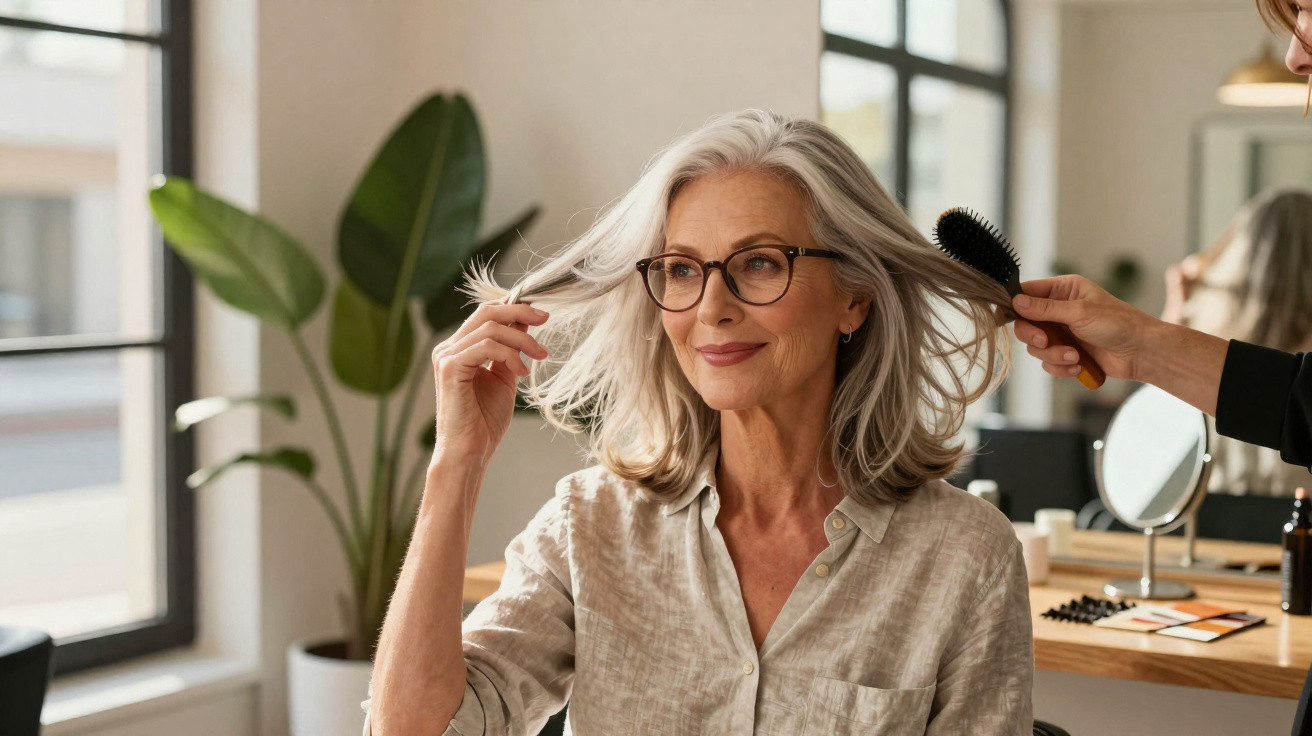
On a Saturday morning in a hair salon, it can feel like a miniature social stage. A woman in her early 60s sinks into the chair, lets her handbag slide to the floor, and jokes to the hairdresser: “Do what you want, but don’t make me look like someone’s grandma, okay?” Nearby, a few clients give quiet, knowing nods. You can sense what’s riding on it for each of them. Hair isn’t merely hair: it’s age, temperament, confidence, and all those tiny verdicts you catch in the mirror when you’re not quite ready.
As the scissors get going, she winces when the first lock hits the floor, then gradually eases.
The deeper worry isn’t getting older. It’s appearing as though you’ve stopped trying.
Granny mistake n°1: The ultra-short, stiff cut that hardens the face
Most stylists will tell you the same thing: after 60, a very common impulse is to cut everything right back. Very short, very functional, hardly any styling required. On paper, it sounds sensible. In reality, it can set the face, reveal every line, and create that dreaded “helmet” look.
Short hair isn’t the issue. The problem is when it becomes too short, too straight and too engineered. With no lift, no softness and no movement where it matters, a style can switch from current to “granny-ish” in seconds.
One woman described to me what she still calls the worst cut she’s ever had. At 63, she went into a neighbourhood salon and said, “I’m tired of my hair, cut it short, I don’t want to think about it anymore.” The hairdresser heard, “Give me the classic senior cut.” Ten minutes later, she left with a tiny rounded cap, sides plastered to her head, and a fringe set stiffly across her forehead.
On the bus home, a teenager offered her a seat and addressed her as “Madam”, in that half-respectful, half-sorry way. That was the moment she realised: the haircut had added a decade. A fortnight later, she booked elsewhere and pleaded for a result with more softness, more asymmetry, more air.
After 60, the face shifts: the jawline becomes gentler, cheeks can look a touch more hollow, and the skin catches light in a new way. An ultra-short, rigid shape tends to deepen shadows rather than soften them.
A better option is a short cut that still has give: feathered or tapered ends, a little height at the roots, and pieces that can sit slightly forward or sweep to the side. Hair that moves makes the face look like it’s still in motion too. That visual cue adds energy and a youthful impression, without trying to pass for 25.
Granny mistake n°2: Clinging to an old length and color that no longer suits you
The opposite pitfall is just as common: keeping hair long no matter what, with the same outline, the same parting, and the same colour you’ve had since 1998. It often comes from longing for “how I used to look”. But heavy, dated length can pull the features down, particularly once the hair starts to thin or loses density.
The “granny” feeling shows up when hair and face are clearly telling two different stories. The face has lived. The hair is stuck in an earlier chapter.
I saw this sharply with a woman I interviewed for a piece on embracing silver hair. She was 67 and wore a dark-brown dye, pin-straight, down to mid-back. From behind, she could have passed for someone in her 30s. From the front, the mismatch was stark: her skin tone had changed, her brows were lighter, and the colour read flat and severe. People constantly asked if she was tired.
Then her granddaughter asked, with complete honesty: “Grandma, why is your hair darker than mine?” That single question pushed her to soften her approach. She chose a long bob just above the shoulders, with gentle highlights to blur the grey. Same woman, same face - but suddenly she looked calmer, lighter, and more in step with herself.
This isn’t about forbidding long hair after 60. It’s about steering clear of lengths and colours that battle your current texture and complexion. Very dark, solid colour - especially black or an intense brown - can make features look harsher and draw attention to under-eye shadows. Extremely long, wispy ends can also underline the loss of volume at the crown.
A fresher, younger-looking result usually comes from a lighter, more nuanced tone around the face, paired with a length that still moves rather than dragging down. Think collarbone length, shoulder-skimming cuts, or a fluid mid-length style. The hair frames the face instead of swallowing it whole.
Granny mistake n°3: Playing it “too safe” with styling… or giving up entirely
A quieter mistake often creeps in: styling that’s overly fixed, or no styling whatsoever. The classic version is the weekly blow-dry set in place and left untouched. At the other extreme: “I just tie it back, I don’t have the energy to think about it.” Both send the same signal - hair is something to restrain or conceal, rather than enjoy.
A more youthful look nearly always includes one detail that feels relaxed and unforced: a piece that falls free, a finish that looks hand-touched instead of lacquered solid.
It happens to everyone: the brush starts to feel like yet another task. You tell yourself, “I’m not going to spend 30 minutes in front of the mirror at my age.” The ponytail becomes the default, the parting hasn’t shifted in six years, and that old round brush from the 90s still creates the same bend at the ends.
And honestly, no one keeps it up every day. The glossy salon blowout in magazines? That’s occasional. Everyday reality is a couple of quick moves you can repeat when you’re rushing, plus one or two products that don’t sit unused on the bathroom shelf.
One colourist I spoke to put it perfectly:
“After 60, the goal isn’t to look younger at all costs. It’s to look awake. Hair that looks a bit lived-in does that much better than hair that looks glued in place.”
To get closer to that, small changes can make a noticeable difference:
- Shift your parting by a few millimetres to lift the roots and break the habit.
- Choose a light texturising spray instead of heavy lacquer, for soft volume rather than a hard shell.
- Add one relaxed detail: a curtain fringe, an easy wave, or a slightly tucked-behind-one-ear finish.
- Keep a bit of softness around the ears and neck, and avoid cuts that reveal everything too sharply.
- Update your accessories: a simple, modern clip or a slim headband will look fresher than an old, stretched elastic.
None of this requires a full reinvention. It’s simply a move from “controlled” to “alive”.
A hairstyle that grows with you, not against you
What truly makes the difference after 60 isn’t the number of centimetres that come off. It’s the intention behind the choice. Are you asking to fade a little, to play safe, to blend into the “after a certain age” category? Or are you aiming to show the face you have now - with softness, light, and a touch of character?
A youthful hairstyle isn’t a filter. It’s a translation. It takes what life has written on your face and says: “Here’s the best angle.”
Think of the women who inspire you at that age - the ones you notice on the street or on the train, the ones you mentally take a snapshot of. Their hair is rarely flawless. It might be slightly untidy, half-curly and half-straight. Yet there’s harmony between who they are and how they wear it.
They’ve made peace with texture changing, with colour shifting every few months, with volume coming and going. Then they work with it rather than battling it.
Maybe that’s the real step away from the “granny” cliché: not trying to look younger, not clinging to old photographs, but letting your hair move with your life instead of staying trapped in habits from twenty years ago.
There’s a wide space between the severe senior cut and the exhausted ponytail - and it’s yours to shape. You can walk into a salon and say: “I want a cut that moves when I laugh.” A stylist who’s truly listening will know exactly what you mean.
| Key point | Detail | Value for the reader |
|---|---|---|
| Skip ultra-short, rigid cuts | Opt for short styles with softness, tapered ends and movement | Softens facial features and avoids the “helmet” effect |
| Refresh length and colour | Lighten around the face and adapt length to your current texture | Creates harmony between hair, skin tone and facial structure |
| Go for “alive” styling, not fixed | Simple gestures, lightweight products, small tweaks to parting and texture | Produces a fresher, more dynamic, less “granny-ish” look |
FAQ:
- Should I avoid short hair completely after 60? Not at all. Short hair can look striking, modern and polished. The key is softness, texture and some lift at the roots, rather than a rigid, ultra-structured silhouette.
- Does going grey automatically age the face? No - not when the cut and tone are adjusted to suit you. A bright, well-shaped grey with the right contrast around the face can look fresher than a very dark, flat dye that no longer matches your features.
- What length is the most flattering after 60? There isn’t one rule for everyone, but many women suit mid-length hair around the shoulders or collarbone. It gives movement and styling options without overpowering the face.
- How often should I change my haircut at this age? You don’t need dramatic overhauls. A small update every 6 to 12 months - a fringe, a different texture, a refined outline - can keep your look current without feeling like a shock.
- Can I still wear bangs after 60? Yes, and they can be very flattering. Choose light, airy bangs or a curtain fringe, and avoid a heavy, blunt fringe that cuts across the forehead too harshly.



Comments
No comments yet. Be the first to comment!
Leave a Comment