
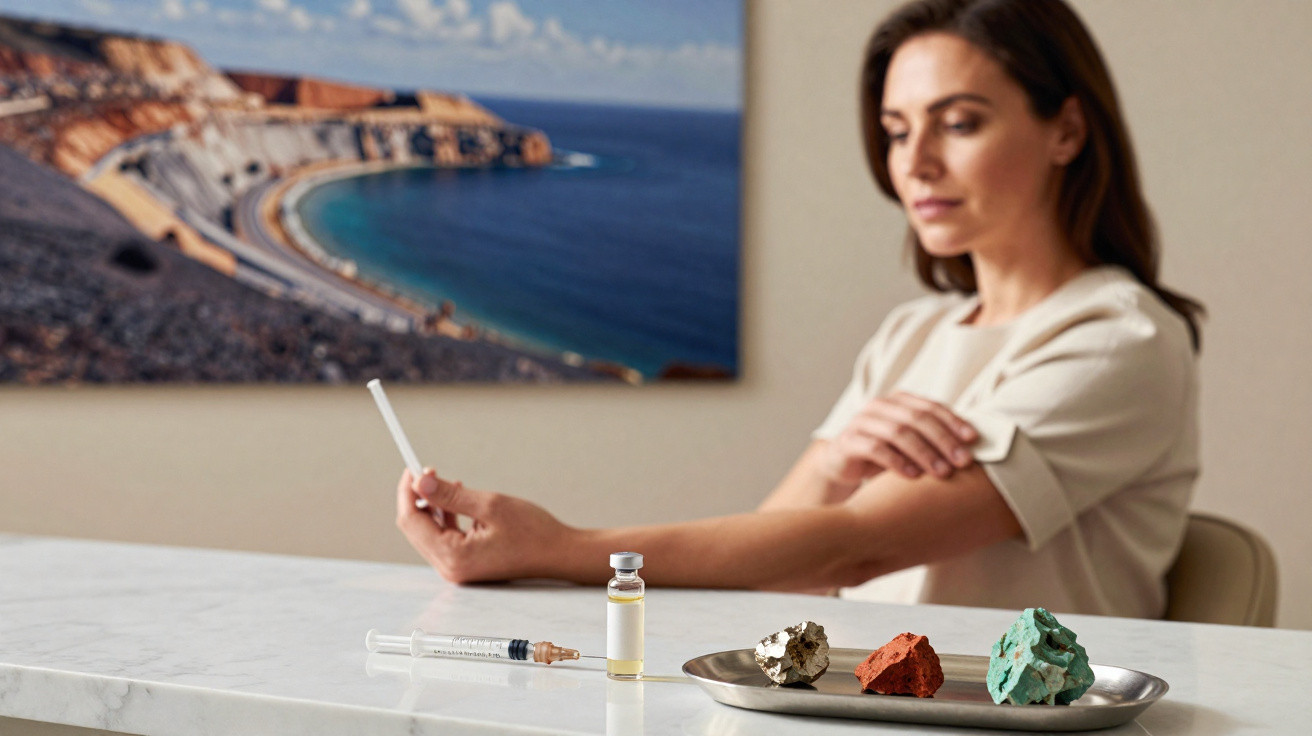
The worldwide rise in injectable cosmetic treatments and fillers is fuelled by what can feel like a near-universal desire to appear younger than we are. These procedures are most often performed on women, although more men are choosing them as well.
That assumption - that youth equals beauty - carries a geological price tag. Each year, more than 14 million stainless steel hypodermic needles are used for cosmetic treatments globally and then thrown away. The metals needed to make those needles are classed as critical.
From ore to stainless steel needles
Stainless steel is an alloy of iron and chromium, with nickel added to most grades. The iron in a needle may have originated in the Pilbara region of Western Australia. It began forming more than a billion years ago, when oxygen produced by the photosynthesis of early bacteria reacted with iron in ancient oceans, before settling and accumulating on the seabed.
The chromium might have been sourced from South Africa’s Bushveld Complex - an igneous intrusion created when magma rose into the Earth’s crust through vertical fractures. As it cooled, chromite separated out, crystallising into distinct layers.
Nickel has its own deep-time story. Like chromite, it formed through the upwelling and cooling of magma linked to the emergence of continents as we know them, and through the weathering of igneous rocks. A likely source is Indonesia, where nickel deposits sit close to the surface and are relatively economical to extract.
A critical mineral is one judged essential to a country’s economy, national security and clean energy technologies, yet supplied through chains vulnerable to disruption from war, tariffs and scarcity. In practice, critical minerals are difficult to substitute.
The critical list
What appears on any nation’s critical minerals list reflects the geopolitics of where materials are mined, the properties of the commodity itself, and the priorities of the government compiling the list.
Chromium is considered critical by the US, Canada and Australia, because it is fundamental to stainless steel production and other high-performance alloys.
Demand for chromium is projected to increase by 75 times between 2020 and 2040, partly because of the clean energy transition. Supply is concentrated: South Africa produced more than 40% in 2023, with Kazakhstan, Turkey, India and Finland next.
Nickel was added to the UK’s critical mineral list in 2024. Often described as the "Swiss army knife" of energy transition minerals, it is used to boost energy density in lithium batteries, which supports miniaturisation and extends the range of electric cars. Indonesia holds 42% of global reserves.
Even iron ore features on the list. High-quality iron ore was added to Canada’s critical minerals list in 2024 due to its role in "green steel" production and decarbonisation targets.
Competing demands and the carbon cost
Fast-rising cosmetic demand for stainless steel is intertwined with pressing needs in other parts of the economy. Stainless steel underpins construction, transport, food production and storage, healthcare, and the manufacture of consumer goods.
It also matters for defence. Stainless steel is used in aircraft and vehicle components, naval vessels, missile parts and ballistics.
The needles used in cosmetic procedures are bound up with other resource challenges that do not come with simple solutions: mining-related conflict, worries about the environmental and social impacts of extraction, and disputes over new mining frontiers such as the deep seabed and the Moon.
There is also the carbon footprint of the many steps needed to turn rock into a needle - and then dispose of it safely. Each needle must be mined, shipped, smelted, manufactured, transported by lorry, used, placed in a sharps bin, and finally incinerated.
Do we have to pick between cosmetic procedures and the green transition? Cosmetic procedures or defence? No. The surge in injectable cosmetic procedures is not what makes chromium, nickel and iron ore critical - but it sits within that wider story, and it is not cost-free.
Bridget Storrie, Teaching Fellow, Institute for Global Prosperity, UCL
This article is republished from The Conversation under a Creative Commons licence. Read the original article.



Comments
No comments yet. Be the first to comment!
Leave a Comment