
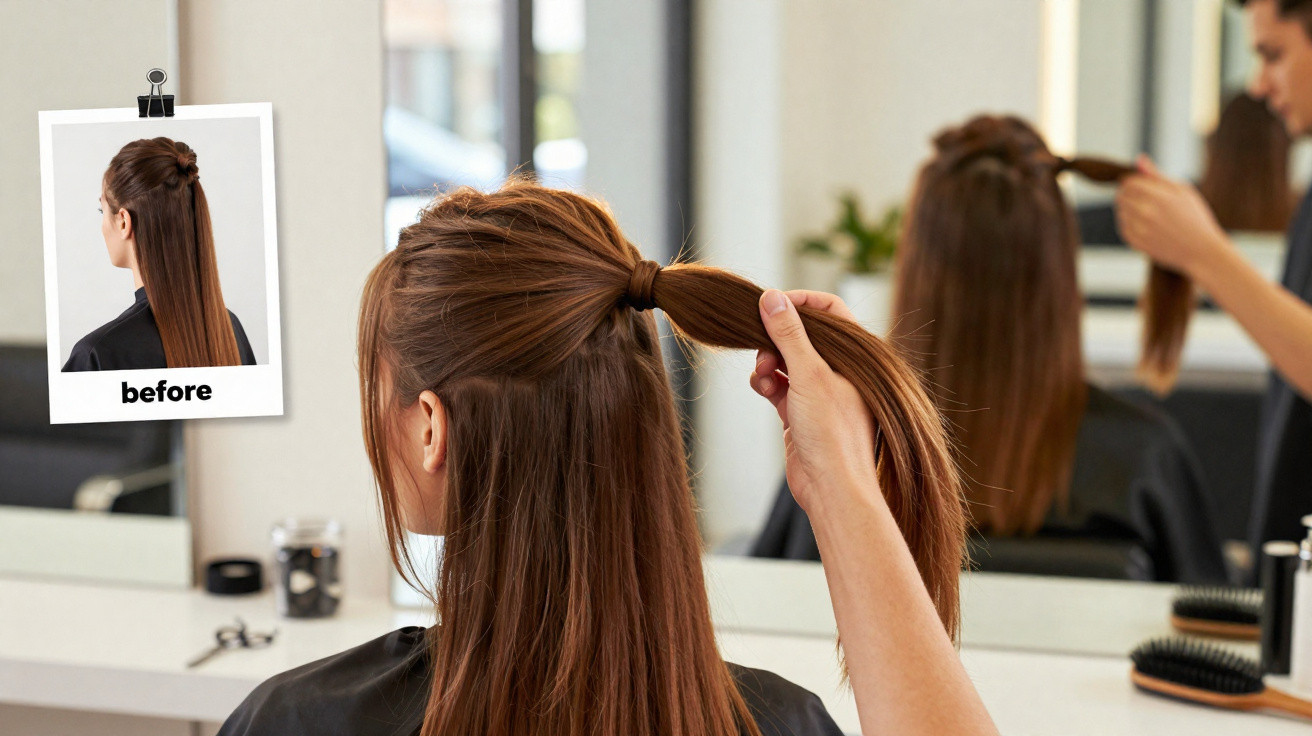
In the gym changing-room mirror, the girl’s ponytail had that familiar defeated look: she’d clearly spent ages smoothing it, pulling the elastic tight, brushing the ends and misting a bit of hairspray, yet the pony still lay sadly against her neck-thin, limp, as though it had run out of energy by lunchtime.
Two treadmills away, another woman snapped her ponytail over her shoulder and it moved like an advert: dense, glossy, swishy from every angle. Same length. Same kind of elastic. Completely different result.
The difference wasn’t a miracle product.
It was the haircut.
There’s a particular way of shaping long hair that can make a flat ponytail look noticeably fuller in one salon appointment. No clip-ins. No hidden weft tucked under a scrunchie. Just scissors, a considered shape, and a stylist who knows how to build volume into the ponytail.
The “ponytail cut” that cheats instant volume
Any experienced stylist will tell you that a ponytail is brutally honest about a haircut. When everything is pulled back, the subtle details you don’t notice with hair down suddenly show at the elastic-right where you can see whether the ends are blunt and weighty or whether the shape is designed to stack and spread.
The haircut that makes ponytails appear thicker is, in essence, long hair cut with internal, invisible layers plus a gently rounded baseline rather than a perfectly straight, one-length finish. The perimeter still looks tidy and the length still looks intact, yet the moment you tie it back, the pony can look dramatically more substantial.
Picture someone like Hailey Bieber or Zendaya on an off-duty day: hair scraped back, no obvious extensions, and still a ponytail that looks plush rather than sparse. More often than not, there’s a clever cut doing quiet work.
You’ll hear stylists refer to it as a “U-shape with internal layering” or a “stacked interior”. One Paris-based hairdresser calls it “cutting air into the hair”. When the hair is worn down you don’t see chunky layers, but when it’s tied up those shorter internal pieces support the longer lengths like hidden scaffolding.
On Instagram, it’s the transformation you see in those oddly satisfying clips: a flat ponytail becomes a rounded, fuller plume after a cut-despite the overall length looking almost unchanged.
The reasoning is straightforward. A blunt, poker-straight, one-length cut pushes the weight right down to the ends. Once you pull it into a ponytail, all that weight compresses into a skinny little tail and everything above it looks slack.
With interior layers and a soft U or V shape at the back, the weight is spread through the hair instead of sitting only at the bottom. When you tie it up, the shorter internal sections sit higher and add lift and thickness, while the longer strands fall beneath to create swing and movement. The eye interprets that stacked shape as “more hair”, even though you haven’t gained a single strand.
You’re not truly increasing density-you’re simply making every millimetre of the ponytail do more.
How to ask for the cut (and avoid a choppy disaster)
This starts in the salon chair, not in your bathroom mirror. Instead of the vague “just a trim”, explain plainly that your ponytail always looks thin and flat. Then bring reference photos of ponytails you like-not only pictures of hair worn down. That one change steers the whole consultation.
Ask for a long cut with a slightly rounded baseline at the back, plus soft internal layers that begin below the cheekbones or around the collarbone, depending on your length. The key phrase is invisible layers-not “shag” and not “choppy”. You’re aiming for ends that still look solid and cohesive when straight, with a subtle curve that makes the ponytail look fuller.
This is where people often get stung. They request volume, the stylist over-layers, and they leave with a wispy, early-2000s-style cut-big when blow-dried, but painfully thin the moment it’s tied up. It’s especially upsetting if you’ve spent months growing your hair.
Tell your stylist you wear your hair up at least three times a week. Ask them to check the ponytail partway through: they can literally tie it up and refine the internal layers until the thickness looks right. Realistically, nobody has time to do this every day-but during the cut, those extra five minutes are worth it.
“Cut for the way you actually live, not just for the salon blowout,” says London hairstylist Ana M., who sees clients obsessed with ponytail thickness. “If you live in a claw clip, a bun, or a pony, your cut has to perform in that position. Otherwise, you’ve paid for a hairstyle you only enjoy two days a month.”
- Say this at the salon: “I want a long, rounded cut with subtle internal layers that make my ponytail look fuller, but I don’t want to lose visible thickness at the ends.”
- Ask them to show you where the shortest internal layers will sit once your hair is tied into a ponytail.
- Request that they tie your hair up once mid-cut to check the shape from behind.
- Keep the front, face-framing pieces a touch shorter: they soften the hairline and add volume at the crown when swept back.
- Be cautious with thinning scissors if your hair is already fine or fragile. Ask for slicing and point cutting rather than aggressive thinning.
Small daily tweaks that boost the “full ponytail” effect
Once the shape is right, the day-to-day steps are surprisingly straightforward. Start with placement. For the fullest look, position the ponytail slightly above the occipital bone (the bump at the back of your head), rather than low at the nape. That height allows the rounded cut to show properly.
Use a standard elastic first, then gently tug tiny sections at the crown to create a bit of lift. Immediately, the ponytail looks less like it’s stuck to your head. To finish, wrap a small strand of hair around the elastic and pin it underneath; it makes the base look thicker and more deliberate.
If your hair is very fine, do a quick upside-down blow-dry before tying it, concentrating on the roots. Alternatively, sleep with your hair in a loose, high “pineapple” bun. When you release it in the morning, the soft bends help the ponytail look puffier.
Avoid anything that flattens the roots on days you know you’ll wear your hair up. Heavy oils, rich masks left on the scalp, and even some smoothing creams can remove the air you need for lift. You don’t have to ditch them-just keep them on the mid-lengths and ends, away from where the ponytail starts.
There’s a simple truth here: volume comes from the haircut, your habits, and a few small illusions. Adjust all three, and your ponytail changes.
Some people swear by texturising spray; others rely on Velcro rollers at the crown for ten minutes while they do their make-up. When your hair feels particularly lifeless, try this: split the ponytail into two sections and add a tiny clear elastic halfway down. That second anchor makes the ends kick out and look fuller.
And if, on some days, the ponytail still droops despite the right cut and the right tricks-twist it into a low, loose bun and carry on. Hair doesn’t need to become a daily exam in perfection.
What this “full ponytail” haircut really changes
When you try a cut that’s designed to look good up, it can subtly change how you feel about your hair. Throwing it up before a video call no longer feels like surrender; it feels intentional. The ponytail becomes a proper style, not a last-ditch way to disguise greasy roots.
You notice the difference on rushed mornings, after the gym, or when you’re travelling with one brush and no styling tools. That small fan of hair at the elastic can look polished enough for most situations. For some, it’s a quiet confidence boost; for others, it simply removes an irritation they didn’t realise they were carrying.
| Key point | Detail | Value for the reader |
|---|---|---|
| Cut shape | Long, rounded baseline with invisible internal layers | Instantly thicker-looking ponytail without losing length |
| Salon communication | Show ponytail photos and ask to test the pony mid-cut | Reduces the risk of over-layering or regret |
| Daily habits | Strategic pony placement, light root lift, smart styling products | Amplifies the effect of the cut with minimal effort |
FAQ:
- Will this haircut work on very fine hair? Yes, if it’s done gently. The idea is to add soft internal layers, not to thin the hair. Ask your stylist to keep the baseline solid and avoid heavy thinning shears.
- Do I have to lose a lot of length? No. The goal is to tweak the shape, not chop it all off. A few centimetres and a change in structure are often enough to transform how the ponytail looks.
- Is this cut okay for curly or wavy hair? It can be beautiful on curls and waves because the internal layers help them spring up. You’ll want a curl-competent stylist who cuts your texture dry or semi-dry.
- How often should I maintain this cut? Every 8–12 weeks for most people. If your hair grows very fast or loses its shape quickly in a ponytail, closer to 8 weeks will keep the volume effect fresh.
- Can I still wear my hair sleek and straight? Yes. When the layers are internal and subtle, your hair will still read as sleek when straightened, just with a softer, more flattering curve at the ends.




Comments
No comments yet. Be the first to comment!
Leave a Comment