
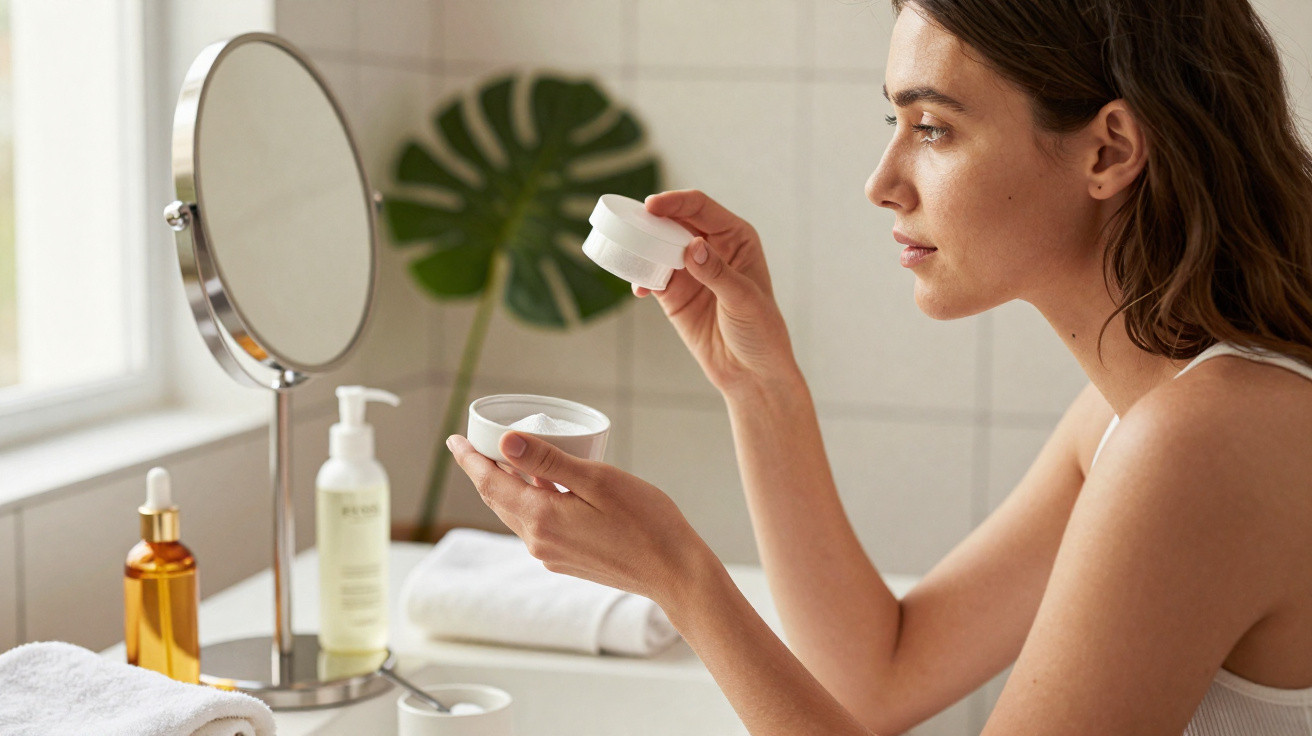
On a Tuesday evening, midway between a half-followed Netflix series and a cold mug of tea, Léa flicks through beauty reels on her phone. In one clip, a creator wipes a white paste beneath her eyes, grins at the camera, and a caption pops up: “Baking soda = botox at home.” Two swipes later, another video insists the reverse, warning about burns and premature ageing. The comments look like a battleground: “Miracle!” “My skin peeled off!” “Dermatologists lie!” “You just don’t know how to use it!”
She heads to the kitchen, opens the cupboard, and looks at the familiar orange box. A couple of spoonfuls, five minutes on the face, and goodbye wrinkles… It sounds temptingly simple in a way that feels almost unsafe.
Some trends don’t merely go viral.
They land straight on your skin.
Baking soda on the face: miracle filter or real skin hazard?
Search “baking soda face mask” on any social platform and you tumble into a rabbit hole: glossy foreheads, crow’s feet that seem erased, and “before/after” shots that resemble beauty filters turned real. The method hardly varies-add a little water, make a paste, smooth it on, wait, then rinse. The promise is always big: lines soften, pores look smaller, and skin feels baby-smooth by morning.
It looks almost absurdly easy on screen-and that’s precisely what makes people copy it.
A 24-year-old French influencer recently shared her “grandma’s secret anti-wrinkle hack” with two million followers. In the video, she taps baking soda straight under her eyes and over her smile lines, brushing off a mild burning sensation as “normal.” The clip sailed past a million views in less than 24 hours.
A fortnight later, a dermatologist posts another video: screenshots of red, inflamed eyelids, raw-looking cheeks, and broken capillaries. Same ingredient. Same trend. A totally different outcome.
The argument comes down to a simple reality: baking soda is alkaline, with a pH of roughly 9, while healthy skin sits around 4.5 to 5.5. That slightly acidic surface-often called the acid mantle-helps protect the barrier that keeps hydration in and unwanted bacteria out. Even a brief hit of something very alkaline can unsettle that barrier. Some people recover quickly; others react with tightness, peeling, irritation, inflammation, and sometimes sensitivity that lingers.
Around the eyes, where skin is about four times thinner, the stakes are higher again.
What dermatologists say vs. what TikTok shows
In clinics, the baking soda craze doesn’t arrive as a shiny reel-it shows up as low-key appointments. A woman in her forties who “only did it twice” and now can’t tolerate the moisturiser she’s always used. A student whose eczema patches spread after trying a DIY exfoliating paste. A man who scrubbed blackheads with baking soda and ended up feeling as if he’d got sunburn-minus the sunshine.
They repeat the same reasoning: “But online, they said it was natural, so it must be safe.”
Some dermatologists are very direct in consultations. They’ll bring out pH scales, explain how the skin barrier works, and talk about the long-term effects-micro-inflammation and the slow knock-on impact on collagen. They liken baking soda to using a harsh household cleaner on delicate silk. It’s not a message designed for clicks, and it certainly doesn’t have the glamour of a “one weird trick” reel.
Meanwhile, the trend keeps itself alive with “3-day miracle” stories. No one is rushing to post content about a damaged skin barrier that takes three months to settle.
A big part of the confusion is what people think “anti-wrinkle” means. If something irritates the skin or makes it puff slightly, fine lines can look blurred for a short while. That’s not the same as meaningful improvement. Real anti-ageing is about supporting the skin-hydration, repair, and protection of collagen-not routinely stressing it with kitchen ingredients. Skin doesn’t forget repeated aggression just because it came from an ingredient that sits next to the flour.
Dermatologists aren’t trying to scare people; they focus on what happens over time.
So how do people actually use baking soda on their face?
In the real world, DIY routines rarely follow careful instructions. The most common approach online is a basic paste: about one teaspoon of baking soda with enough water to make it creamy, then applied as a thin layer over the face or dabbed directly onto wrinkles. Some leave it for five minutes; others push it to fifteen. Quite a few then rub while rinsing to get “extra exfoliation”.
The under-eye area often gets the most attention-despite being the one zone many dermatologists say should be off-limits.
Then there are the more extreme “recipes”: baking soda combined with lemon juice, vinegar, or toothpaste. It’s an acid–base mix with added fragrance and detergent. It fizzes, tingles, and stings. Many users interpret discomfort as proof it’s working. In reality, hardly anyone keeps this up daily, because the skin tends to object quickly and loudly.
When it burns, most people simply reduce the time and try again, assuming they just “overdid it” the first time.
Dermatologists and more cautious beauty professionals keep coming back to the same guidance, often sounding both worried and weary:
“Baking soda is a great cleaner for sinks, not for skin,” sighs Dr. Marion Lefèvre, a Paris-based dermatologist. “I understand the attraction of cheap, simple solutions. But the face, and especially the eye contour, is not a place for experiments with household powders. Once the barrier is damaged, it may take months to repair.”
To make things clearer, many specialists now draw firm lines:
- Never apply baking soda directly around or on the eyelids.
- Do not mix it with lemon, vinegar, or toothpaste for facial use.
- Avoid scrubbing with it if your skin is dry, sensitive, or acne-prone.
- Do not leave a baking soda mask on “to feel the tingle” longer than a minute or two, if at all.
- Stop immediately if you feel burning, intense tightness, or see redness that lasts.
If not baking soda, then what for wrinkles?
Once you strip away the hype, the question underneath the trend is straightforward: how do you soften wrinkles without injections or spending a fortune? The slightly boring answer still does the most: wearing sunscreen every day on the face and around the eyes; using a gentle cleanser that doesn’t leave your skin feeling squeaky-clean; and applying a basic moisturiser consistently-morning and night, not only when you remember.
After that, you might add a targeted eye cream or serum with ingredients such as peptides, low-dose retinol, or hyaluronic acid.
Most people recognise the moment that fuels these hacks: you zoom in on a selfie, notice a new line near the eye, and feel a small jolt of panic. That’s the gap where “magic” DIY tricks slide in. Wanting smoother skin isn’t the issue-the trap is believing a cheap, aggressive shortcut will outsmart biology without consequences.
Sometimes the kindest move for your future self is to stop waging war on your skin barrier in the name of “natural” solutions.
Professionals tend to recommend routines that look almost dull next to a foaming paste:
- Daily SPF 30–50 around eyes and on the whole face, even on cloudy days.
- A fragrance-free cleanser and a simple moisturiser that suits your skin type.
- Gentle actives: low-strength retinol, bakuchiol, or peptides introduced slowly.
- Occasional professional treatments if you wish: superficial peels, microneedling, or laser under medical supervision.
- Sleep, less smoking, less chronic stress-the usual suspects that quietly deepen facial lines.
None of that will travel like “baking soda eye lift in 5 minutes”.
It does tend to create better skin in five years, though.
The new beauty divide: cheap hacks vs. skin peace
The baking soda obsession points to a wider frustration that goes beyond one ingredient. People are fed up with pricey creams and airbrushed promises. They want shortcuts, cupboard fixes, practical tips that feel like something a grandmother might have done. And the beauty world responds with a split screen: dermatologists waving red flags on one side, and creators chasing views with increasingly extreme DIY “challenges” on the other.
Somewhere between those two is your face, your eyes, and the years you still want to feel comfortable in your own skin.
| Key point | Detail | Value for the reader |
|---|---|---|
| Skin barrier and pH | Baking soda is strongly alkaline and disrupts the skin’s natural acidic film. | Helps you understand why a “simple” powder can trigger irritation or long-term sensitivity. |
| Eye area risk | Under-eye skin is thinner and more fragile, with higher risk of burns and inflammation. | Encourages extra caution and keeps you from testing viral hacks too close to your eyes. |
| Safer anti-wrinkle options | Gentle skincare, sunscreen, and proven actives like retinol or peptides. | Offers realistic alternatives to harsh DIY methods while protecting your skin’s future. |
FAQ:
- Can baking soda really reduce wrinkles? It may temporarily make lines look smoother by irritating or slightly swelling the skin, but it doesn’t repair collagen or truly reverse wrinkles. Long term, repeated irritation can actually speed up aging signs.
- Is baking soda safe under the eyes? Dermatologists generally say no. The under-eye area is extremely thin and sensitive, and baking soda’s high pH can trigger burns, dryness, or chronic irritation.
- What should I do if I already used baking soda on my face? Rinse gently with lukewarm water, stop using it, and switch to a mild cleanser and soothing moisturiser. If burning, redness, or swelling persists more than a day or two, a medical consultation is wise.
- Are there safer DIY options for exfoliating or brightening? Oat flour, yoghurt, or honey masks are usually gentler than baking soda, though they can still irritate some skins. Patch testing and moderation remain key, especially if you’re reactive or have existing conditions.
- What’s the best simple routine to prevent wrinkles? Daily broad-spectrum SPF, a gentle cleanser, consistent moisturising, and possibly a low-dose retinoid at night. Add sleep, less smoking, and less sun, and your future face will probably thank you more than any kitchen hack ever could.
Comments
No comments yet. Be the first to comment!
Leave a Comment