
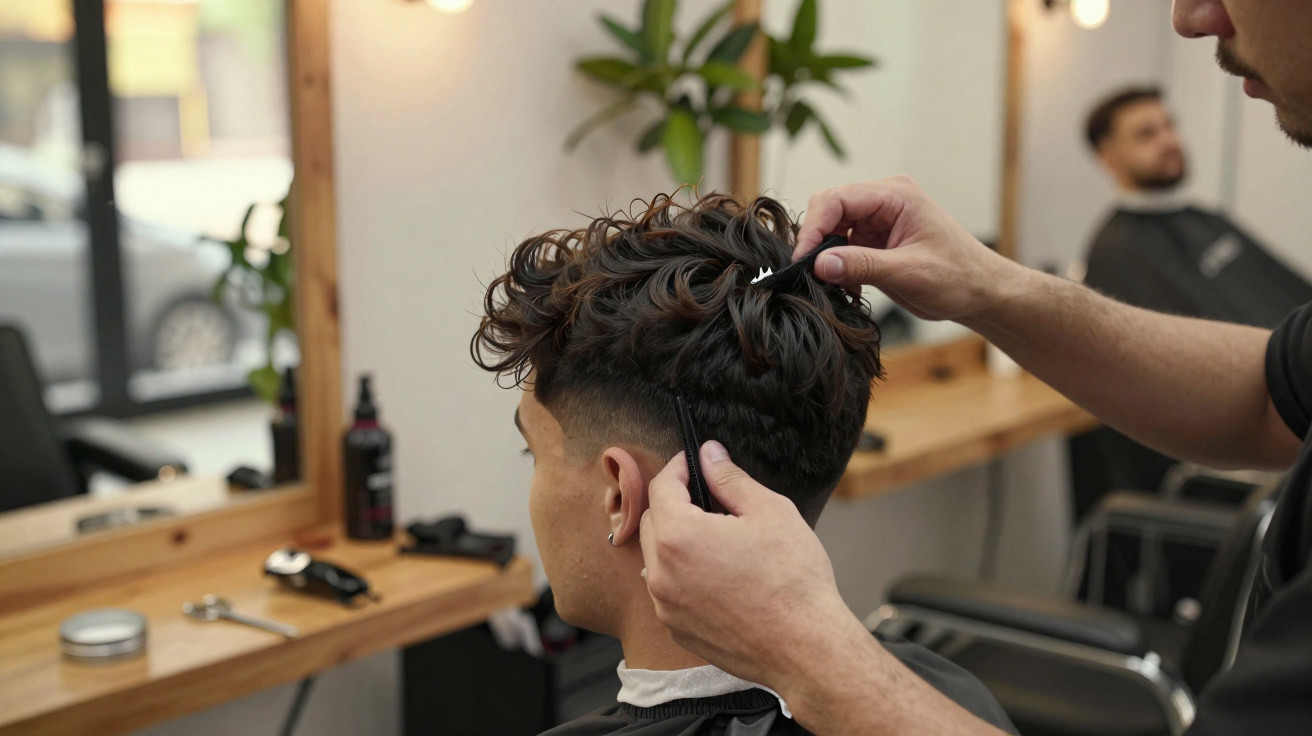
The first thing that hits you is the noise: that gritty, crunchy snip as thick hair meets the scissors and refuses to co-operate. In the busy chair by the window, a bloke in his thirties keeps checking the mirror, bracing himself every time a heavy clump of dark hair drops to the floor. His barber chuckles: “Man, your hair could stop traffic,” and the comb flicks back up like it’s on a spring.
A quarter of an hour later, the same bloke runs his hand through it and-suddenly-it settles. It’s flat without looking lifeless. The neckline is sharp, the sides sit close to the head, and the top falls exactly where it should.
Barbers will tell you the trick isn’t some miracle product. It’s one particular haircut.
The cut barbers swear by for thick, stubborn hair
Ask a few barbers how to deal with heavy, difficult hair and you’ll hear the same recommendation more and more: a textured crop with a low fade. Not the razor-edged, overly sculpted Instagram take-a softer, everyday version that reduces bulk without making you look like a plastic action figure.
The principle is straightforward: keep the sides and back snug with a low fade, leave a bit of length on top, then disrupt the density with texture so it doesn’t sit like a helmet. You end up with something that looks natural, moves as you do, and grows out without going odd by week three.
It’s the kind of cut that quietly lets you off the hook when you don’t nail the styling every single morning.
Imagine this: a guy walks into a local barbershop with the standard “thick hair problem”-sides that puff out, a cowlick at the back, and a fringe that either sticks straight up or collapses into his eyes. He shows the barber a celebrity photo taken under perfect studio lighting. The barber looks at his head, then the photo, and gently manages expectations.
Rather than copying the screen-idol cut exactly, the barber steers him towards a textured crop: low fade, a slightly longer fringe, and a top shaped with point-cutting instead of blunt, straight lines. About twenty minutes later, the outline is completely changed. The hair sits closer to the head, the fringe can be worn forward or nudged to the side, and the cowlick is softened with shorter graduation around the crown.
Two weeks later he’s back, half amazed: “This is the first time my hair didn’t explode as it grew.”
There’s a practical reason barbers keep returning to this style for dense hair. When thick strands are all cut to one uniform length, they push outwards-so a classic “short back and sides” can quickly turn into a mushroom shape as it grows. A crop with texture breaks up that sameness. Those tiny differences in length stop the hair from clumping together and ballooning.
The low fade is just as important. By keeping the fade low around the ears and nape, you remove weight where thick hair usually flares out, while leaving enough length above to blend in smoothly. That’s why this feels far easier to live with than a high-and-tight if you’ve got stubborn growth patterns.
It isn’t only about looking crisp on day one-it’s about keeping the volume under control on day twenty-one.
How to ask for it (and what to do once you have it)
It starts with what you actually say in the chair. Barbers reckon the worst approach with thick hair is to sit down and mumble, “Short on the sides, bit off the top.” Instead, start with behaviour, not centimetres. Tell them, “My hair grows outwards, I want something that sits closer to my head and doesn’t puff up.”
Then be clear on the framework: low fade on the sides and back, textured crop on top. Bring a couple of realistic photos on your phone (with different angles). Ask for extra texture through the top and fringe, not a blunt, straight edge.
Most barbers will immediately understand the brief. They’ll rely on scissors and texturising methods, rather than just dragging one clipper guard over everything and hoping it works.
After you leave with the cut, day-to-day upkeep is where plenty of men start to panic. Thick hair can feel weighted when damp and chaotic when it dries, so the temptation is to pile on strong gel or wax. That’s when it can turn stiff, greasy, or strangely triangular.
Barbers tend to suggest something lighter: a matte clay or paste, worked into almost-dry hair using your fingertips-not forced through with a heavy-handed rake. Use less than you think, warm it up between your palms, then press and tap it through the top and fringe. You’re not trying to glue it in place; you’re guiding direction and creating separation.
And, honestly, almost nobody does this without fail every day. Which is exactly why the haircut itself needs to carry most of the load.
“Guys with thick hair think they need more product,” explains London barber Sam Costa. “What they actually need is a smarter cut. Once the weight is in the right place, styling takes two minutes, not twenty.”
He says the biggest misstep is asking a barber to “thin it out everywhere”. It sounds sensible when your hair feels like a dense forest, but it often causes problems. Too much thinning can create frizz, patchy gaps in the shape, and ends that stick out in every direction.
Instead, barbers prefer taking weight out in specific, controlled sections, while keeping strength where the style depends on it. If you want a quick checklist for your next appointment, save this in your notes:
- Ask for a low fade or taper around the ears and nape, not an ultra-high fade.
- Keep some length on top (2–4 cm), then add texture rather than blunt lines.
- Call out specific issues: puffiness, cowlicks, a fringe that drops too heavily.
- Go for matte products instead of shiny gels for a softer, modern finish.
- Book a tidy-up every 3–5 weeks so the shape doesn’t collapse.
Why this cut feels different when you live with it
A textured crop with a low fade doesn’t demand attention-and that’s precisely why so many barbers recommend it. Thick hair often pushes you into extremes: very short and severe, or longer and unruly. This cut sits neatly in the middle. It can look clean and professional for work, then you can mess it up a touch at the weekend with your hands and a small amount of product.
It’s also reassuring to have a style that doesn’t turn on you the moment the weather shifts. Humidity, missing a shampoo, a rushed morning… it still looks like itself. It might relax and soften, but it doesn’t suddenly transform into a triangle. That alone is a quiet kind of confidence most men don’t even know they’re missing.
| Key point | Detail | Value for the reader |
|---|---|---|
| Textured crop + low fade | Reduces bulk at the sides and breaks up density on top | Stays tidier for longer and grows out more naturally |
| Describe problems, not just length | Explain how your hair behaves as it grows | Better communication and less post-cut frustration |
| Light, matte styling products | Clay or paste applied to almost-dry hair with fingertips | Shape and movement without greasy weight or stiffness |
FAQ:
- How do I describe this cut to my barber? Say you’d like a low fade on the sides and back with a textured crop on top, keeping enough length for movement, and mention that your hair is thick and tends to puff out.
- Is this cut good for wavy thick hair too? Yes-wavy, thick hair responds particularly well. The texture on top brings out the wave, while the low fade stops the sides from flaring.
- How often should I get it trimmed? Most barbers suggest every 3–5 weeks. The fade is the first thing to grow out, so a quick clean-up at the sides can refresh the look even if the top still sits well.
- Do I need to blow-dry my hair for this style? You don’t have to. Let it air-dry, then apply product when it’s almost dry. A quick blast with a hairdryer can help if your fringe is very heavy or you want a bit more lift.
- What if my hair is thick but also coarse and straight? Barbers usually add a little extra texture and may leave the top slightly longer. Coarse, straight hair needs more point-cutting and less blunt scissor work to stop it sticking up.




Comments
No comments yet. Be the first to comment!
Leave a Comment