
The café had that familiar late-morning buzz: laptops out, oat lattes queued up, and women dressed in every variation of “I made an effort” and “I’ve stopped caring”. One thing kept drawing my attention more than the shoes or the handbags.
It was their hair.
You could pick them out straight away. The women who somehow looked quietly finished even in leggings and trainers, as though they had life just a touch more under control than the rest of us. The trick wasn’t a full face of make-up or a wardrobe of designer labels.
It was one simple, neat haircut that more or less behaves on its own.
No curls. No straighteners. No 6 a.m. blow-dry.
Just one very particular cut that does the heavy lifting in the background.
The quiet power of the blunt long bob
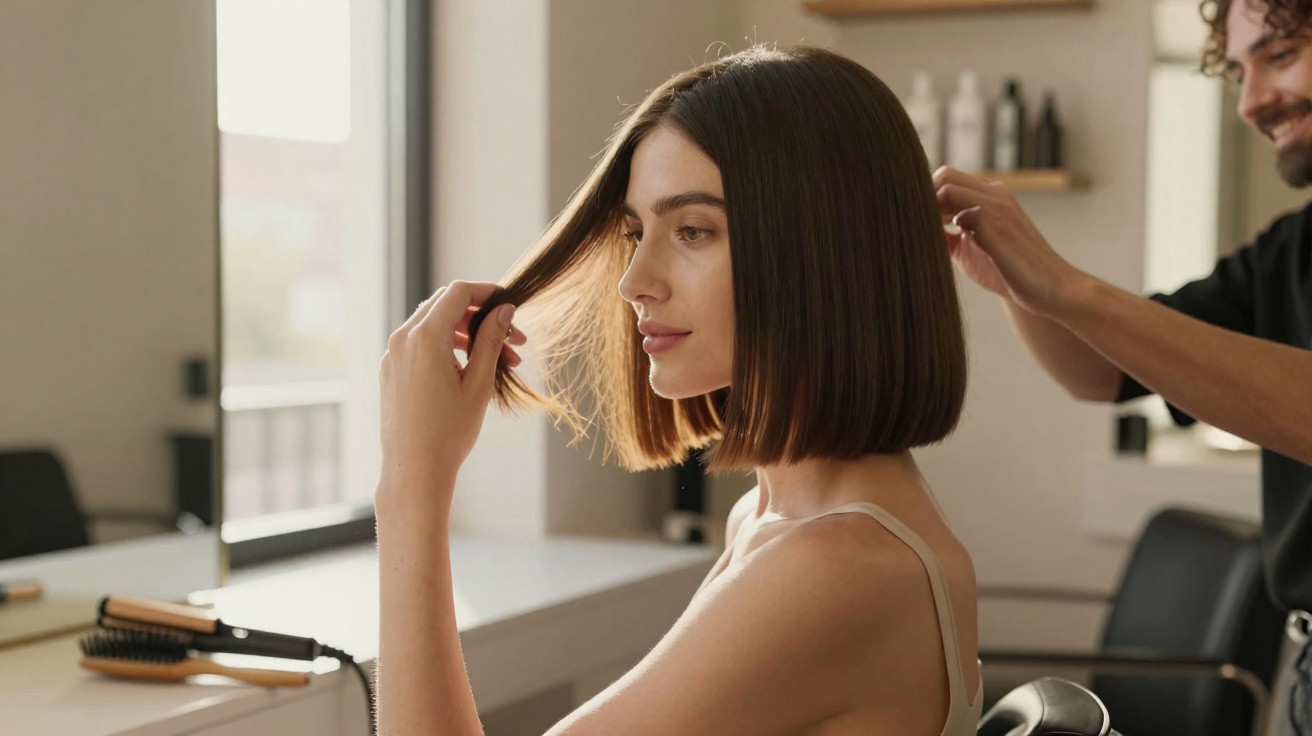
Watch people for ten minutes on the Tube or in a shared workspace and you’ll start noticing the same theme. The women who look “put together” without making a show of it often have an identical silhouette: a blunt, collarbone-skimming bob - the long bob, better known as the lob.
It sits in that in-between zone from jaw to shoulders, with crisp edges and a little weight through the ends. It’s not a dramatic chop, and it’s not mermaid hair either - just that calm, self-assured length that grazes the neckline and, somehow, makes even a hoodie look considered.
You don’t clock the haircut first. You just register that she looks…sorted.
Take Emma, 34 - project manager, two children, permanently five minutes behind. For years she stuck with “safe” long hair. Most of the time it lived in a messy bun, split ends tucked away and roots left to their own devices. On a good day she’d curl it for a wedding. Most mornings it never graduated beyond the claw clip.
Then, one Tuesday, after a grim video call where she caught her own frizz in that tiny Zoom square, she ducked into a salon on her lunch break and asked for “something that looks done even when I’m not”. The stylist pointed her towards a blunt lob: slightly shorter at the back, with the front brushing the collarbones.
The following week, colleagues started saying, “Wow, you look so fresh today” - on mornings when she had quite literally rolled out of bed and let it air-dry. Same person, same chaos, just a different outline around her face.
There’s a straightforward reason this cut works so hard. A blunt long bob hits the sweet spot: long enough to feel feminine and flexible, but short enough to keep its shape without constant intervention. The weight helps pull the ends smooth, the solid line adds structure, and the length frames the jaw without swallowing the neck.
On a psychological level, clean edges read as deliberate. Your brain sees that straight baseline and assumes: this was chosen, not accidental. So even if you’re in yesterday’s jeans with no mascara, the shape is quietly signalling: I meant to look like this.
That’s the real trick - not perfection, but the impression of intention.
How to get the “done-without-doing” cut
If you walk into a salon and simply ask for a “lob”, you may not get what you had in mind. What you actually need to describe is this: hair that’s one length (or almost one length), landing anywhere from just below the jaw to the top of the shoulders, with only very soft internal layers - and only if your hair is thick.
Bring photos. Choose two or three realistic, everyday references rather than heavily styled Instagram images. Show the exact point on your collarbone where you want the ends to sit when the hair is dry, not when it’s wet. Be clear that you tend to air-dry and you don’t want to spend more than two minutes styling.
Ask for a tidy outline, with the ends gently softened so it doesn’t read like a helmet. Think straight, but not rigid.
Plenty of women end up disliking shorter cuts because they unintentionally request the wrong details. They say, “I want it to swing,” and leave with harsh layers that start flicking out the moment humidity arrives. Or they agree to a razor finish that looks cool on day one and looks weary by month two.
Be honest about how you actually live. If you never blow-dry, say so. If you always tuck your hair behind your ears, say it. Your haircut has to match your real life, not your fantasy Sunday-morning version of yourself.
Let’s face it: nobody maintains that fantasy every single day.
The women who genuinely love their low-effort bob tend to repeat the same line: “I do almost nothing and it still looks like I tried.” One French stylist I interviewed captured it perfectly.
“I tell my clients: your cut should look 70% done by gravity alone,” she laughed. “Your hands and a little product can handle the other 30%.”
In practical terms, the simplest routine often looks like this:
- Tip your head upside down, roughly dry the roots for two minutes, then let it air-dry.
- Sleep on a silk or satin pillowcase so the blunt ends don’t kink in odd angles.
- In the morning, smooth the front sections with damp hands and a pea-sized amount of cream or serum.
- If you need to, tap a straightener only on the very tips to sharpen the line.
- Book a tiny “dusting” trim every 8–10 weeks to keep the baseline crisp.
A bit of intention. Hardly any effort.
The hidden emotional comfort of a “reliable” cut
There’s a subtle kind of relief when your hair stops being a daily decision. One less debate with yourself in the mirror. One fewer moving parts on mornings when you already feel slightly off.
When your cut naturally falls in a way that flatters your face, you’re not dependent on willpower or spare time just to feel alright walking out the door. The default is “good enough” - and on some days, “good enough” feels like a soft place to land.
We’ve all had that moment where you cancel plans simply because you can’t face wrestling with your reflection.
A blunt long bob works like a default setting. Even when you do nothing to it, there’s a consistent outline - a shape you can rely on. That dependability doesn’t get enough credit. And for women balancing children, work, a social life, or simply exhaustion, not having to “earn” looking presentable each morning is a quiet gift.
Some readers describe it as a kind of gentle armour: you start the day already a little polished, so you spend less energy internally apologising for yourself. Your hair stops being a project. It’s just…done enough.
And that tiny change can build a steadier confidence than a new lipstick ever could.
You may notice, as many women do, that once the hair is simplified, other choices start to soften too. The need for heavy make-up eases off. The urge to hide behind a ponytail after a bad night’s sleep becomes less urgent. You stop saving complicated tutorials you were never going to attempt.
The aim isn’t to look like a magazine cover. It’s to recognise yourself more quickly in the mirror, without the mental static of “I should be doing more”. A well-cut lob can be a quiet promise to yourself: today, this is enough effort.
And on the days you do want to go bigger - with waves or a sleek blow-dry - that clean, blunt line becomes the ideal, tidy canvas.
| Key point | Detail | Value for the reader |
|---|---|---|
| Blunt long bob shape | Collarbone-grazing, mostly one-length, clean outline | Gives an instant “put together” look with minimal styling |
| Salon communication | Use photos, show exact desired length, explain real habits | Reduces post-cut regret and gets a truly low-maintenance result |
| Simple routine | Rough-dry roots, light product, trims every 8–10 weeks | Keeps the cut sharp and polished without daily effort |
FAQ:
Question 1: Will a blunt long bob work if my hair is naturally wavy or curly?
- Yes, but ask for the line to be cut slightly longer when wet and, if needed, add very soft internal layers so the shape doesn’t triangle out. Having a few curls finished with dry cutting at the end helps refine the outline.
Question 2: What if I have very fine hair?
- A one-length lob is often ideal for fine hair because the blunt edge makes it appear fuller. Keep it nearer the collarbone than the jaw so the weight isn’t all sitting at the bottom.
Question 3: Can I still tie it up?
- Usually yes, although it’s more likely to be a low, stubby ponytail or a half-up style. If a full ponytail is non-negotiable, ask your stylist to leave it just a touch longer at the back.
Question 4: How often do I need trims to keep it looking “put together”?
- Every 8–10 weeks for most people. If your hair grows very quickly or starts flicking out at the shoulders, every 6–8 weeks will keep the line looking sharp.
Question 5: Do I need special products for this haircut?
- Not necessarily. A lightweight smoothing cream or serum - plus heat protection if you use tools - is usually plenty. The cut does most of the visual work; products are just supporting actors.




Comments
No comments yet. Be the first to comment!
Leave a Comment