
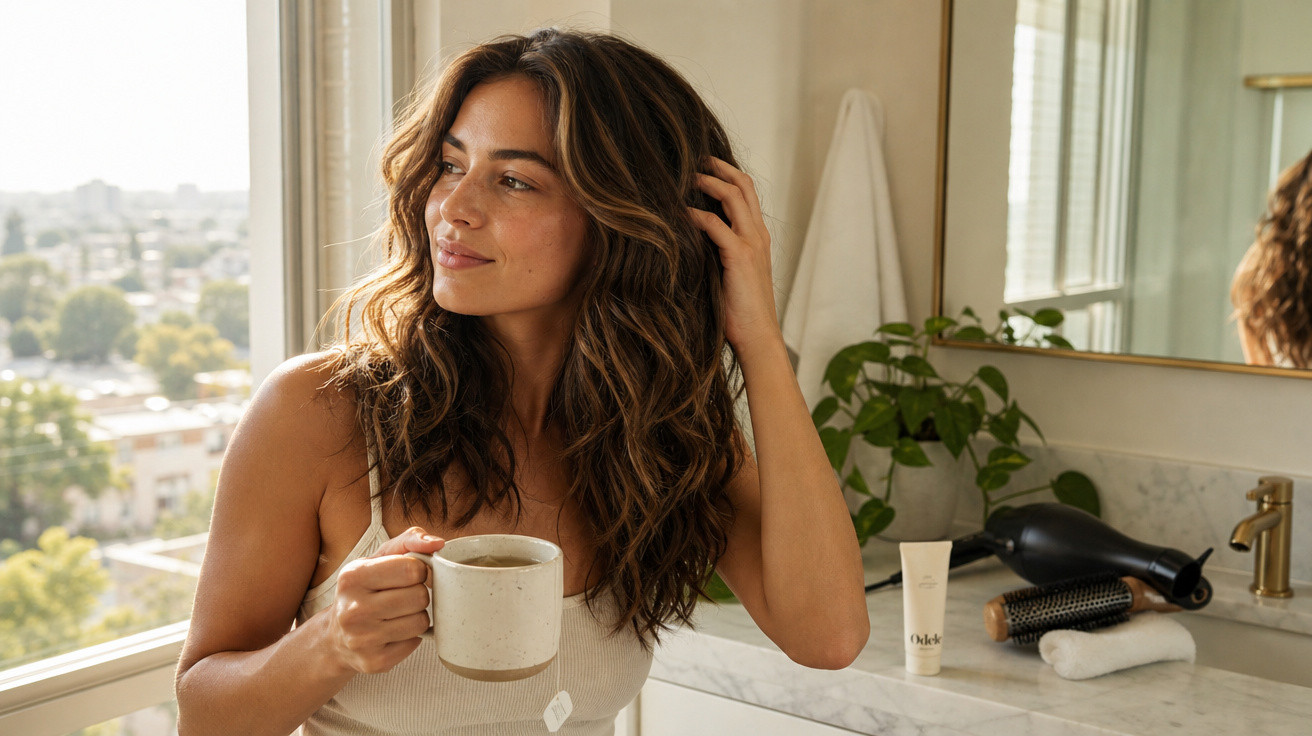
The woman sitting ahead of me in the café has the sort of hair that seems as though it simply… came out that way. Soft movement, no stiff curls, no poker-straight ends trying to kick out. She keeps sweeping one side behind her ear and it settles back into place like an easy wave. You can tell she wasn’t battling a round brush at 7 a.m. This is air-dried hair, yet it looks polished, deliberate, almost editorial.
Around her, people are scrolling through Reels promising “the one product you need,” while quietly hanging on to their blow-dry brushes. There’s this unspoken envy we hardly ever admit: we all want the haircut that still looks good when we’ve done almost nothing.
Not “perfect” good. Just… right.
The sort of cut that lets you off the hook on a Tuesday.
The real reason some hair looks good with zero styling
Once you spot it, you can’t stop seeing it: people whose hair looks “effortless” weren’t merely favoured by the hair gods. They’ve got a very particular kind of haircut. The movement seems to begin at the roots, the ends taper gently, and the shape stays put even when the weather decides otherwise.
This is the sort of haircut that treats air-drying as the main event, not the emergency option. The layers sit where the hair naturally bends. The length adds weight where frizz would normally take over. The outline follows the face like a soft frame rather than a rigid line. You’re not battling your texture. You’re working with its natural laziness.
Hairdressers see this constantly: someone arrives clutching a screenshot of glossy, polished, blow-dried hair, then admits they rarely go near a dryer. One Paris stylist told me nearly 70% of her clients now ask outright, “Can this look good without styling?” She smiles, because it’s an honest question. What they really mean is, “I’m exhausted.”
One client she remembers had shoulder-length hair that ballooned when left to itself. By adding invisible layers underneath the top section and lifting the length just off the shoulders, everything shifted. Same hair, same products, same life. But when she stepped out of the shower and let it dry on its own, the ends curved inward, the volume softened into a gentle halo, and the hair finally suited her routine.
There’s a simple reason for this. Hair has a default setting, a pattern it always tries to return to: waves, curls, cowlicks, flatness. When a cut ignores that default and forces an Instagram-inspired shape, the hair pushes back the second the dryer is switched off. When the cut follows your natural pattern, the hair settles into place without being managed.
The magic isn’t in a miracle product or some secret towel trick. It’s in geometry, weight, and the point where the scissors enter and leave a strand. That’s the quiet technology behind a really good haircut.
The cut that actually likes being air-dried
The most forgiving air-dry haircut shares one thing across textures: a lived-in shape with softened edges. Think collarbone to just below the shoulders, with subtle layers beginning beneath the cheekbones and never creating a harsh step. On straight or slightly wavy hair, that reads as a long bob with movement. On curlier textures, it’s a rounded shape where curls stack softly instead of turning into a triangle.
The trick lies in weight distribution. A blunt, heavy line at the bottom can look sleek when styled, then become bell-shaped when left alone. A handful of carefully placed internal layers removes bulk without thinning the hair into frizz. You still get fullness, just with some air in it. The hair can fall where it wants, but the shape catches it before it becomes unruly.
Picture a friend who always looks pulled together, even in leggings and a sweatshirt. Her hair might be a shaggy lob, the ends brushing her collarbones, with pieces that naturally flick away from her face. She insists she “did nothing.” You’re sceptical, but the next time you’re at her house you glance at her bathroom and… she genuinely doesn’t own a round brush. Just a comb, a wide-tooth brush, and maybe a leave-in cream.
She tells you the best haircut she ever had began with the stylist watching her hair dry. They misted it, let it air-dry for ten minutes, then cut according to how it lifted, bounced, and dropped. No glossy blowout reveal. Just hair doing what it naturally wanted to do, then being edited rather than transformed. That little story carries a quiet truth about what really works.
From a technical perspective, an air-dry-friendly cut respects density and direction. Cowlick at the front? The stylist avoids a thick fringe that will separate the second it dries. Very fine hair? They skip aggressive layering that would collapse into limp, stringy ends. Coily hair with strong shrinkage? They cut where the curl actually lives, not where the stretched strand reaches.
Let’s be honest: nobody truly does this perfectly every single day. Most of us wash, squeeze with a towel that’s a bit too rough, perhaps rake in a product, then rush out the door. A haircut that still looks intentional under those conditions is designed around that reality. It isn’t laziness. It’s intelligent design.
How to ask for (and live with) this kind of haircut
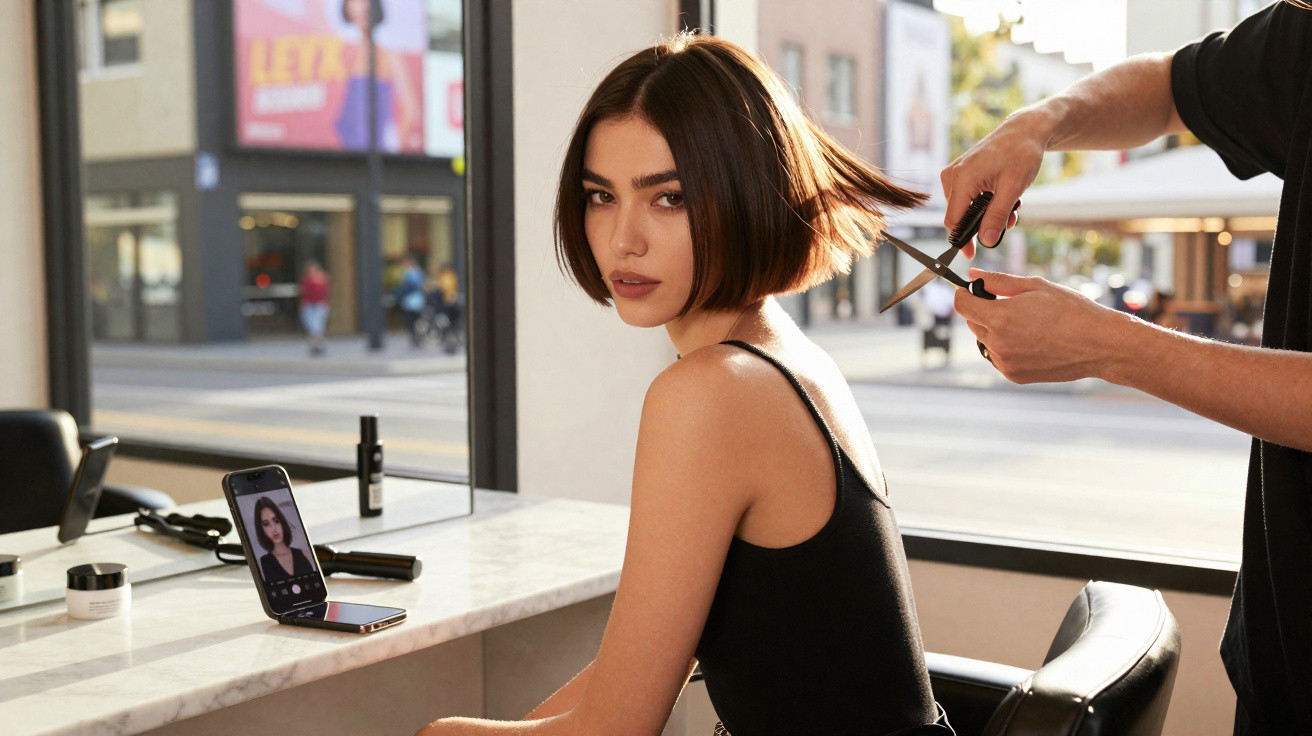
The process starts before the scissors come out. Next time you sit in the chair, resist the urge to say, “I usually blow-dry it smooth.” Tell the truth about what happens in a normal week. “I wash it at night and sleep on it.” “I let it dry in the car on the school run.” “I don’t own a dryer.” That gives your stylist the real brief.
Then ask for a cut that is specifically intended to be worn air-dried. Mention soft internal layers rather than chunky ones. Ask them to leave the perimeter slightly broken, not ruler-straight. If your hair has any wave at all, suggest a length that sits either properly above the shoulders or clearly below them, so the ends don’t flick out awkwardly against your jumper.
The biggest mistake many of us make happens in the bathroom, not the salon. We rough-dry our hair with a standard towel as though we’re polishing a car. The cut may be excellent, but the friction roughs the surface into frizz. Swap the terry towel for an old cotton T-shirt or a microfibre towel. Squeeze, don’t rub.
Another common trap is too much product, applied too late. Once hair has already started drying, creams and gels sit on top instead of helping shape it from the beginning. Try applying a light cream or foam to soaking-wet hair, with your head tilted forward. Comb it through once, then leave it alone. The less you interfere with the cut while it forms its natural pattern, the better the end result looks.
“An air-dry cut is like a good pair of jeans,” says London hairstylist Amira K. “If it only looks good when you stand perfectly still and hold in your stomach, it’s not made for real life. I want hair that still looks good when you’re late, sweaty, and sprinting for the bus.”
- Ask for honesty
Tell your stylist you want hair that fits your real routine, not your fantasy one. - Bring realistic photos
Choose reference images where the hair looks soft, a little fuzzy, and clearly not heat-styled. - Observe your natural pattern
Let your hair air-dry fully at least once before your appointment so you can see its true texture. - Protect the cut at home
Use a gentle towel, a wide-tooth comb, and no more than one or two products. - Give it two weeks
Hair often needs several washes to settle into a new shape and for you to understand its new habits.
The quiet confidence of hair that’s allowed to be itself
There’s something oddly calming about watching your hair dry and not dreading the result. You shower, pat it gently, smooth a little cream between your palms, and then… you leave it alone. No arm workout, no hot air blasting in your ears, no final panic because one side won’t cooperate. The cut does the hard work.
That doesn’t mean your hair suddenly becomes flawless. It means the way it dries feels in step with your life. On good days, it looks deliberately undone. On bad days, it still looks like you, just with a slightly softer, fuzzier outline. That small drop in pressure changes far more than your reflection.
We’ve all had that moment of spotting someone’s easy, natural hair and assuming there must be some secret step we’re missing. Most of the time, the “secret” is simply that their haircut was built for air, not heat. The stylist cut for the reality of their texture instead of trying to force a fantasy blow-dry.
If you begin there - with your routine, your patience level, your actual texture - the entire conversation with your hair changes. You stop punishing it into shapes that collapse the second you get caught in the rain. You start asking different questions: not “How do I control this?” but “What kind of cut would let this be beautiful on its own?”
That’s the quiet revolution: hair that looks natural, even when all you did was step out of the shower and get on with your day.
| Key point | Detail | Value for the reader |
|---|---|---|
| Choose air-dry-friendly shapes | Soft layers, a broken perimeter, and lengths that work with your texture | Hair looks intentional without relying on styling tools every day |
| Speak honestly to your stylist | Describe your real routine and ask for a cut designed around air-drying | Reduces frustration and mismatched expectations after every wash |
| Adjust your drying habits | Gentle towels, minimal touching, and product applied to soaking-wet hair | Helps preserve the cut’s shape and keeps frizz under control |
FAQ:
- Question 1What should I tell my hairdresser if I want a cut that looks good air-dried?
- Question 2Does this kind of haircut work on very fine, flat hair?
- Question 3Can curly or coily hair really be air-dried without frizz?
- Question 4How often should I trim an air-dry-friendly haircut?
- Question 5Do I still need styling products if the cut is right?



Comments
No comments yet. Be the first to comment!
Leave a Comment