
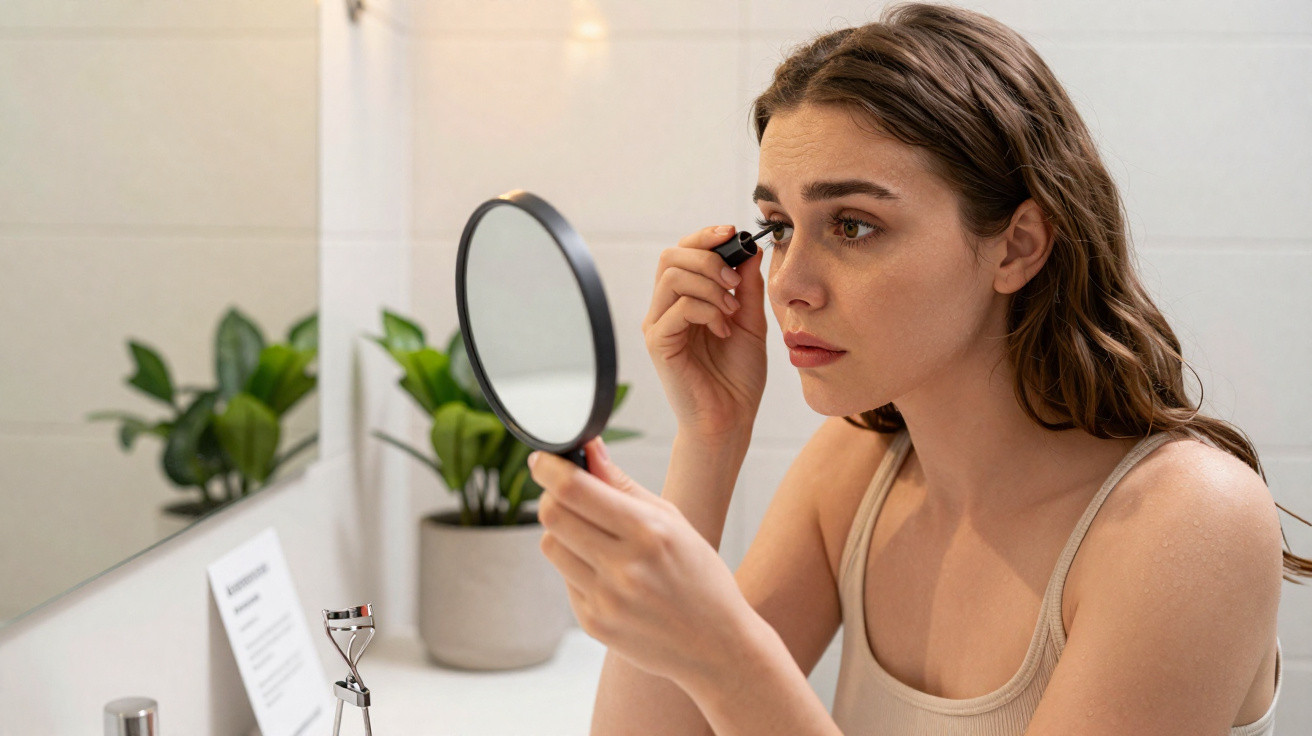
At first, everything looks flawless in the mirror. Your lashes fan upwards in a perfect curve, your eyes suddenly look more awake - almost like you’ve had eight hours’ deep sleep and a seaside break. Your friend says, “Wow, what have you done to your eyes?” and you think: why didn’t I do this sooner?
Then, two or three weeks later, comes the bit hardly anyone shows on Instagram. Tiny snapped-off lashes on the cotton pad, gaps along the lash line, mascara that suddenly applies oddly. And that uncomfortable question appears: is my lash perm to blame?
The hidden price behind the perfect curl
People rarely talk about what lashes feel like after a lash perm in real life. At first it’s weightless: you wake up with “finished” eyes, you need less make-up, and your bathroom routine gets quicker. Convenience is cheering on the inside, and your reflection is cheering on the outside.
And then you start spotting little hairs by the sink and you find yourself Googling whether that’s still normal. That’s the point where the hype turns into doubt - and that’s where your lashes’ real story begins.
Take Laura, 27, who called her first lash perm a “game changer”. She went to a salon every eight weeks, skipped mascara entirely, and used only a bit of clear gel. After her third treatment, the first gaps appeared. On the outer corner of her right eye, the lashes suddenly looked stepped, almost as if they’d been nibbled. The stylist told her it was “completely normal” and would grow back.
Months later, you could clearly see in Laura’s selfies that her lash line had become more uneven. Not bare, but patchy - and, above all, prone to snapping. A little friction while removing make-up was enough for a few more lashes to come away.
There’s no mystery behind this - it’s chemistry plus mechanics. A lash perm uses lotions that break down the lash’s inner structure so it can be set into a new shape. Essentially, it’s the same principle as a perm on head hair - just much closer to the eye and on far finer hairs.
The lash cuticle is affected, and the lash itself becomes more porous. If the treatment is done too frequently or left on too long, the lash loses elasticity. It then breaks more easily, especially where it was bent most sharply: near the root or midway along the lash shaft.
What you can do if your lashes are suffering after a lash perm
The most important step is almost boringly simple: take a break. No fresh lash perm, no lash lift, no tinting - not until a full lash cycle has had time to run its course. On average, that’s 6–8 weeks, and sometimes a little longer.
During that time, you can support them with conditioning serums or straightforward oils, such as castor oil or jojoba oil, applied very sparingly. Lashes, like the hair on your head, need phases where nothing “optimising” happens at all. If you want to, you can use a very light, non-waterproof mascara in this period - the kind that comes off without scrubbing.
In this sensitive stage, lots of people make the same mistake: they try to hide the breakage with more product. Extra mascara, waterproof formulas, stronger cleansers because everything is “so sticky”. The fear of short lashes ends up putting even more stress on already fragile ones.
Let’s be honest: hardly anyone patiently massages in a lash serum every evening and then removes mascara for five minutes with gentle strokes and lukewarm water. Real life looks more like quick wipes and vigorous rubbing because you’re tired. That’s exactly why it’s worth deliberately slowing down for once and building a couple of new micro-habits at the sink.
A line a lash artist once said to me in the salon has stuck:
“Lashes forgive a lot - but they have a memory. What you overdo today, you’ll see in the mirror in a few weeks.”
If you love your lash perm and don’t want to give it up entirely, a small plan helps keep things from getting that far:
- Have a lash perm no more often than every 8–10 weeks - don’t book in “just in case” earlier.
- In between, do a full 2–3-week “make-up diet” for your lashes - and avoid waterproof mascara.
- Never pull at lashes, twist them, or “test” how strong they are - they remember.
- Choose gentle, oil-based cleansers; press cotton pads on and lift off, don’t rub.
- If you can see gaps or significant breakage, skip a treatment and ask a different stylist for a second opinion.
Between vanity, self-care, and an honest look in the mirror
When lashes start snapping more quickly after a lash perm, it’s rarely just a cosmetic issue. There’s often a quiet fear underneath: that your eyes will lose their impact, that you’ll look “bare” once the curl disappears.
Rationally, we know nobody in everyday life studies our lashes as closely as we do in a magnifying mirror. And yet a brittle lash line can feel like a small loss of control over your own face. It’s in this tension - vanity versus common sense - that the urge to “fix it” immediately shows up, instead of letting the problem heal.
It gets interesting when you pay attention for a few weeks to how much your day-to-day confidence hangs on these supposedly tiny details. A day with nicely curled lashes and flattering bathroom lighting, and suddenly that meeting feels less intimidating. A day with flaky lashes and smudged mascara, and you feel a notch less composed.
Maybe the real game changer isn’t the next chemical treatment at all, but a calmer relationship with these small fluctuations. The thought: “Alright, my lashes are in rehab mode. I’m still me.”
When you talk about it with friends, you quickly realise how common lash breakage after a lash perm is - people just don’t mention it much because it doesn’t match the glossy aesthetic. There’s the one who’s gone back to fully natural lashes. Another who only books with highly experienced lash professionals and schedules strict breaks. And the one who’s learned to live with a simple lash comb and a lightweight serum instead of maximising every curve.
Perhaps that’s the quiet luxury: knowing what your own lashes can realistically handle, and not demanding more from them than they can give.
| Key point | Detail | Benefit for the reader |
|---|---|---|
| Chemical stress on lashes | Lotions break down the lash structure, making lashes more porous and prone to breakage | Understands the real mechanism behind lash breakage and can choose treatments more consciously |
| Plan regeneration phases | At least a 6–8-week break between perms, conditioning serums, and gentle make-up removal | Maintains lash-line density long term and reduces the risk of visible gaps |
| Adjust everyday habits | No rubbing, no waterproof mascara during rehab, no fiddling with lashes | Protects sensitive lashes day to day without giving up a groomed look entirely |
FAQ:
- Question 1 Do lashes always break faster after a lash perm?
- Answer 1 No, not necessarily. The risk increases with treatments that are too frequent, left on for too long, or when lashes are already weakened.
- Question 2 How long do lashes need to recover from a lash perm?
- Answer 2 A full lash cycle is roughly 6–8 weeks. In that time, weakened lashes can shed and new, healthier ones can grow in.
- Question 3 Does a lash serum help with lash breakage after the treatment?
- Answer 3 A conditioning serum can support the hair structure and keep lashes more flexible, but it doesn’t replace a genuine break from chemical treatments.
- Question 4 Is a lash perm damaging even the first time?
- Answer 4 When carried out properly and on healthy lashes, most people tolerate a first perm well - as long as you don’t re-treat too soon.
- Question 5 How do I know I shouldn’t get another lash perm yet?
- Answer 5 Clear gaps, lots of short stubbly lashes, a tight feeling along the lash line, or increased shedding are warning signs that a break is sensible.



Comments
No comments yet. Be the first to comment!
Leave a Comment