
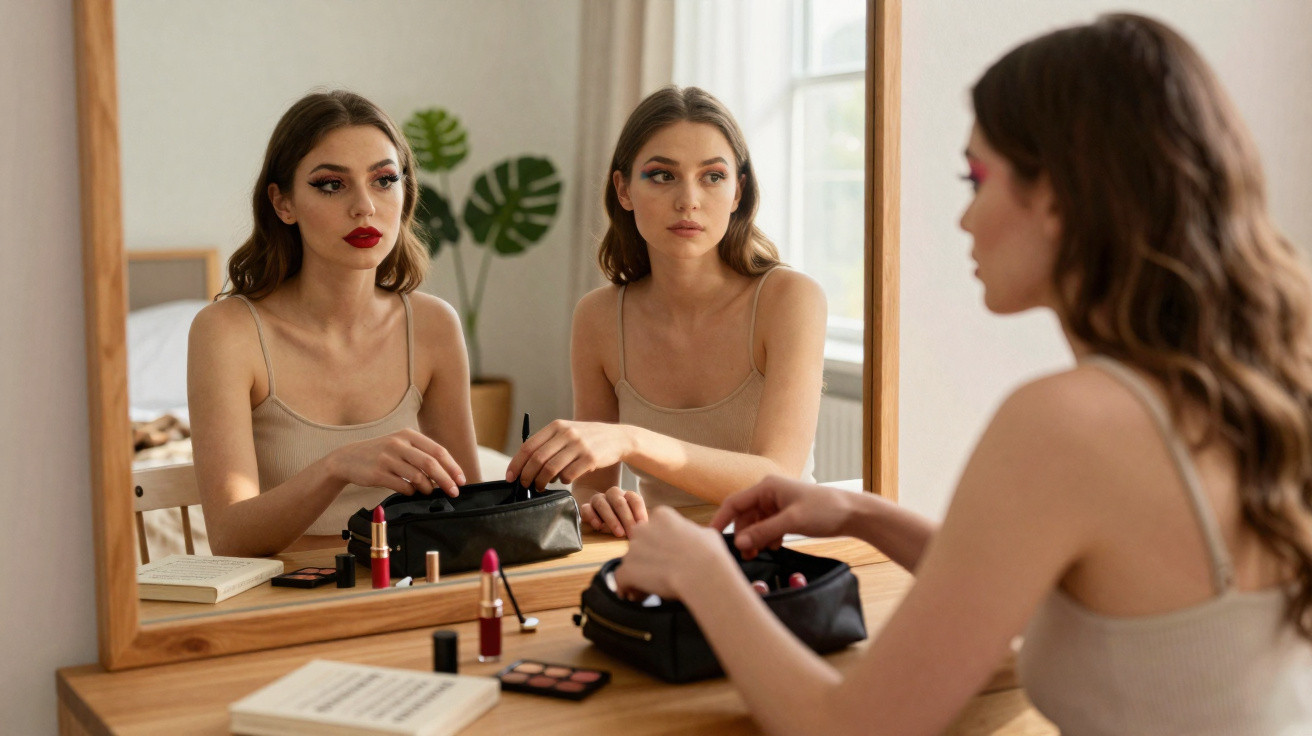
Sometimes understated, sometimes pure drama: your make-up style speaks louder than you think - and can reveal sides of you you barely recognise.
Make-up is often treated as a bit of fun at the mirror, a fashion choice, or simply the routine you do before heading out. But a new psychological study suggests that powder, mascara and lipstick are frequently driven by unconscious motives - and those motives can line up strikingly well with certain personality traits, including the darker edges of character.
Why researchers are suddenly interested in mascara
At first glance, it sounds straightforward: people wear make-up because it is trendy, because it makes them feel more attractive, or because their work expects it. Styles change from decade to decade, and products come and go with each new wave. Yet one question keeps cropping up: why does one woman stick with a “no-make-up look” into her 60s, while another won’t step outside at 20 without heavily emphasised eyes?
That is exactly what a large-scale research team set out to untangle. Instead of chasing the latest TikTok hype, they focused on the link between make-up behaviour and deep-rooted personality characteristics.
“The way you do your make-up is rarely random - it often matches your inner attitude to yourself and to other people with surprising accuracy.”
To do this, 1410 women in Brazil were surveyed online. They completed standard personality questionnaires - the well-known Big Five inventory and measures of the so-called dark triad - and then described in detail how, when and why they use make-up.
Dark triad: when make-up meets a darker side of character
In psychology, the “dark triad” refers to three more problematic tendencies:
- Narcissism: a strong need for admiration and a focus on one’s own appearance
- Machiavellianism: strategic coldness, manipulation and calculation
- Psychopathy: impulsivity, low empathy and little guilt
Earlier research had already hinted that make-up is linked with narcissism and extraversion. This newer study pushed further: how much do women shift their make-up depending on the situation - and how does that relate to these darker traits?
More people, more make-up - especially on a first date
One pattern appeared immediately: when they are at home alone, most women reach for make-up far less often and apply it more lightly. Around other people, they put on more - and the increase is strongest in moments that feel high-stakes.
“Top of the list: the first date. This is when make-up is applied most intensely to make an impression and to feel more secure.”
Whether it is a restaurant, a bar or a walk, the power of a first in-person impression seems to amplify the pull of the make-up bag.
What high narcissism leaves behind in the make-up bag
The clearest relationship in the results was between narcissism and cosmetics. Women with higher narcissism scores showed a consistent pattern:
- They spend more time doing their make-up.
- They use make-up more often in everyday life.
- They spend noticeably more money on cosmetic products.
- They adapt their make-up strongly to the context, for example when meeting new people or for appointments with high visibility.
For them, make-up functions as a tool for collecting attention, approval and compliments. It is less about “looking a bit fresher” and more about controlled self-presentation.
Extraverted women use make-up as a stage - but in a different way
Women high in extraversion - a strong drive towards contact, sociability and presence - also tend to spend more on cosmetics. The difference is that they adjust their look less sharply to specific situations.
An extraverted make-up enthusiast often paints her face to match how she feels, rather than what the occasion supposedly demands. A bold lipstick at the office, glittery eyeshadow at brunch: here, the point is self-expression and enjoyment of visibility, not strategic impact.
“If you are very sociable, you use make-up more like fashion: a colourful extension of your mood, not only a mask for special occasions.”
Psychopathy: less make-up, steadier habits
One of the more surprising findings concerned women with higher psychopathy scores. On average, they wear less make-up than narcissistic women - and, above all, they are more consistent.
Where narcissistic women fine-tune their appearance from situation to situation, women with psychopathic tendencies keep a relatively stable style. Date, office or supermarket: the level of make-up changes little. For them, make-up is less of a relationship-management tool, because other people’s reactions often matter less.
Anxious, sensitive - and more heavily made up in company
Another notable result involved neuroticism. People who score high on this trait tend to be more emotionally unstable, more easily unsettled and more prone to anxiety.
These women shift their make-up behaviour considerably depending on the context. When alone, their make-up remains moderate; in company, they apply more - similar to women higher in narcissism, but for a different internal reason.
“For emotionally sensitive women, make-up seems to act like a kind of ‘protective layer’ - something controllable in uncertain social situations.”
A perfectly drawn eyeliner flick or a high-coverage foundation can create the sense: “At least I have something under control, even if I feel unsure inside.”
How typical make-up types can be interpreted
Of course, not everyone fits neatly into a single box. Even so, the findings allow for a few broad types:
| Make-up type | Possible tendency | Typical motive |
|---|---|---|
| Styling that varies strongly depending on the occasion | Narcissism, neuroticism | Managing impressions, seeking approval or security |
| Very similar make-up most of the time, little adjustment | Psychopathy tendencies | Low interest in social expectations |
| Noticeable looks regardless of context | Extraversion | Self-expression, enjoyment of being seen |
| Hardly any make-up, very understated | Can range from introverted to very self-assured | Distance from norms or little need for self-presentation |
Where fashion meets psychology - and where the limits are
The study offers clues, not a crystal ball. Spending a lot on high-end cosmetics does not automatically make someone narcissistic. And a woman with a simple everyday look can still be highly responsive to validation - just via other routes.
What does stand out is that make-up is more than “just cosmetics”. It works like a personal communication tool where several layers come together:
- social norms: what counts as “well-groomed”, and what is considered “too much”?
- individual biography: who was often judged on appearance, and who never was?
- personality structure: how strong is the need for control, attention or independence?
What you can take from the study for yourself
It gets particularly interesting if you look honestly at your own patterns. Do you go heavier on make-up on anxious days? Do you turn it up for important meetings or dates and then scale it back as soon as you are alone? Or do you stick to your look consistently, whether it is a job interview or a trip to the supermarket?
Psychologists would say these patterns contain a lot of information - not to pass judgement, but to understand yourself better. If you notice you hardly dare to go out without make-up, you can work on separating self-worth from the mirror. If you realise you use your appearance strongly as a way to manipulate, it is worth asking how fair that is to other people.
At the same time, the study also underlines that make-up can be a legitimate tool: to feel more confident, to get through a difficult day, or simply to enjoy colour and form. It only becomes problematic when the mirror becomes the sole source of stability or validation.
The researchers are planning further studies in other countries and age groups. Trends shift, and products do too - but the question of what our make-up style reveals about our inner patterns remains. And that is where an honest look pays off: not only in the bathroom lighting, but at the motives behind it.
Comments
No comments yet. Be the first to comment!
Leave a Comment