
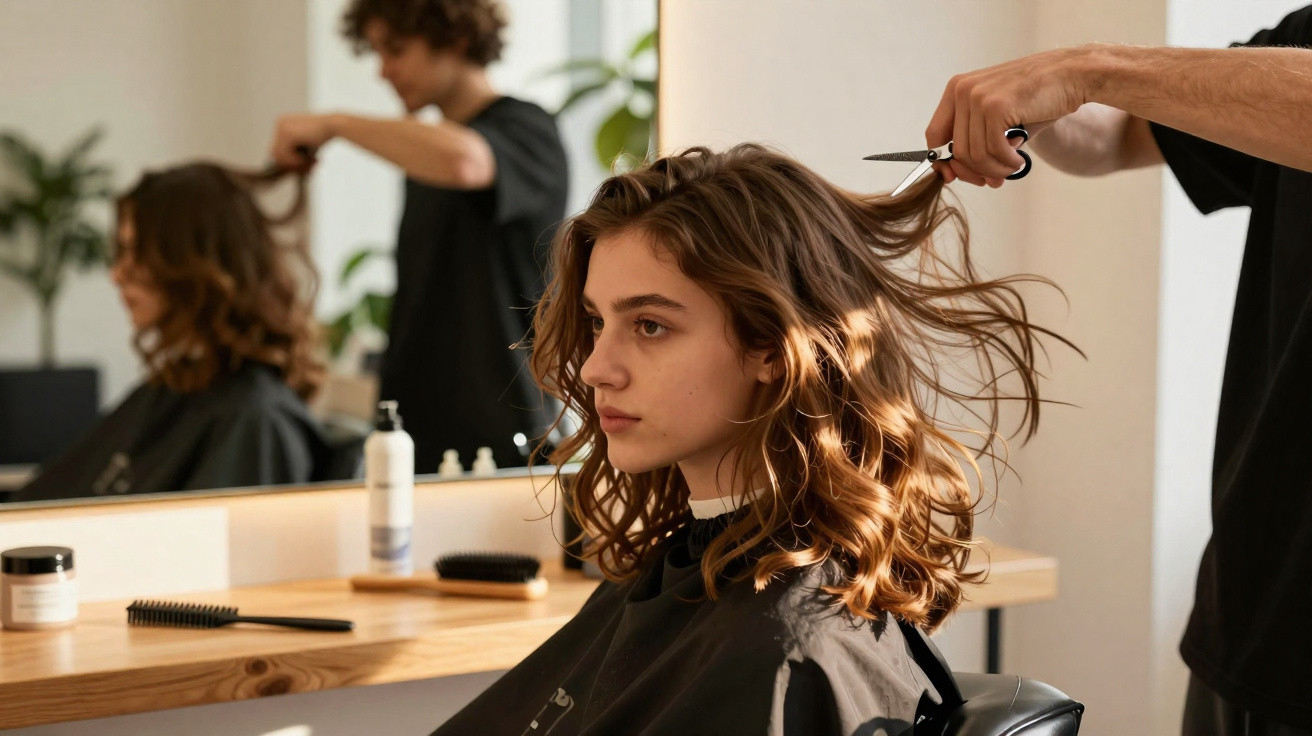
The woman in the salon chair had that expression you recognise instantly: the one people wear when they’re bracing for a “just a trim” that somehow ends in a helmet. She was gripping her phone and flicking through pictures of soft, lived-in cuts, while the mirror showed a blunt bob that sat around her face like a cardboard box. The stylist lifted a section, combed it through, and the tips met in a flat, uncompromising line. There was no spring to it. Hardly any movement. It simply lay there, obedient- and slightly miserable.
Then he changed the angle of the scissors.
Rather than snipping straight across, he glided them down the length. No severe edge at all. The hair fell into light, feathery pieces, and all at once the shape looked as if it could breathe. What you’re seeing has a name.
The haircut that moves when you do
We’ve all had that experience: hair that looks flawless in the salon, only to become a solid block the moment you’re back home. More and more stylists now lean on a cut designed for flow, not for rigid lines. It’s the difference between hair that swings as you move and hair that hangs like a heavy curtain. One works with motion; the other resists it.
This flow cut isn’t one neat trend you can trace back to a single TikTok clip. It’s closer to a way of thinking. The principle is straightforward: each section should melt into the next, without obvious steps, no weighty “shelf”, and no clear line flashing into view when you turn your head. Your hair should look good when you rough it up with your fingers- not only after 40 minutes with a round brush.
Consider Maya, 32, who spent years requesting “just a straight trim” on her long hair. Every appointment ended the same way: a brutally blunt edge that photographed well but felt lifeless day to day. In humid weather especially, her hair sat on her shoulders like a towel. Eventually, a new stylist said, “Let’s try something softer. I want your hair to move.”
This time, instead of a single horizontal cut, the stylist worked through vertical sections. She point-cut into the ends, created tiny pockets of air between strands, and gently shaped around the face. Maya got up, shook her head once, and laughed. Her hair rippled rather than clumping together. It skimmed her jaw instead of chopping across it. Three months later, the grow-out still looked deliberate. Friends assumed she’d had a big change- when really it was mostly a different approach to cutting.
What’s happening is technical, but it’s meant to be almost invisible. A flow-focused cut relies on internal layers, sliding techniques, and soft texturising- not a hard perimeter line. Rather than one bold, straight cut, there are multiple subtle, near-undetectable adjustments. Each one changes how the hair falls, not merely where it finishes. That’s why the outline curves naturally instead of forming a stiff edge.
On straight hair, this removes the “Lego” effect and replaces it with a sleek, fluid shape. On wavy or curly hair, it honours the curl pattern instead of slicing across it. You’re basically teaching the hair how to move, not just where to stop. Once you notice that difference in the mirror, those older, rigid cuts can suddenly feel like they belong to another decade.
How to ask for flow instead of a stiff line
Begin with the simplest request: tell your stylist you want movement, not a blunt edge. The phrasing matters. The moment you say “flow” or “softness” instead of “just straight across”, you’re influencing the cut before the scissors even come off the tray. Bring reference photos where the ends bend and drop into a gentle curve- not images where the bottom looks as if it was measured with a ruler.
Next, explain how your hair behaves in real life. Do you wear it up most days? Let it air-dry? Give it a quick blast with the dryer and head out? A flow cut should be planned around your routines, not an idealised version of them. A strong stylist will likely use point-cutting, slide-cutting, or invisible layers through the interior, rather than leaving you with a single flat line at the ends. You may not see the layering clearly. You’ll notice it the first time your hair starts to move.
A common misstep is asking for “a blunt bob” or “a straight trim” when what you truly want is softness. Blunt doesn’t always mean stiff- but without the right internal work, that’s often where it lands. Another misconception is thinking more layers automatically equal more movement. With fine hair, too many layers can leave the ends looking wispy and stringy rather than flowing. With thick hair, poorly placed layers can pile up and create shelf-like steps.
There’s also the emotional side that rarely gets mentioned. After one bad, choppy cut, it’s easy to panic at anything that sounds like “texturising” or “thinning”. You cling to a straight line because it feels safer. Yet that “safe” edge can be exactly what’s weighing down your whole look. And realistically, hardly anyone blow-dries their hair into perfection every single day. A cut that only looks alive once it’s been styled will let you down on the mornings you’re racing out of the door.
“I don’t want your hair to look cut,” one Paris-based stylist told me. “I want it to look like it just grew that way, following your neck, your collarbones, the way you move.”
- Ask for soft, diffused edges, not a hard line at the bottom.
- Show photos where the hair bends and falls, not just sits in a perfect sharp shape.
- Tell your stylist how often you actually style your hair, not how often you wish you did.
- For curls and waves, request shaping that follows your natural pattern instead of forcing it into a straight outline.
- For straight or fine hair, ask for minimal, strategic internal layers to avoid that heavy “hair curtain” effect.
Living with hair that finally has its own rhythm
Once you switch to a cut that prioritises movement over hard edges, everyday life changes in small but satisfying ways. Hair that used to just sit there starts responding when you sweep it back over your shoulder. A quick air-dry looks deliberate rather than chaotic. Even a basic half-up style feels different because the shorter, softly cut pieces fall to frame your face instead of sticking out like stubborn chopsticks.
You may find you reach for less product. Less heat. Less effort. Hair cut for flow doesn’t need constant persuasion to behave. You can sleep on it, wake up, add a little water or a lightweight cream, and it naturally finds its shape again. A fringe grows out without that awkward “ledge” stage. Your collarbones show through soft curves of hair instead of disappearing under one straight, heavy block.
What catches many people off guard is how much a flow haircut can change how they feel physically. When your hair moves with you, you often feel less rigid too. You start flipping it, tucking it behind an ear, or running your fingers through it on a video call without worrying you’ll ruin a fixed shape. The cut stops fighting your life and starts following it. That’s the quiet force behind the current obsession with natural flow: it’s less about chasing a perfect trend and more about letting your hair behave like… hair. And once you’ve seen your reflection with that kind of ease, it becomes very difficult to return to a straight, unbending line.
| Key point | Detail | Value for the reader |
|---|---|---|
| Ask for movement | Use words like “flow”, “soft edges”, and “natural fall” at the consultation | Translates your wish into language stylists instantly understand |
| Match cut to real habits | Describe how you actually dry and style your hair day to day | Leads to a cut that looks good even on rushed, no-styling mornings |
| Prioritise invisible structure | Internal layers and point-cutting over one harsh perimeter line | Gives hair natural movement and better grow-out without constant touch-ups |
FAQ:
- Is a flow-focused haircut only for long hair? No. Bobs, lobs, shags, and even short crops can be cut to move softly. The idea is in the technique, not the length.
- Will this type of cut thin out my hair too much? Not if it’s done well. The goal is to remove bulk where your hair feels heavy, not to make the ends skinny or weak.
- How often do I need to maintain a flow haircut? Usually every 8–12 weeks. Because there are no harsh lines, the grow-out tends to look softer for longer.
- Does this work on very straight, heavy hair? Yes, especially if your stylist uses internal layers and slide-cutting. It can transform a stiff “sheet” of hair into something that swings.
- What should I show my stylist as a reference? Choose photos where the hair looks like it’s in motion or freshly shaken out, not just perfectly lined up at the ends. And bring at least three, not just one.





Comments
No comments yet. Be the first to comment!
Leave a Comment