
Many people insist this approach is kinder and more respectful to hair health.
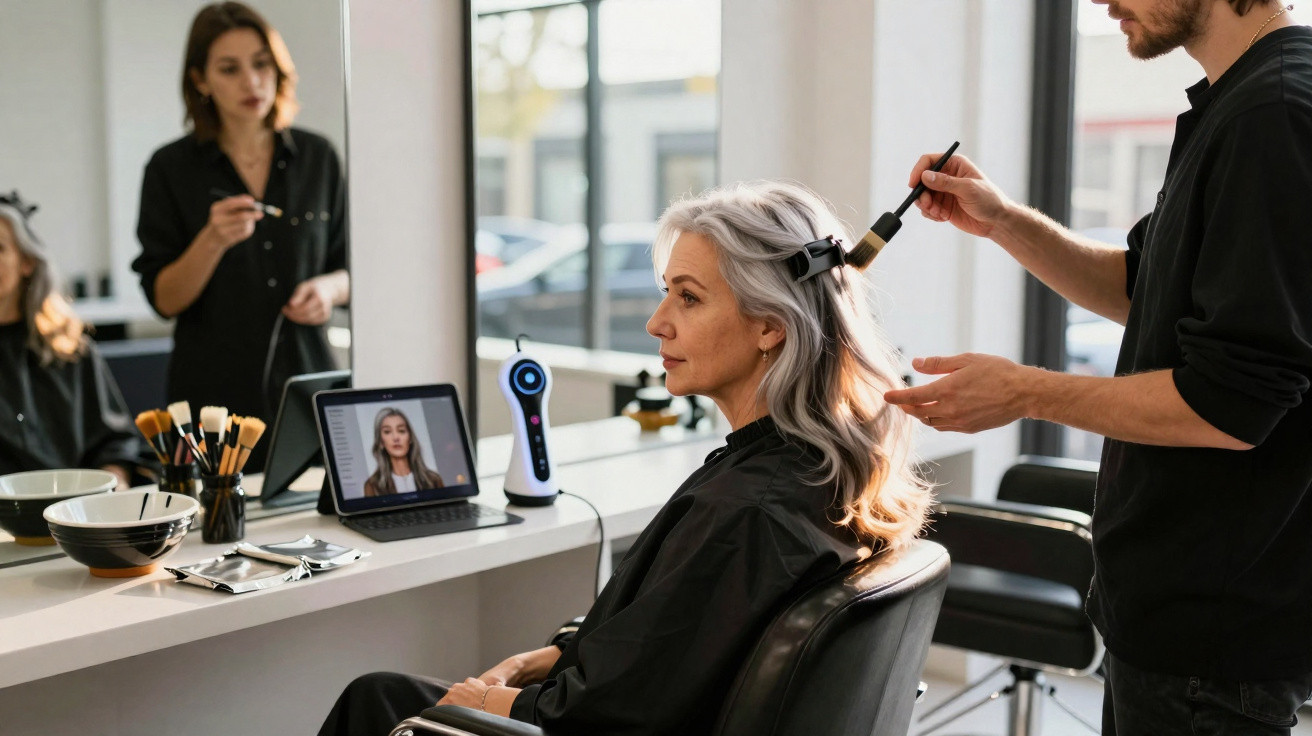
The woman settled in the salon chair looks calm, yet her colourist seems on edge. Her regrowth is almost entirely silver, while the mid-lengths and ends are still a deep chocolate brown. On the trolley beside them, the familiar dye tubes sit untouched. Instead, the stylist is holding thinning scissors, a clarifying spray… and nothing that resembles “colour” in the usual sense.
Two other stylists pause their own clients to look on. One chews her lip. Another murmurs, “Are you actually going to do the grey reveal thing? On purpose?”
This is the year’s most polarising hair trend: refusing dye altogether and using “reverse blending” to bring natural grey to the surface. Some people call it brilliant. Others say it could ruin your career.
The grey method that’s replacing classic hair dye
This disputed technique begins nowhere near a colour bowl. It starts with taking colour away. Stylists remove as much old pigment as the hair can safely tolerate, then use careful cutting, softening and texturising so the natural grey pattern becomes the focal point. The intention isn’t to conceal white strands, but to frame them.
Where salons once piled on camouflage, this approach goes looking for what’s true underneath. It’s like hair archaeology: unearthing what already exists rather than repainting the ruins. Early on, it can be slower, messier and decidedly un-Instagram. Even so, salon grids are filling with dramatic before-and-afters labelled “ditch the dye” and “grey transition”.
A London colourist told me that around half of her over‑40 clients now ask about “going grey on purpose”. This isn’t a neon rebellion; it’s a silver one.
TikTok serves up the same plot again and again. A woman in her forties, fifties or sixties looks into her bathroom mirror-half worn out, half intrigued. She lifts her fringe to show a crisp white streak at the front, then freaks out at the hard line of demarcation creeping down her parting. The caption underneath reads: “Spent £15,000 on dye over 20 years. I’m done.”
The hashtag #grombre has racked up tens of millions of views. Research into beauty spend suggests women can part with more than £1,000 a year on colour upkeep alone. That’s a lot of Saturdays breathing in ammonia, watching the foils, praying the toner doesn’t tip too ashy. This newer method offers something else entirely: a blunt, brave transition… followed by freedom.
On a Tuesday afternoon in Paris, I watched a 57‑year‑old lawyer let go of her brunette identity in a single appointment. When it was finished, her hair was a cool, luminous blend of steel and pearl, with only a faint echo of her old brown breaking up the texture. Her face moved from fear to something close to relief.
For stylists trained to perfect even, consistent colour, the thinking behind this movement can feel almost insulting. Clients are no longer requesting “coverage” so much as authenticity. The old deal was straightforward: you bring your roots, the salon deletes them. Now that deal is being rewritten, and hair professionals are expected to act as part therapist, part colour strategist and part long-term project manager.
You’re not stacking permanent dye on top of already delicate lengths. Instead, you narrow the difference between dyed hair and natural regrowth, then allow time to do the rest. Some people also read a quiet feminist message in refusing to maintain the illusion of endless youth.
On the other hand, traditionalists warn about patchy, inconsistent outcomes and lost salon income. They argue it tempts people into DIY mishaps and leaves clients stuck in unmanageable in-between phases. Some even dismiss it as “giving up”. The argument isn’t only technical-it’s philosophical. What are we really asking of our hair: perfection, or proof of life?
How the “no-dye grey” method actually works
Most journeys begin with a long consultation. A skilled stylist will chart your natural grey distribution, review your colouring history and assess how much discomfort you can tolerate. Then comes the unglamorous stage: easing artificial pigment out over time-sometimes via a gentle lightener, sometimes through a colour remover, and sometimes simply through patience and strategic cuts.
Rather than pursuing one solid, uniform shade, the professional uses micro‑highlights, lowlights and intelligent placement to “bridge” the distance between roots and ends. They may lift the darkest bands into a smoky beige so they sit nearer your silver. They might place a few icy pieces around the face so a natural white streak reads as deliberate rather than accidental. The target is harmony, not sameness.
You walk out with hair that doesn’t feel “finished” in the traditional sense. It’s in motion, a little untamed, and oddly compelling. That unfinished feeling is intentional.
Upkeep changes too. Glosses and toners become the new staples, not full-power permanent colour. You might rely on a violet shampoo to counter yellowing, plus a rich mask to stop coarse grey fibres from ballooning into static. The focus shifts from hiding to curating.
Nearly everyone stumbles in the beginning. Moving too quickly with bleach can leave ends weak and frayed, nothing like the calm, grounded result you pictured. Cutting everything into a dramatic pixie on a bad day-just to “get it over with”-can then make you feel strangely exposed in the mirror. Or you can swing the other way, doing nothing for months, living with harsh regrowth and feeling trapped between two versions of yourself.
On a deeply human level, this is the pinch point. On an ordinary Wednesday, under fluorescent office lights, you might suddenly feel a decade older. That’s when the urge to sprint back to full coverage hits hardest. As one client put it, “I didn’t realise how much my dark hair was like armour.” We rarely acknowledge that part out loud.
Let’s be honest: nobody keeps this up perfectly every day. The immaculate blow-dry, the salon-grade styling, the glossy waves that make grey sparkle rather than frizz-most mornings it’s a quick air-dry and hope for the best. Which is exactly why technique matters: the cut and the colour placement must suit how you actually live, not the routine you imagine you’ll maintain.
“When you remove dye from the equation, you’re not just revealing grey,” says New York stylist Maya L., who went viral for her own silver bob transition. “You’re revealing how a woman really feels about ageing, work, dating, even social media. The hair is just the excuse.”
Beneath the emotions, there’s a practical checklist that every stylist I spoke to repeated. They emphasised lighting: assess grey in natural daylight, not only under bright salon fluorescents. They stressed texture: coarse grey needs more moisture, while fine grey benefits from more structure. And they all insisted the first three months are the toughest, regardless of how confident you feel on day one.
- Begin with a long, frank consultation about budget, timeline and fear factor.
- Gradually stop using permanent dyes; move to semi-permanent colour or glosses during the transition.
- Request a cut with movement and softness, rather than a blunt, unforgiving line.
- Schedule “checkpoint” appointments every 8–12 weeks to adjust tone and shape.
- Keep at least one styling product you truly enjoy using, not something you feel you ought to use.
Why this grey movement hits so deep
The grey method is not really about hair. It’s about control, time and the stories we rehearse in the mirror. Stepping away from dye confronts a quiet rule many women were raised with: ageing is something to manage, not show. When someone arrives at work with a fresh silver crop, it can jolt colleagues more than a dramatic weight loss or a new partner.
On a packed metro, I watched a woman with a steel-grey bob get questioned by a stranger about half her age. “How did you get that colour?” the younger woman asked, tugging at her own flat brown ponytail. The older woman laughed and replied, “I stopped fighting my scalp.” People nearby chuckled, but the moment felt larger than small talk. It looked like a tiny permission slip passed from one generation to the next.
We all know the bathroom-mirror moment under unforgiving light: a version of you that arrives before you’re ready. Lines, hollows, silver at the temples. This newer grey movement doesn’t promise to smooth away the shock. It asks you to lean into it and build a look around it. Whether you try the method or not, it raises sticky questions: Who are you getting dressed-and dyed-for? Who gains when you’re frightened of your own reflection?
Social platforms are intensifying the collision. On one side are filters, anti-ageing serums and thirty-step routines. On the other are raw “big chop” clips-women crying with a towel around their shoulders, then laughing through the tears when they see their new silver curls. The algorithm rewards both drama and honesty, and this controversial method delivers both.
Stylists are caught in the crossfire. Some quietly dislike the trend, worried that fewer colour appointments will mean slimmer pay packets. Others see fresh opportunity in longer, higher-priced transition services and tailored grey care. What they broadly agree on is that we’re not returning to the era when hiding roots indefinitely felt like the only respectable option.
The grey transition method isn’t demanding that everyone bins their dye overnight. It simply introduces a stubborn thought: perhaps your natural colour isn’t a flaw to be fixed. Perhaps it’s texture, pattern, landscape. And once that thought takes hold, going back to the old system-booking root coverage every four weeks like clockwork-can feel oddly out of date.
Some people will test the method and dislike it. Some will approach it gradually with softer, more translucent colour. Some will leap in and never touch a box dye again. The real shift isn’t that hair dye is “dead”; it’s that the monopoly on what counts as “good hair” is starting to fracture.
The next time you notice someone with unapologetically silver strands in the supermarket queue, you may register more than a colour. You might see a long conversation with a nervous stylist, a diary full of cancelled dye appointments, a new relationship with time. You might even feel a flicker of curiosity about your own roots, waiting quietly beneath the paint.
| Key point | Detail | What it means for you |
|---|---|---|
| Grey transition method | Reveals natural grey by reducing artificial pigment and using smart cutting | Offers an alternative to lifelong root touch‑ups |
| Emotional impact | Challenges beliefs about ageing, identity and beauty norms | Helps you understand why this choice feels so personal |
| Practical roadmap | Consultation, staged pigment removal and soft, adaptable cuts | Provides a realistic route if you’re considering ditching dye |
FAQ:
- Is traditional hair dye really “over” because of the grey method? Not quite. Dye isn’t disappearing, but the idea that everyone “should” cover their grey is losing its grip. The new method simply adds another valid choice.
- How long does a grey transition usually take? Anywhere from six months to two years, depending on your starting colour, hair length and how dramatic a change you’re comfortable with in public.
- Will my hair look bad during the in‑between phase? You’ll have awkward days, yes. Smart cutting, strategic glosses and accessories like headbands or sleek buns can soften that phase a lot.
- Is this method suitable for curly or textured hair? Yes, but it demands even more nuance. Many curl specialists prefer slower pigment removal and shape‑focused cuts to protect curl pattern.
- What if I try going grey and then change my mind? You can always return to dye, though it may take work to rebuild depth and shine. The experiment itself often clarifies what truly makes you feel like “you”.




Comments
No comments yet. Be the first to comment!
Leave a Comment