
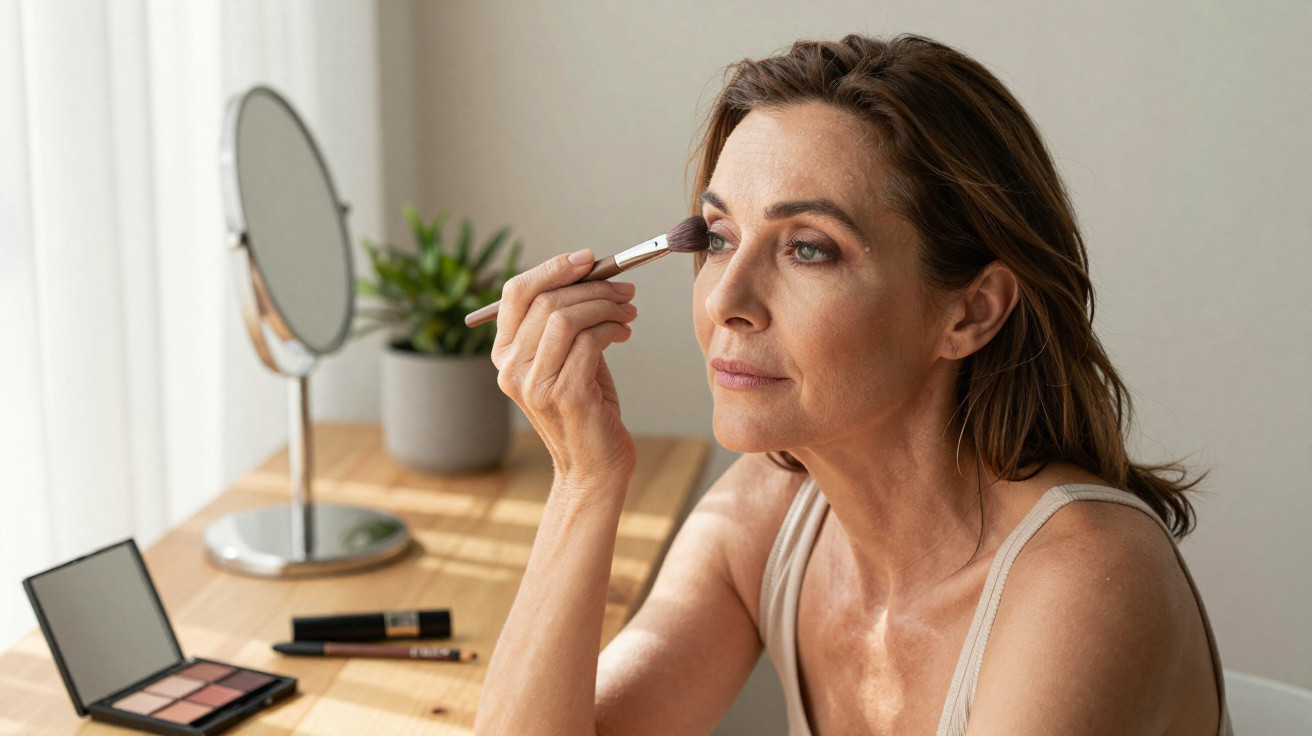
A straightforward make-up technique can make a visible difference.
Many people notice it first in photos: the eyes look more tired, eyeshadow barely shows, and the upper lid seems to sit on top of the mobile lid. That’s exactly where a clever method comes in-one make-up artists use for hooded eyelids and age-related drooping-and it’s easy to recreate at home without professional experience.
Why drooping lids “swallow” eyeshadow
If you have hooded eyelids or drooping lids, you’ll know the frustration: with your eyes closed, the eyeshadow looks spot-on; once you open them, almost all of it disappears. The reason is simply anatomy.
- The upper crease sits lower and covers the mobile lid.
- As the years pass, the skin on the upper lid loosens and drops slightly.
- Eyeshadow quickly settles into the crease and can emphasise a tired look.
A common knee-jerk reaction is to skip eye make-up altogether. That’s a shame, because when it’s placed well, eyeshadow can visually lift the eye area and make you look more refreshed-especially after your 50th birthday.
The key isn’t using more product, but placing it correctly: eyeshadow needs to sit where you can still see it with your eyes open.
The trick technique: place eyeshadow higher and “redraw” the lid
Instead of rigidly following your natural crease, this approach uses a small optical illusion. The concept is simple: you create your crease a little higher-where the skin is still visible when you look straight into the mirror.
Step 1: Check your starting position in the mirror
Sit upright in front of the mirror, look straight ahead, and keep your eyes open. This lets you see exactly how much of your upper lid is actually visible. Only that visible area matters for eyeshadow placement.
- With a soft, mid-light eyeshadow, mark a point just above your real crease.
- This point is usually slightly higher and shifted a little towards the outer corner.
- This is where your “new” shadow placement will begin.
Step 2: Apply eyeshadow deliberately a bit higher
Now for the real trick: the deeper or mid-tone shade doesn’t go into the original crease-it goes slightly above it. The result is an eye that looks more open, with a lifted expression.
Do it like this:
- Sweep a light shade (close to your skin tone) over the mobile lid as a base only.
- Place a mid-tone shade into the area just above the natural crease-where you can still see it with your eyes open.
- Pull the shadow gently outwards and upwards to shape the look of a lifted eye.
Imagine you’re painting your own “lid arch” a little higher-the eyes look instantly fresher, without any surgical procedure.
Why the right brush makes all the difference for hooded eyelids
Alongside technique, the tool you use matters more than most people expect. Thick, flat brushes or strongly pigmented sponge applicators can deposit too much colour in one spot, making lids look heavier very quickly. Professionals tend to rely on one particular type.
The ideal brush type for more mature eyes
A fluffy blending brush with a softly tapered point is ideal. It’s gentle, moves lightly over the skin, and helps you avoid harsh edges.
- soft, fluffy bristles - distribute colour gently and evenly
- slightly tapered tip - fits perfectly into the “new” crease
- medium-sized shape - not too small, so transitions stay soft
Instead of pressing pigment onto the lid, use light sweeping motions. That creates a delicate gradient that travels upwards-lifting the look rather than weighing it down.
The right application method: sweep, don’t pat
For drooping lids, make-up professionals recommend using the brush almost like a small fan.
Helpful motions:
- small semicircles in the “new” crease
- sweeping strokes from the outer third of the eye up and out
- barely any pressure - the brush should feel like it’s “stroking” over the skin
The lighter the brush seems to float over the lid, the softer the blend-and soft blends rejuvenate the eyes far more than harsh lines.
Which colours make eyes look more youthful
Shade selection affects whether the eyes appear bright and fresh or tired and heavy. With more mature skin, it’s worth being especially picky about colour and finish.
| Problem | Better choice | Best avoided |
|---|---|---|
| Tired-looking eyes | rose, peach, warm beige | very grey tones, dull brown |
| Heavy lids | mid-tone matte browns, taupe | very deep black, harsh lines |
| Fine lines | light satin finishes | chunky glitter, metallics with lots of particles |
Glitter can look busy quickly because particles settle into fine lines. Subtle mattes or softly satin eyeshadows are usually far more flattering on hooded eyelids.
Eyeliner and mascara: small tweaks, big impact
Eyeshadow can change a lot on its own, but lashes and definition pull the whole look together. If you have drooping lids, it pays to use eyeliner in a very targeted way.
Soft liner instead of a harsh block
A thick black line across the entire upper lash line can make the eye look smaller. A gentler method works better:
- use a dark kohl pencil or eyeshadow only on the outer third of the upper lid
- let the line taper slightly upwards, without extending too far out
- smudge softly with a small brush-no hard edges
Filling the upper waterline with a dark kohl can also make lashes look fuller, without adding heaviness to the lid.
Lashes as a “mini lift”
With the right mascara technique, you can reinforce the lifted effect:
- place an eyelash curler close to the roots, hold briefly, then release
- apply more mascara to the outer lashes than the inner ones
- choose a brush shaped like a bristle wand rather than a clumpy “volume” brush
Every line and every lash should point upwards or slightly outwards-this draws the gaze up and looks like a small lifting effect.
What many people don’t realise: prep and care change everything
Especially with more mature skin, preparing the eyelid properly is worth it. Dry, slightly creased skin can make eyeshadow apply patchily and highlight uneven texture.
Useful steps before you start your make-up:
- apply a thin layer of eye cream and let it absorb fully
- use an eyelid primer so eyeshadow doesn’t slip into the crease
- add a light touch of concealer at the inner corner to reduce shadows
This helps shades last longer and stops them settling into the crease-one of the classic issues with drooping lids.
Risks and limits of heavy eye make-up on mature skin
As effective as the method is, too much product can backfire. Several heavy layers of eyeshadow and mascara can pull the lids down further and make fine lines stand out more.
If your eyes are very sensitive, it’s best to avoid strongly perfumed formulas or coarse glitter. Rubbing while removing make-up can irritate already delicate lid skin. Gentle cleansing oils or micellar water on a cotton pad-pressed on lightly and then wiped away-are kinder to the area.
What’s striking is how much small adjustments can do: simply placing the crease higher and blending softly can make the face look more awake, without taking much time. Many women say that five minutes of targeted eye make-up makes them look fresher than a thick layer of foundation.
If you want to take it a step further, you can pair the technique with subtle brow grooming. A slightly lifted, neatly brushed eyebrow can intensify the lifting effect of the eyeshadow. The key point: don’t go too dark-stick to no more than one or two shades deeper than your natural hair colour so the eyes stay open and the look doesn’t turn harsh.





Comments
No comments yet. Be the first to comment!
Leave a Comment